
Trusted Industrial Wastewater Treatment Project EPC Contractor Offering Premium GFS Tanks for Complex Effluent Challenges
The core challenges of industrial wastewater treatment center on the "three highs"-high difficulty, high cost, and high energy consumption. Wastewater from new energy, chemical, and pharmaceutical industries is complex in composition with numerous characteristic pollutants, and traditional treatment processes are difficult to remove effectively. These persistent issues place a premium on selecting an experienced Industrial Wastewater Treatment Project EPC Contractor who can design systems that balance performance with operational economy.
Chinese companies have significant price advantages in the mid-to-low-end equipment segment, yet the industry also faces continuous technological upgrade pressure from increasingly stringent emission standards, as well as new requirements for digitalization and low-carbon transformation on operational refinement management capabilities. Addressing these demands requires not only advanced biological processes but also robust physical infrastructure, which is where factory-engineered GFS Tanks provide a decisive advantage over conventional construction.
Full-Process Factory Standardized for GFS Tanks
To overcome the variability inherent in on-site construction, leading Industrial Wastewater Treatment Project EPC Contractor solutions increasingly rely on prefabricated components. GFS Tanks are fully factory-prefabricated to standardized specifications, with finished product quality stability far exceeding cast-in-place concrete tanks. All concrete tank processes are completed in the open air, with rebar tying, concrete pouring, and curing heavily influenced by worker skill, temperature, and rainfall. Wall thickness, density, and strength vary significantly between batches, with hidden defects like honeycombing, voids, and insufficient wall thickness common-quality cannot be uniformly controlled. This unpredictability directly undermines the long-term reliability that industrial projects demand, making GFS Tanks the preferred choice for EPC contractors focused on lifecycle performance.
Center Enamel's GFS Tanks steel panels, seals, and reinforcement components are all mass-produced in automated factories. Steel stamping, high-temperature enameling, and dimensional cutting are all controlled by CNC equipment, with each panel's parameters and enamel thickness strictly following unified national standards. All components are uniformly packaged and transported to site, with assembly strictly following standardized construction drawings. Full-process quality inspection from raw materials to finished components ensures highly consistent product performance parameters, completely eliminating the uncontrollable quality risks of on-site concrete construction, with every tank delivering stable, consistent performance. For any Industrial Wastewater Treatment Project EPC Contractor, this factory-controlled quality translates into predictable timelines, reduced site labor, and a 30-year corrosion-resistant service life.
UASB Process Definition
With the structural integrity of GFS Tanks securing the physical reactor vessels, the biological treatment core often relies on proven anaerobic technology. UASB, or Upflow Anaerobic Sludge Blanket Reactor, is the benchmark mainstream technology for medium-to-high concentration soluble organic wastewater treatment. It requires no mechanical mixing or media carriers, relying on the upward flow of wastewater to suspend and expand granular sludge within the reactor, forming a stable sludge bed layer. Highly active anaerobic granular sludge efficiently degrades pollutants, with excellent settleability and high microbial concentration. UASB innovatively integrates reaction, sedimentation, and gas-liquid-solid separation functions, simplifying the anaerobic treatment process with advantages of high efficiency, energy savings, and compactness. It is widely used in various medium-to-high concentration soluble organic wastewater treatment applications, and its compatibility with GFS Tanks makes it a staple design for EPC contractors serving the food, beverage, and chemical sectors.
Brewery Wastewater Sources
The UASB process finds one of its most common applications in the beverage industry, where wastewater volume and strength fluctuate significantly. Brewery wastewater is high-concentration organic wastewater from the entire production process of beer, liquor, and wine-a high-volume wastewater type in the food industry. Key pollution stages include raw material soaking/washing, saccharification/fermentation, distillation/purification, and filling/packaging. Major wastewater streams include still bottoms, fermentation yellow water, spent mash, and raw material soaking wastewater. Auxiliary discharges include equipment/pipeline washing, floor cleaning, production line maintenance, and cooling water. Discharge has significant intermittency and seasonality-high volume during peak production seasons, reduced during off-seasons. Large breweries have unified collection systems; small and medium-sized facilities have more dispersed collection with prominent uncontrolled discharge issues, concentrated in brewing facility areas. An experienced Industrial Wastewater Treatment Project EPC Contractor can tailor GFS Tanks-based UASB systems to handle these load variations while capturing biogas for energy recovery.
Indonesia Palm Oil Biogas Upgrade Project
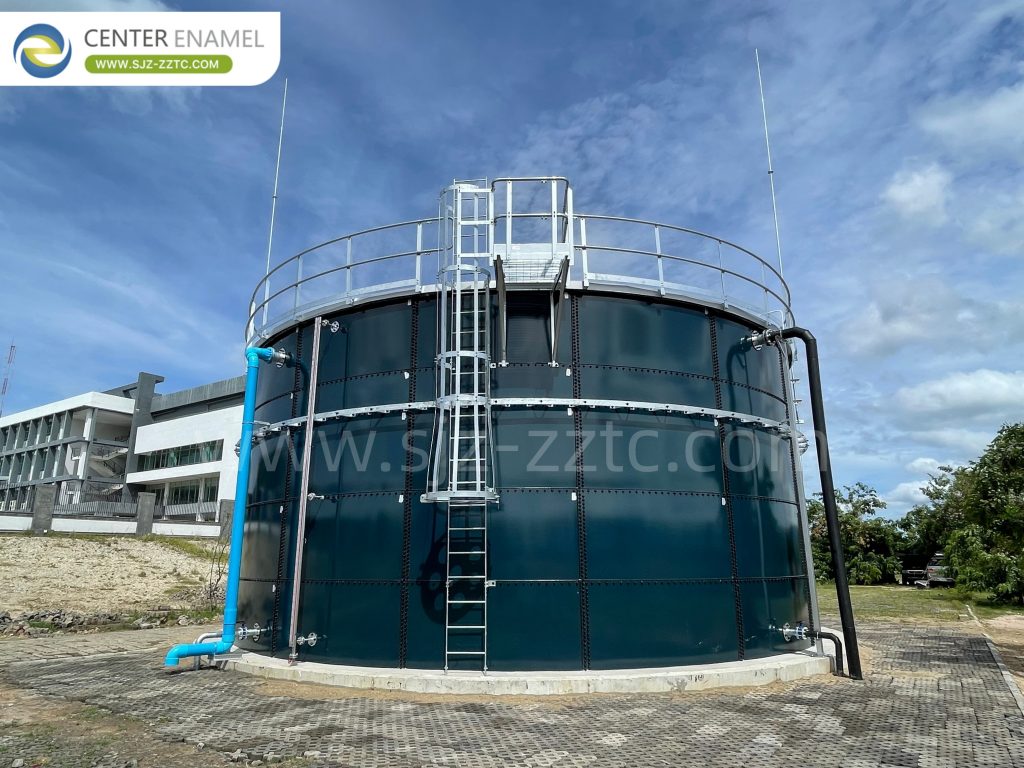
Brewery applications share technical commonalities with other agro-industrial waste streams, as demonstrated by a landmark project in Southeast Asia. Commissioned in 2013 as the core anaerobic digestion reactor for the POME treatment station, this Indonesia palm oil biogas upgrade project features 3 GFS Tanks in two sizes: 17.58 m dia. × 8.4 m height / 16.82 m dia. × 7.2 m height. The tanks serve as the core anaerobic reaction equipment specifically for high-organic palm oil production wastewater-anaerobic digestion degrades pollutants and recovers biogas. Tanks are adapted to local palm industry wastewater needs, showcasing the ability of a skilled Industrial Wastewater Treatment Project EPC Contractor to deliver corrosion-resistant solutions for tropical, high-salinity effluents. GFS Tanks assembly is convenient with corrosion resistance for Southeast Asia's hot humid high-corrosion environment-a mature biomass energy environmental benchmark project that continues to influence regional design standards.
Center Enamel R&D Team
Behind every successful project delivered by an Industrial Wastewater Treatment Project EPC Contractor lies a foundation of material science and engineering innovation. Center Enamel has built a full-chain professional team covering R&D, design, marketing, installation, and after-sales. The R&D team is led by national-level materials technology experts, specializing in enamel frit and tank anti-corrosion core technologies. External senior environmental engineering and mechanical structure engineers are retained to strengthen R&D capabilities, focusing on anti-corrosion coating formulations, specialty corrosion-resistant tanks, and anaerobic supporting integrated equipment-continuously breaking through industry technological barriers. This dedicated team ensures that GFS Tanks evolve to meet emerging challenges, from high-salinity chemical wastewater to abrasive palm oil mill effluent.
The team operates through proprietary laboratories with external university research collaboration-conducting year-round new material and new process durability pilot testing and long-term corrosion simulation testing. Specialized enamel formulations are iteratively developed for extreme conditions such as high-salinity wastewater, strong acid/alkali POME, and high-organic livestock manure-providing core technical support for the company's annual new invention and utility patents-building a proprietary material technology barrier. For any Industrial Wastewater Treatment Project EPC Contractor, this in-house R&D capability translates into tailored solutions that extend tank life and reduce lifecycle costs.
Center Enamel Innovative Material Technology
The R&D efforts directly feed into the company's core product advantage. Center Enamel has independently developed over 200 anti-corrosion enamel formulations, with proprietary double-sided double-layer enameling technology-GFS Tanks anti-corrosion service life exceeds 30 years-far surpassing concrete and ordinary equipment-suitable for global high-corrosion wastewater and biogas fermentation conditions. This material leadership, combined with full EPC project delivery capability, positions Center Enamel as a premier Industrial Wastewater Treatment Project EPC Contractor for clients seeking durable, low-maintenance infrastructure. Whether for brewery wastewater, palm oil effluent, or chemical plant discharge, the synergy of advanced enamel technology and modular GFS Tanks ensures that every project meets performance, budgetary, and sustainability goals.
FAQ Section
1. What makes Center Enamel a reliable Industrial Wastewater Treatment Project EPC Contractor?
We offer full-cycle services-from design and fabrication to installation and commissioning-backed by 30,000+ global projects. Our factory-prefabricated GFS tanks ensure consistent quality, while our in-house R&D tailors corrosion solutions to your specific effluent chemistry.
2. How do GFS tanks compare to concrete tanks for industrial wastewater?
GFS tanks are factory-engineered with double-sided enameling, providing 30+ years of corrosion resistance-far exceeding concrete. They eliminate on-site quality variations, reduce construction time, and require less maintenance, making them ideal for high-salinity, acidic, or abrasive wastewaters.
3. Can you handle projects in remote or challenging environments?
Yes. We have installation coverage in over 100 countries, including tropical, high-altitude, and severe cold regions. Our dual-service model (cross-border teams + local agents) ensures on-site survey, assembly, commissioning, and operator training are delivered seamlessly anywhere.