
Industrial Wastewater Treatment Solution Provider: Leading GFS Tanks with UASB Process for Global Projects
Global industrial wastewater treatment policies are escalating from "compliance discharge" to mandatory "resource recovery" and "zero liquid discharge." The EU, through its Circular Economy Action Plan, requires member states to increase industrial wastewater reuse rates and extends carbon footprint accounting to the full life cycle of wastewater treatment. China continuously updates and tightens industrial water pollutant discharge standards, with increasingly stringent limits on total nitrogen, total phosphorus, and characteristic pollutants for industries such as chemicals, pharmaceuticals, and printing and dyeing. Some water-scarce regions and highly polluting industries are mandated to adopt zero or near-zero liquid discharge technologies. Germany has established a differentiated pretreatment technical standard system by industry, requiring industrial wastewater to meet specific quality requirements before discharge into municipal wastewater treatment plants, implementing strict source control.
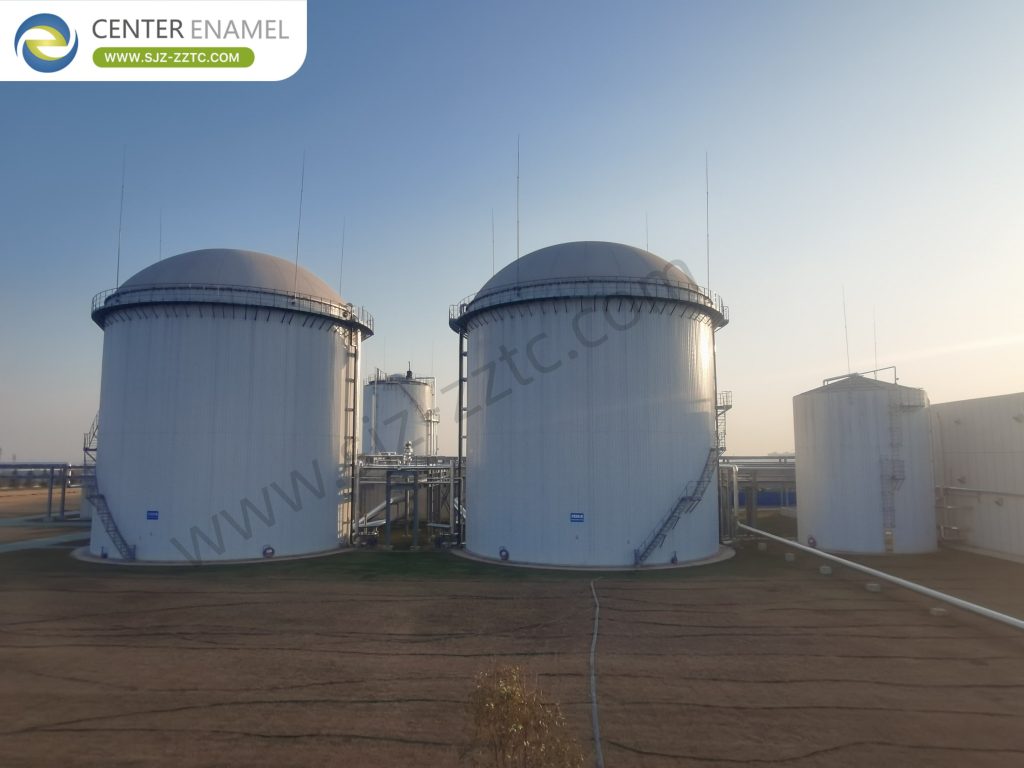
As an established Industrial Wastewater Treatment Solution Provider, Center Enamel aligns its engineering capabilities with these evolving global regulations, offering GFS tanks and integrated systems that meet the most rigorous discharge and reuse standards worldwide.
Given these tightening policy drivers, the selection of robust, adaptable infrastructure becomes critical for long-term compliance and operational success. GFS tanks, with their proven durability and corrosion resistance, have emerged as the preferred storage and reaction vessels for industrial wastewater treatment projects across diverse regulatory environments.
GFS Tanks Adaptable to Extreme Climates
Building on the need for reliable infrastructure under any regulatory regime, GFS tanks also demonstrate exceptional adaptability to challenging geographic and climatic conditions. GFS tanks can undergo customized wind and seismic design based on project site climate and geological conditions, with environmental adaptability far superior to concrete tanks. Concrete tanks are cast-in-place monolithic structures, with seismic and wind resistance entirely dependent on on-site construction quality. In remote areas, typhoon-prone zones, and earthquake belts, construction quality is difficult to control. Under strong earthquakes or typhoons, concrete tanks are prone to cracking and base settlement damage, with subsequent reinforcement costs equivalent to rebuilding.
GFS tanks undergo collection of local seismic intensity, maximum wind pressure, and foundation bearing capacity data before construction, with customized thickened steel panels, stiffening ribs, and anchored base components-all factory-prefabricated to standardized specifications. For any Industrial Wastewater Treatment Solution Provider, offering GFS tanks that withstand extreme weather ensures project longevity and client confidence. The bolted panel structure has excellent stress distribution capability, making it less prone to overall fracture under seismic and typhoon impacts, and minor foundation settlement will not cause through-cracking. Structural parameters can be flexibly adjusted for mountainous, coastal typhoon-zone, and high-seismic-zone projects, providing long-term protection against extreme natural climate damage.
The climate resilience of GFS tanks directly supports the stable operation of advanced anaerobic treatment processes, which form the core of many industrial wastewater solutions.
UASB Process Advantages
Within the framework of anaerobic treatment, the UASB process offers distinct operational and economic benefits that make it a cornerstone of modern industrial wastewater management. No mechanical mixing equipment is required, with sludge suspension achieved through hydraulic action, resulting in very low overall energy consumption. High-concentration anaerobic granular sludge can be cultivated, with high sludge concentration, strong activity, excellent settleability, low sludge washout, and low sludge yield, significantly reducing sludge disposal costs. The integrated design combines reaction, sedimentation, and separation simultaneously, with small footprint and moderate capital investment. Simple structure with low failure rates and convenient maintenance.
A professional Industrial Wastewater Treatment Solution Provider integrates these UASB advantages with high-quality GFS tanks to deliver systems with high volumetric loading rates, excellent organic pollutant degradation efficiency, and good shock load resistance. Stable biogas production with high resource recovery value. The process is mature and widely adopted, with well-established construction, commissioning, and O&M systems, suitable for large-scale industrial wastewater treatment.
These process efficiencies are particularly well-suited to specific waste streams, such as brewery wastewater, where the pollutant profile presents unique opportunities for biological treatment.
Brewery Wastewater: Environmental Toxicity of Pollutants
Complementing the UASB process capabilities, brewery wastewater presents a uniquely manageable pollutant profile. No chemical toxicity-purely natural organic wastewater with very low ecotoxicological risk and easy environmental restoration. All pollutants are natural organics from grain fermentation-starches, sugars, alcohols, amino acids, proteins-containing no heavy metals, bacteriostats, or persistent toxic organics. They do not inhibit biochemical bacteria and have no acute or chronic toxicity to soil, water, or plants. The core pollution is only high-concentration oxygen-demanding organics-direct discharge rapidly depletes dissolved oxygen, causing oxygen depletion, black-odor conditions, algal blooms, and channel siltation. Pollutants have no bioaccumulation potential and are rapidly decomposed by microorganisms and natural water bodies-no long-term persistent ecological harm.
For an Industrial Wastewater Treatment Solution Provider like Center Enamel, this pollutant profile allows for highly efficient, cost-effective treatment trains using GFS tanks as the core anaerobic digestion vessels, maximizing biogas recovery while ensuring rapid environmental restoration.
This combination of process knowledge and equipment reliability has been proven in real-world applications, including the landmark palm oil biogas upgrade project in Indonesia.
Indonesia Palm Oil Biogas Upgrade Project
Commissioned in 2013 as the core anaerobic digestion reactor for the POME treatment station, this project features 3 GFS tanks in two sizes: 17.58 m dia. × 8.4 m height and 16.82 m dia. × 7.2 m height. The tanks serve as the core anaerobic reaction equipment specifically for high-organic palm oil production wastewater-anaerobic digestion degrades pollutants and recovers biogas. Tanks are adapted to local palm industry wastewater needs. GFS tank assembly is convenient with corrosion resistance for Southeast Asia's hot humid high-corrosion environment-a mature biomass energy environmental benchmark project.
This project exemplifies how a leading Industrial Wastewater Treatment Solution Provider leverages GFS tanks to deliver turnkey solutions that address both pollution control and renewable energy generation in challenging tropical climates.
Successful project delivery of this scale requires not only superior equipment but also a highly skilled installation and construction team capable of maintaining quality across global sites.
Installation and Construction Team Expertise
The installation team has practical experience from over 10,000 GFS tank projects globally, strictly following standardized construction procedures-full control over project mobilization, civil coordination, tank assembly, piping, and commissioning schedules and quality. The team is proficient in complete standardized installation processes for GFS tanks, dual-membrane gas storage covers, USR/CSTR/IC anaerobic reactors, and biogas desulfurization/piping systems-adaptable to large-scale farms, industrial parks, remote mountainous sites, coastal high-corrosion sites, and other complex locations-strictly implementing unified global safety construction standards.
As a trusted Industrial Wastewater Treatment Solution Provider, Center Enamel deploys these teams as complete units for large overseas cross-border projects, providing on-site construction, technical training, and local worker practical instruction. Full control over construction details, air-tightness testing, and corrosion protection ensures timely and stable commissioning of global environmental projects through standardized delivery capability.
This extensive field experience feeds directly into the company's broad portfolio of benchmark projects, demonstrating its capability to handle diverse industrial applications worldwide.
Center Enamel's Extensive Global Benchmark Project Cases
Center Enamel's project portfolio covers over 100 countries across Southeast Asia, Africa, Europe, and the Americas-30,000+ mature projects-accumulating complete industry solutions across palm oil, livestock, municipal, brewing, and food waste biogas. This global footprint confirms Center Enamel as a premier Industrial Wastewater Treatment Solution Provider, rapidly matching customized solutions for different regional climates, water quality, and regulations using robust GFS tanks as the foundation of every system. The company's integrated approach-from design and manufacturing to installation and after-sales support-ensures that clients receive a seamless, reliable, and compliant solution for their specific industrial wastewater challenges.
Frequently Asked Questions (FAQ)
Q1: What makes Center Enamel a reliable Industrial Wastewater Treatment Solution Provider for global projects?
Center Enamel combines over 30,000 completed projects across 100+ countries with proprietary GFS tank manufacturing, in-house engineering teams, and standardized global installation procedures. This vertical integration ensures quality control, cost efficiency, and compliance with diverse international regulations including EU circular economy mandates and China's discharge standards.
Q2: How do GFS tanks enhance the performance of UASB and other anaerobic treatment processes?
GFS tanks provide a gas-tight, corrosion-resistant environment essential for stable anaerobic digestion. Their smooth enamel surface prevents biofilm accumulation and sludge adhesion, while the modular bolted design allows for rapid installation and future expansion. The tanks also withstand biogas pressure and H₂S corrosion, ensuring long-term operational reliability for high-organic industrial wastewater.
Q3: In which extreme climate conditions can GFS tanks be deployed successfully?
GFS tanks can be customized for seismic zones, typhoon-prone coastal areas, high-altitude mountainous regions, and hot-humid tropical environments like Southeast Asia. They feature factory-prefabricated thickened panels, stiffening ribs, and anchored base components, with structural parameters adjusted to local wind pressure, earthquake intensity, and foundation conditions-providing superior resilience compared to cast-in-place concrete tanks.