
Leading Industrial Wastewater Treatment Solutions with Advanced GFS Tanks and Expert Biogas Plant Design
Industrial wastewater treatment faces mounting pressure from tightening environmental regulations, rising operational costs, and the urgent need for sustainable resource recovery. The "three highs"-high difficulty, high cost, and high energy consumption-represent the core challenges that plant operators and environmental engineers must overcome to achieve both compliance and profitability. As industries diversify and wastewater streams become increasingly complex, the demand for integrated solutions that combine robust containment, efficient biological treatment, and expert system design has never been greater.
Whether addressing the recalcitrant organics in pharmaceutical effluents or the high-strength loads from food processing, success hinges on the synergy between reliable infrastructure and process expertise. This is where professional Biogas Plant Design, durable GFS Tanks, and comprehensive Industrial Wastewater Treatment strategies converge to deliver lasting environmental and economic value.
Core Industry Challenges of Industrial Wastewater Treatment
The path to effective wastewater management is fraught with technical and financial obstacles that require innovative solutions. The core challenges of Industrial Wastewater Treatment center on the "three highs"-high difficulty, high cost, and high energy consumption. Wastewater from new energy, chemical, and pharmaceutical industries is complex in composition with numerous characteristic pollutants, and traditional treatment processes are difficult to remove effectively. Chinese companies have significant price advantages in the mid-to-low-end equipment segment. The industry also faces continuous technological upgrade pressure from increasingly stringent emission standards, as well as new requirements for digitalization and low-carbon transformation on operational refinement management capabilities. Addressing these challenges demands not only advanced process knowledge but also durable infrastructure like GFS Tanks that can withstand harsh chemical environments while maintaining structural integrity over decades of service.
GFS Tanks Adaptable to Extreme Climates
Selecting the right containment solution is a critical first step in overcoming the operational challenges posed by diverse geographical and climatic conditions. GFS Tanks can undergo customized wind and seismic design based on project site climate and geological conditions, with environmental adaptability far superior to concrete tanks. Concrete tanks are cast-in-place monolithic structures, with seismic and wind resistance entirely dependent on on-site construction quality. In remote areas, typhoon-prone zones, and earthquake belts, construction quality is difficult to control. Under strong earthquakes or typhoons, concrete tanks are prone to cracking and base settlement damage, with subsequent reinforcement costs equivalent to rebuilding.
GFS Tanks undergo collection of local seismic intensity, maximum wind pressure, and foundation bearing capacity data before construction, with customized thickened steel panels, stiffening ribs, and anchored base components-all factory-prefabricated to standardized specifications. The bolted panel structure has excellent stress distribution capability, making it less prone to overall fracture under seismic and typhoon impacts, and minor foundation settlement will not cause through-cracking. Structural parameters can be flexibly adjusted for mountainous, coastal typhoon-zone, and high-seismic-zone projects, providing long-term protection against extreme natural climate damage. This resilience makes GFS Tanks the preferred choice for global Industrial Wastewater Treatment projects, from tropical Southeast Asia to arid Middle Eastern climates.
UASB Applicable Scenarios in Biogas Plant Design
Once the containment infrastructure is secured, selecting the appropriate biological process becomes paramount for efficient treatment and energy recovery. The UASB process is a cornerstone of modern Biogas Plant Design and Industrial Wastewater Treatment, suitable for soluble medium-to-high concentration organic wastewater, covering light industrial wastewater from brewing, sugar refining, starch, papermaking, food processing, printing and dyeing, and more. It is suitable for wastewater where organics are predominantly soluble with low suspended solids content, not suitable for high-solids, high-viscosity wastewater.
The UASB can be used alone as the primary treatment process or as a pretreatment for high-strength wastewater to reduce downstream aerobic load. It is also suitable for municipal wastewater anaerobic pretreatment and low-solids livestock wastewater treatment. With its low cost and stable operation advantages, it is suitable for long-term continuous, large-flow Industrial Wastewater Treatment projects. When integrated with high-quality GFS Tanks as the reaction vessels, the UASB process forms the heart of a robust, energy-positive treatment system, enabling operators to convert organic pollutants into valuable biogas while minimizing sludge production and operational complexity.
Operation and Maintenance Cost Analysis for Industrial Wastewater Treatment
Understanding the full spectrum of operational expenditures is essential for designing sustainable and economically viable treatment systems. O&M costs for Industrial Wastewater Treatment are moderate to high with generally moderate economics. Pretreatment requires pH adjustment chemicals, coagulants, and decolorizing agents-moderate to high chemical costs. Anaerobic + aerobic processes are mature and stable with controllable equipment O&M costs. Advanced decolorization (ozone generators, Fenton oxidation) has high energy consumption and chemical costs-major cost driver. Membrane water reuse systems have high capital investment and frequent membrane replacement-high maintenance costs.
Dye and sizing sludge production is high, with significant disposal costs. High-temperature wastewater requires heat exchange cooling, but heat recovery can offset some energy costs. Frequent water quality fluctuations require frequent parameter adjustments-moderate labor requirements. Water reuse can offset some costs, but overall resource recovery benefits are limited-generally moderate economics. Strategic Biogas Plant Design can significantly improve these economics by maximizing energy recovery and minimizing chemical usage, while the superior corrosion resistance and low maintenance requirements of GFS Tanks help reduce long-term O&M burdens, making the overall treatment system more cost-effective over its lifecycle.
Indonesia Palm Oil Biogas Upgrade Project
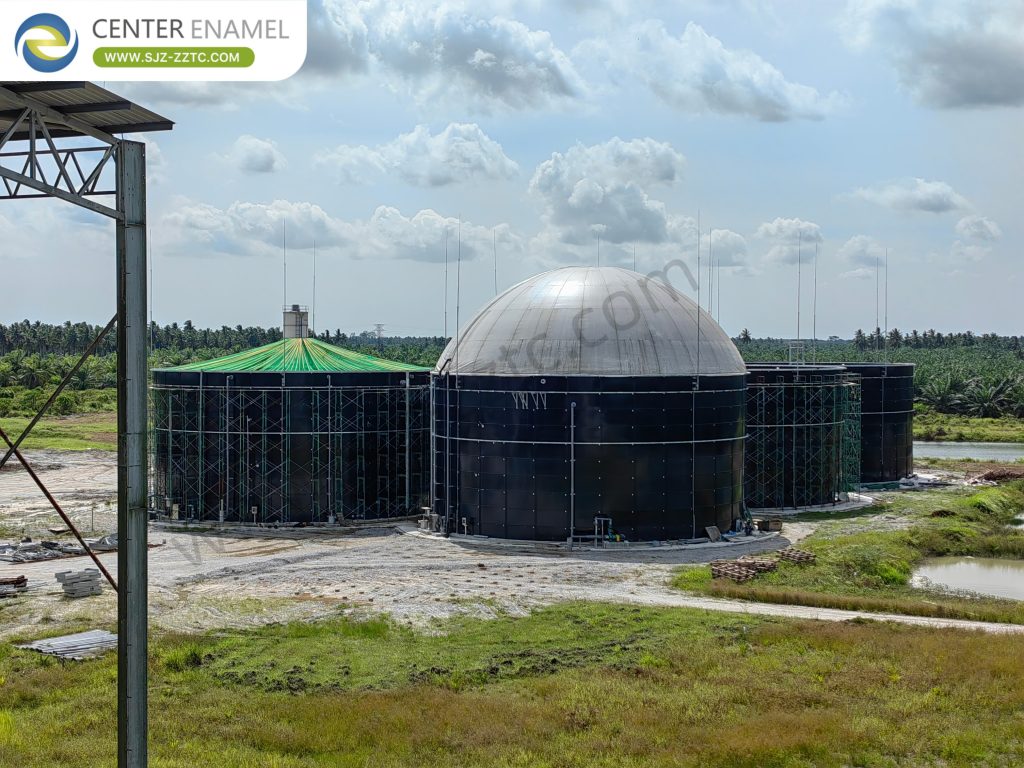
Real-world applications demonstrate the tangible benefits of combining expert design with premium equipment in challenging industrial environments. This project, commissioned in 2013 as the core anaerobic digestion reactor for the POME treatment station, features 3 GFS Tanks in two sizes: 17.58 m diameter × 8.4 m height and 16.82 m diameter × 7.2 m height. The tanks serve as the core anaerobic reaction equipment specifically for high-organic palm oil production wastewater-anaerobic digestion degrades pollutants and recovers biogas.
The GFS Tanks are adapted to local palm industry wastewater needs. Their assembly is convenient with corrosion resistance for Southeast Asia's hot humid high-corrosion environment-a mature biomass energy environmental benchmark project. This project exemplifies how effective Industrial Wastewater Treatment and thoughtful Biogas Plant Design can simultaneously address environmental pollution and generate sustainable energy, reinforcing the role of GFS Tanks as the preferred containment solution for anaerobic digestion in tropical and challenging climates.
After-Sales and Technical Support Team
The long-term success of any treatment facility depends not only on initial design and construction but also on the quality of ongoing support and maintenance. The after-sales team adheres to the service principles of rapid response, professional efficiency, and full-cycle support-providing 24/7 full-lifecycle O&M support to global clients, ensuring that Biogas Plant Design and Industrial Wastewater Treatment systems continue to perform optimally.
Standard remote services include fault diagnosis, process parameter adjustment, and tank anti-corrosion maintenance guidance. For domestic and long-distance overseas clients, overseas technical service personnel can be dispatched for on-site inspection, annual inspection, and equipment refurbishment as needed. The team also maintains long-term client feedback tracking mechanisms-regularly collecting tank and anaerobic equipment operational data to continuously optimize product structure and support processes. Supporting external technical expert teams provide specialized support for anaerobic process commissioning, biogas upgrading O&M, and wastewater upgrade/retrofit projects-ensuring long-term stable operation of domestic and overseas projects, continuously improving global client satisfaction and repurchase rates.
Flexible and Efficient Service Delivery System
Ultimately, the ability to deploy solutions efficiently and adapt to changing site conditions defines a truly client-centric provider. Center Enamel's own cross-border construction teams combined with a global localized agent network enable modular GFS Tank assembly with short construction periods and dismantlable/reusable capability. This flexibility is suitable for overseas short-term projects, phased expansions, and relocation needs, providing full-lifecycle after-sales O&M support ensuring long-term stable client operations in their Industrial Wastewater Treatment and Biogas Plant Design initiatives.
Frequently Asked Questions
Q: How does Biogas Plant Design impact the overall efficiency of Industrial Wastewater Treatment?
A: Professional Biogas Plant Design integrates process selection, tank sizing, gas collection, and energy utilization to maximize methane recovery from organic pollutants. This approach reduces operational costs, minimizes sludge disposal, and generates renewable energy-turning a treatment facility into a net-positive energy asset. Key design considerations include feedstock characteristics, temperature control, and hydraulic retention time optimization.
Q: Why are GFS Tanks considered superior to concrete tanks for wastewater and biogas applications?
A: GFS Tanks offer factory-controlled glass-fused-to-steel coating that provides exceptional corrosion resistance, durability, and a service life exceeding 30 years. Unlike concrete tanks, they are not susceptible to cracking, chemical attack, or seismic damage. Their modular bolted design enables rapid installation, future expansion, and relocation, with consistent quality independent of on-site construction conditions.
Q: What after-sales support is typically available for international Industrial Wastewater Treatment projects?
A: Comprehensive after-sales support includes 24/7 remote fault diagnosis, process optimization guidance, corrosion maintenance advice, and dispatchable overseas technical personnel for on-site inspections and refurbishment. Long-term client feedback tracking and external expert teams for anaerobic commissioning and system upgrades ensure continuous performance improvement and high client satisfaction across global operations.