
How Integrated Industrial Wastewater Treatment and Anaerobic Digestion Solve Effluent Challenges
The global map of industrial wastewater treatment is being redrawn. Asia-Pacific, led by China, has become the world's largest market, with operation and maintenance services rising steadily as the sector shifts from project construction toward long-term operational management. North America focuses on upgrading existing facilities, while Europe emphasizes high-value-added resource recovery technologies. Wastewater from the new energy chain-lithium batteries, photovoltaics, and hydrogen-has emerged as the most notable growth area, its complex composition generating strong demand for customized solutions.
Third-party treatment models in industrial parks are maturing and consolidating the professional operation market. The water-scarce Middle East shows strong demand for advanced treatment and reuse, while manufacturing transfer into Southeast Asia drives new facility construction. Across every one of these markets, two questions dominate project planning: how to select the right anaerobic digestion process, and how to contain it in equipment that lasts. Answering both well is the foundation of effective industrial wastewater treatment.
Regional Pressures Reshaping Treatment Strategy
Each region brings distinct priorities to project design. In Asia-Pacific, scale and long-term operational reliability dominate, with facilities expected to run for decades under progressively stricter standards. North American owners concentrate on retrofitting aging infrastructure to extend service life. European projects treat wastewater as a resource stream, favoring technologies that recover energy and water rather than simply discharge them. The new energy industry chain introduces complex wastewater compositions that resist conventional approaches, demanding engineered, site-specific solutions. Meanwhile, industrial park third-party models are professionalizing operations, and water scarcity in the Middle East is pushing advanced reuse to the forefront. Understanding where a project sits within these regional dynamics is the first step toward specifying anaerobic digestion and containment infrastructure that will perform over its full lifecycle.
Inside the IC Reactor: How Anaerobic Digestion Works in Practice
At the heart of high-performance anaerobic digestion sits the IC (Internal Circulation) reactor. Pretreated high-strength organic wastewater enters the lower main reaction zone from the bottom, mixing with recirculated sludge-water mixture and rising rapidly. Anaerobic microorganisms efficiently degrade organic matter, producing large volumes of biogas. The gas-lift action of biogas carries the mixed liquor upward to the top gas-liquid separator, where biogas is collected. Degassed sludge-water mixture then returns by gravity through downcomers to the reactor bottom, creating autonomous internal circulation that repeatedly enhances pollutant degradation. After multiple circulation cycles, the wastewater enters the upper polishing zone for further reaction and sludge-water separation. Remaining trace organics are fully degraded, sludge settles back to the lower reaction zone, treated effluent overflows from the top, and aged sludge is periodically discharged. The result is fully autonomous circulation and efficient continuous operation-anaerobic digestion that runs reliably without external recirculation pumps.
Papermaking Wastewater: Where Anaerobic Digestion Proves Its Worth
Papermaking offers a clear illustration of why process selection matters. Its wastewater carries high suspended solids, high COD, high alkalinity, and large discharge volume, with suspended solids being the most distinctive feature. Typical characteristics include suspended solids of 1,000–5,000 mg/L-primarily fiber fines, fillers such as calcium carbonate and talc, and colloidal substances. COD ranges widely: cooking black liquor can exceed 100,000 mg/L, while combined wastewater COD runs approximately 1,500–5,000 mg/L. Cooking black liquor pH can exceed 13, making it strongly alkaline. BOD/COD sits around 0.3–0.45, indicating moderate biodegradability, with lignin and cellulose being the refractory fractions. The stream is rich in lignin, hemicellulose, resin acids, and tannins, producing moderate to high brown color, and arrives at moderate to high temperatures of 40–60°C. Large mills discharge tens of thousands of tons daily with relatively stable water quality. For these facilities, anaerobic digestion applied as front-end treatment dramatically cuts organic load while generating biogas-and the right containment keeps that system stable for years.
| Parameter | Typical Range / Characteristic |
| Suspended solids | 1,000–5,000 mg/L (fiber fines, fillers, colloids) |
| COD | Black liquor >100,000 mg/L; combined wastewater 1,500–5,000 mg/L |
| pH | Black liquor can exceed 13 (strongly alkaline) |
| BOD/COD ratio | Approximately 0.3–0.45 (moderate biodegradability) |
| Refractory fractions | Lignin and cellulose |
| Color | Moderate to high (brown), from lignin, resin acids, tannins |
| Temperature | 40–60°C |
| Discharge volume | Tens of thousands of tons daily at large mills |
GFS Tanks: Containment Engineered for Corrosive, Changing Media
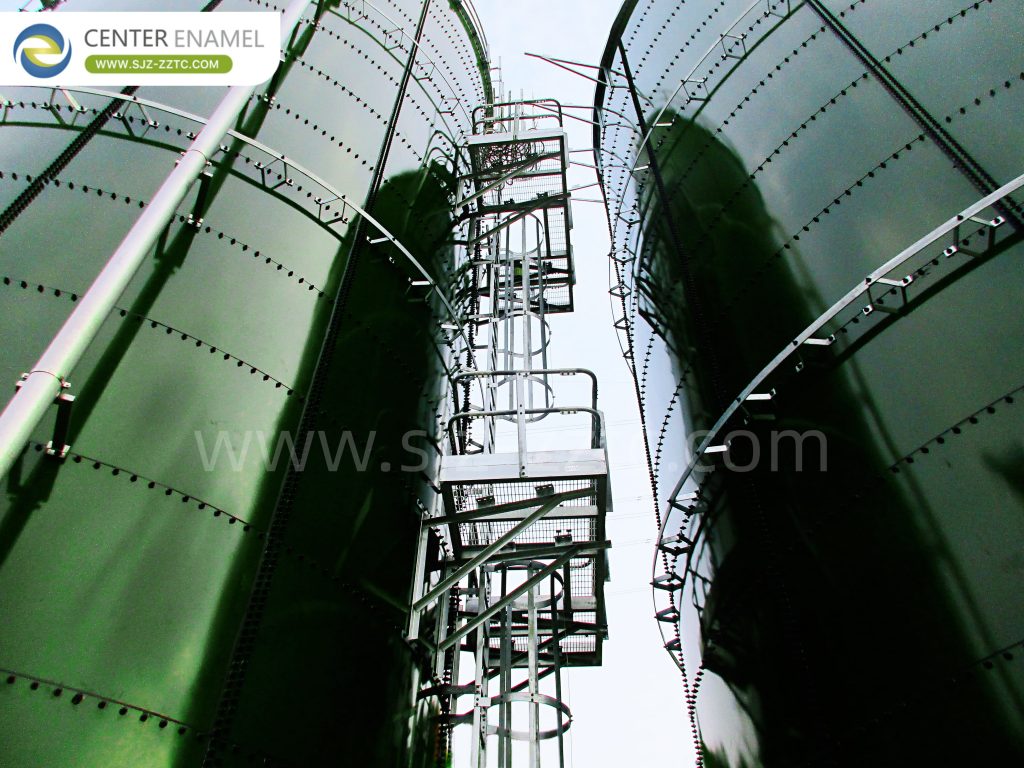
Anaerobic digestion performs only as well as the vessels that contain it. Center Enamel has independently developed over 200 specialized enamel formulations and supporting patents, capable of customizing anti-corrosion enamel based on the customer's storage media-adaptability comprehensively superior to concrete tanks. Concrete tanks use a single material and suit only neutral clean water storage. When storing corrosive materials such as livestock manure, palm oil mill effluent, chemical wastewater, food waste digestate, or high-salinity wastewater, additional anti-corrosion linings must be applied.
These linings are prone to failure, preventing long-term stable operation and struggling with alternating high and low concentration conditions. GFS tanks can be specifically formulated with enamels resistant to strong acids, strong alkalis, high organic content, and high salinity. A single tank can switch between multiple wastewater and fermentation feedstock storage requirements, making GFS tanks universally applicable across biogas anaerobic digestion, municipal wastewater, livestock farming, food processing, and industrial water treatment. This eliminates the need to rebuild tanks when media changes-perfectly meeting the needs of diversified, multi-condition environmental protection projects.
| Tank Type | Corrosion Resistance | Media Flexibility | Long-Term Stability |
| Concrete tank | Neutral clean water only | Requires added linings for corrosive media; linings prone to failure | Limited under alternating concentrations |
| GFS tank | 200+ enamel formulations for acids, alkalis, high organics, high salinity | Single tank handles multiple media and feedstock changes | Designed for long-term stable operation |
Design Depth Tailored to Local Conditions
Even the best process and tank technology require project-specific engineering. Center Enamel's design team includes senior engineers registered in the Hebei Provincial Science and Technology Expert Database, with design standards aligned to strict European and American high-end equipment safety standards. The team provides complete integrated design for differentiated overseas projects in livestock biogas, POME, municipal wastewater, hazardous waste storage, seawater desalination, and more-covering tank structure, anti-corrosion and sealing systems, biogas piping, and anaerobic process integration. Pre-design work thoroughly investigates local seismic zone, wind pressure, soil bearing capacity, water quality corrosivity, and local environmental discharge standards, applying thickened panels, reinforced anchored bases, and optimized sealing and corrosion structures as needed. Complete customized equipment solutions are tailored to customer plant area, wastewater load, treatment targets, and budget-balancing safety, economics, and local adaptation. This is what allows industrial wastewater treatment systems to remain compliant and stable across widely different global conditions.
Single-Source Delivery from Frit to Commissioning
Integration reduces risk. Center Enamel is the only company globally integrating proprietary enamel frit R&D, self-manufactured tanks, and EPC general contracting-full-process self-control from solution design and equipment production through cross-border logistics, overseas construction, and post-construction O&M. This structure significantly reduces client coordination and time costs, because every stage sits under one accountable partner rather than being split across multiple vendors. For anaerobic digestion projects where process and containment must work as one system, this single-source model removes interface gaps and shortens the path from design approval to steady operation. It also means that when issues arise-whether in tank structure, sealing performance, or process parameters-there is one team responsible for resolution.
Validated in the Field: South Africa Brewery Project
Real projects confirm the value of integrated delivery. In South Africa's brewing industry, a high-concentration organic wastewater treatment project featured both Center Enamel GFS tanks and stainless steel tanks as core equipment. GFS tanks served as the primary anaerobic digestion system, suited to brewery wastewater's high-COD, high-sugar, readily decomposable characteristics for efficient organic pollutant degradation. Stainless steel tanks handled wastewater transfer and chemical storage supporting processes. The complete equipment package delivered excellent corrosion resistance and flexible assembly, providing long-term stable treatment of brewery production and cleaning wastewater while solving local brewing industry pollution challenges. This mature African case demonstrates how the right combination of anaerobic digestion process and durable tank infrastructure performs under real operating conditions.
| Project Parameter | Specification |
| Location | South Africa |
| Industry | Brewery |
| Application | High-strength organic wastewater treatment |
| Core Equipment | GFS tanks (anaerobic digestion), stainless steel tanks (transfer/storage) |
| Key Challenge | High-COD, high-sugar, readily decomposable wastewater |
| Outcome | Long-term stable treatment, corrosion-resistant, flexible assembly |
Frequently Asked Questions
Q: How does the IC reactor improve anaerobic digestion efficiency?
Its built-in gas-lift circulation returns degassed sludge to the reaction zone automatically, boosting sludge-wastewater contact and degradation without external pumps.
Q: Can GFS tanks handle the high alkalinity of papermaking black liquor?
Yes. Specialized enamel formulations resist strong alkalis, high organics, and salinity, outperforming concrete tanks that depend on failure-prone linings.
Q: Does Center Enamel handle design and installation, or only tank supply?
The company provides full EPC delivery-design, manufacturing, logistics, overseas construction, commissioning, and post-construction O&M support.
Ready to specify an industrial wastewater treatment system that pairs the right anaerobic digestion process with durable containment? Share your effluent characteristics and site conditions, and our engineers will develop a tailored configuration for your project. Contact Center Enamel today to move from concept to compliant, long-lasting operation with a single accountable partner.