
Integrated Sewage Water Treatment Solution For Municipal Communities
A sewage water treatment solution for a community combines screening, biological nutrient removal, and sludge handling inside one engineered package. The bolted Glass-Fused-to-Steel (GFS) tankage holds the UBF and A2/O reactors and the sedimentation step, so the plant reaches stable COD, nitrogen, and phosphorus reduction without building concrete on site.
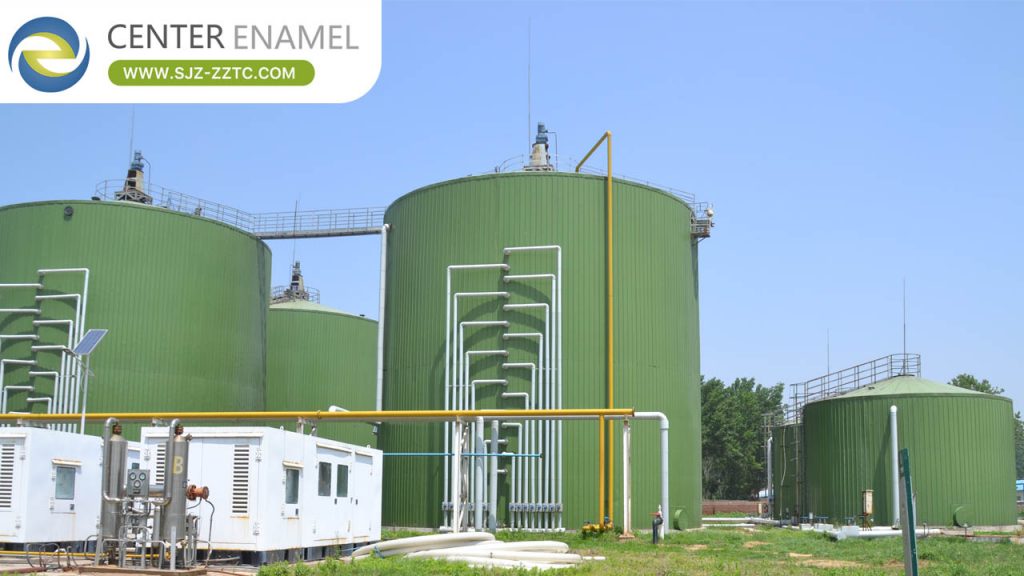
What A Sewage Water Solution Includes
A complete solution covers intake screening, a primary settlement, a biological stage, secondary clarification, sludge dewatering, and disinfection. For municipal communities the biological stage is usually an anaerobic-anoxic-oxic (A2/O) train that removes carbon, nitrogen, and phosphorus in one circuit, supported by an upflow blanket filter (UBF) for the harder organic load.
| Scope Item | Function | Typical Tank / Equipment |
| Screening and grit | Remove solids and sand | Mechanical screen, grit chamber |
| Biological stage | Carbon, N, P removal | UBF + A2/O GFS tanks |
| Clarification | Separate biomass and water | Sedimentation tank |
| Sludge | Stabilise and dewater | GFS sludge tank, dewatering unit |
| Discharge | Meet permit limits | Disinfection, outfall |
Why Bolted GFS Tankage For Communities
Factory-coated GFS panels arrive ready to bolt, so a community plant can be built in weeks rather than months of concrete curing. The enamel lining resists the corrosive sewage environment and is certified to NSF/ANSI 61 for contact with potable-adjacent duty. Modular panels also let the owner add a tank later as the population grows.
Project Case Study: Domestic Sewage Treatment Project In Ghana
Project / Application: Municipal domestic sewage treatment, Ghana. Industry: Municipal. Tank Type: Glass-Fused-to-Steel (GFS). Key Requirements: Reliable nitrogen and phosphorus removal at community scale.
| Field | Value | Source / Evidence |
| Daily Treatment Volume | 1,800 m3/day | Company project reference |
| Reactor Types | UBF + A2/O + Sedimentation | Company project reference |
| UBF Tank | 1 set, O11.46 x 9.6 m | Company project reference |
| Secondary Sedimentation | 1 set, O14.52 x 4.8 m | Company project reference |
| A2/O Tanks | 2 sets, Outer O20.64 x 6.6 m | Company project reference |
| Installation Year | 2021 | Company project reference |
| Parameter | Influent | Effluent |
| COD Cr | 1,000 mg/L | 100 mg/L |
| BOD5 | 500 mg/L | 25 mg/L |
| Ammonia N | 30 mg/L | 10 mg/L |
| SS | 400 mg/L | 25 mg/L |
| Total P | 10 mg/L | 2 mg/L |
| pH | not stated | 6.5 to 9.0 |
About The Supplier
Shijiazhuang Zhengzhong Technology Co., Ltd (Center Enamel) manufactures Glass-Fused-to-Steel tanks rated for wastewater duty, with enamel firing at 820-930 C and certifications including ISO 9001, NSF/ANSI 61, and CE-EN 1090. The bolted system supports rapid overseas deployment and factory-controlled quality.
Comparison: Delivery Models For Community Sewage
| Model | Best For | Main Trade-off |
| Integrated package | Towns wanting one accountable party | Higher coordination upfront |
| Split civil plus process | Owners with local concrete crew | Interface risk at tank-process boundary |
| Containerised unit | Remote or temporary sites | Limited capacity per unit |
A municipal sewage water solution works best when the biological process and the tankage are engineered as one package. Size the UBF and A2/O volume to the population and the load, then let the bolted GFS tanks make delivery fast and the lining make it durable.
Frequently Asked Questions
Q1: What does a sewage water solution include? A1: Screening, biological nutrient removal, clarification, sludge dewatering, and discharge, engineered as one package.
Q2: Which process removes nitrogen and phosphorus? A2: An A2/O (anaerobic-anoxic-oxic) train removes nitrogen and phosphorus, often supported by a UBF for carbon.
Q3: How is tankage sized for a town? A3: It scales with population and per-capita flow, typically designed around the 1,800 m3/day class seen in one referenced municipal plant.
Q4: What standards apply to sewage discharge? A4: Local effluent permits set COD, BOD, nitrogen, phosphorus, and SS limits; tank linings follow NSF/ANSI 61.
Q5: Why choose bolted GFS over concrete? A5: Faster erection, factory coating quality, and modular expansion, with corrosion-resistant enamel.
Q6: Can the plant expand later? A6: Yes, modular GFS panels let an owner add tank volume as the community grows.
Q7: What happens to the sludge? A7: Sludge is stabilised and dewatered, then stored in a dedicated GFS tank before reuse or disposal.
Q8: Is on-site assembly difficult? A8: No, bolted panels are assembled by a small crew; one overseas municipal project used a 7-person team for the tankage.
Discuss your community flow and discharge limits with an engineer, or request a tankage and process scope for your sewage water solution.