
Is a Micro-Turbine Better Than a Gas Engine for Small Biogas Plants?
For plants below about 50–100 kWe, the micro-turbine often wins on simplicity and low maintenance, while the gas engine wins on electrical efficiency. A gas engine reaches 30–45% electrical versus a micro-turbine’s 28–35%, but the turbine has far fewer moving parts, tolerates dirtier gas, and delivers very high-grade exhaust heat. The right pick depends on whether you value peak efficiency or uptime and heat quality more.
The Core Trade-offs
Gas engines are reciprocating piston machines with hundreds of parts: they squeeze more electricity from the gas but need oil changes, valve service, and periodic overhaul. Micro-turbines spin a single rotor on air bearings with no oil system—they run for long intervals with little service, and their 500–650 °C exhaust is ideal for absorption cooling or drying. Against that, a micro-turbine’s lower electrical efficiency means it needs more biogas for the same power and gives up some revenue per cubic metre of gas.
Comparative Data Table: Micro-Turbine vs Gas Engine (<100 kWe)
| Factor | Gas engine | Micro-turbine |
| Electrical efficiency | 30–45% | 28–35% |
| Moving parts | many (pistons, valves) | few (single rotor) |
| Maintenance | oil, valves, overhaul | minimal, long intervals |
| Fuel gas tolerance | needs cleaning to spec | tolerates dirtier gas |
| Exhaust heat grade | 80–95 °C water | 500–650 °C (premium) |
| CapEx per kW | lower | higher |
When Each One Is the Better Choice
Choose a gas engine when electricity is the product and you have a stable, cleaned gas supply and a service partner nearby—you get the most kWh per cubic metre of biogas. Choose a micro-turbine when the plant is remote, gas quality is variable, or you need high-grade heat for a process such as drying or absorption cooling; the turbine’s uptime and fuel tolerance then outweigh its efficiency gap. Below roughly 30 kWe the micro-turbine’s simplicity advantage is usually decisive.
Frequently Asked Questions (FAQ)
Q1: Is a micro-turbine better than a gas engine for small biogas plants?
A: It depends. The gas engine is more electrically efficient (30–45% vs 28–35%); the micro-turbine wins on low maintenance, fuel tolerance, and high-grade heat. Below 50–100 kWe the turbine’s simplicity often tips the balance.
Q2: Which is more efficient at small scale?
A: The gas engine, typically 30–45% electrical versus 28–35% for a micro-turbine. That efficiency gap is the main reason to pick an engine when electricity is the priority.
Q3: Which needs less maintenance?
A: The micro-turbine, by a wide margin. With a single rotor on air bearings and no oil system, it avoids the oil changes, valve service, and overhauls that a reciprocating gas engine requires.
Q4: When does a micro-turbine win outright?
A: When the site is remote, gas quality is variable, or premium heat is needed for drying or absorption cooling. Below about 30 kWe its simplicity advantage is usually decisive.
Project Case Reference
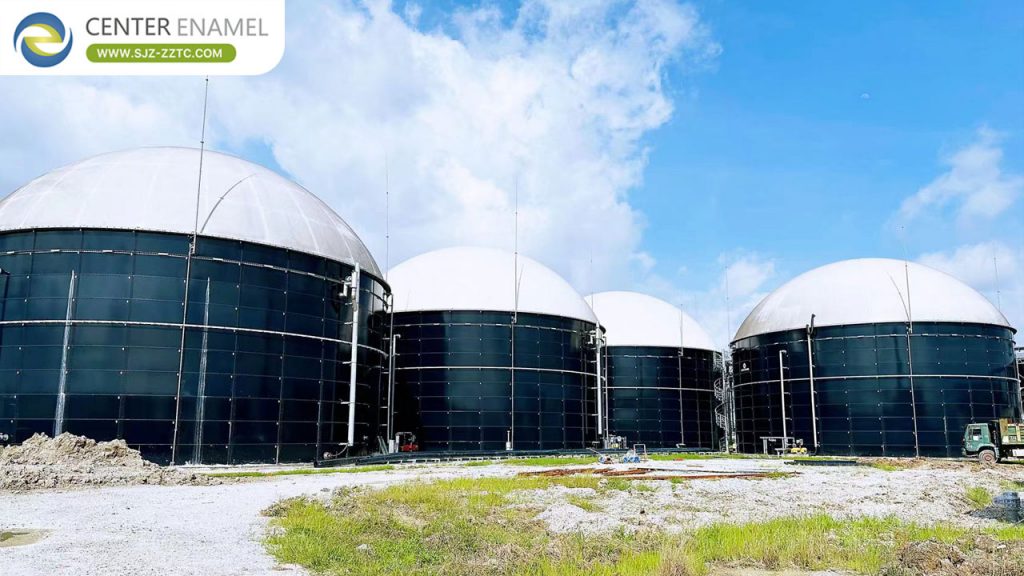
Malaysia Biogas Project — Malaysia · 2026
5 GFS Tanks · 27,000 m³ Total Volume · 22,000 m³ Biogas/Day
A large-scale biogas project in Malaysia featuring 5 Glass-Fused-to-Steel (GFS) tanks. The project achieves approximately 80% digestibility, with each single tank producing about 4,400 m³ of biogas daily, totaling 22,000 m³ per day across all 5 tanks.
Technical Specifications
Single Tank Volume: 5,400 m³ (Ø24.46 × 12 m)
Total Effective Volume: 27,000 m³ (5 tanks)
Daily Biogas Production: 22,000 m³ total
Digestibility: ≈ 80%
Gas Production Rate: 0.45 m³ / kg COD removed
Tank Type: Glass-Fused-to-Steel (GFS)
Water Quality Data
| Parameter | Inlet Water | Effluent |
| COD | ≥ 60,000 mg/L | ≥ 12,000 mg/L |
| BOD | ≤ 25,000 mg/L | ≤ 5,000 mg/L |