
Is Biogas Recovery Common in the Food Industry?
Biogas recovery is increasingly common in the food industry—especially in dairies, breweries, distilleries, slaughterhouses, and large food processors—because their process water and by-products are concentrated, steady, and rich in biodegradable organics that anaerobic digestion (AD) converts efficiently into renewable energy. Adoption is no longer experimental; for high-volume processors it is a mainstream treatment-and-energy option.
What Biogas Recovery Means in Food Processing
In this context, biogas recovery is the capture of methane from organic residues—whey, spent grain, fruit pressings, fat, and high-strength process water—via anaerobic digestion, then using that gas in a combined heat and power (CHP) unit, boiler, or biomethane-upgrading skid. Rather than paying to discharge a strong effluent, the plant converts it into on-site power, heat, and sometimes transport fuel.
How Common Is It? By Sub-Sector
The table below shows where AD is already well established versus emerging. Dairy and brewing lead because their streams are both strong and consistent; meat and fruit processing are close behind; packaged-food and beverage bottling are the fastest-growing segment as discharge fees rise.
| Food sub-sector | Adoption of AD biogas | Why |
| Dairy / cheese | Widespread | whey, wash water, steady COD |
| Brewery / distillery | Widespread | sugars, yeast, high BOD |
| Slaughterhouse / rendering | Common | blood, fat, protein |
| Fruit / veg processing | Common | pressings, sugars, seasonal |
| Packaged food | Growing | mixed organics, rising fees |
| Beverage bottling | Growing | sugar rinses, CIP water |
Why Food Streams Suit Anaerobic Digestion
Food residues are nearly ideal feedstock: they are readily biodegradable, low in the heavy metals and recalcitrant toxins that trouble industrial waste, and they arrive in predictable volumes during production. Anaerobic digestion returns roughly 0.30–0.45 m³ of biogas per kg of COD removed (about 60% methane), so a strong food stream (5,000–30,000 mg/L COD) yields dense, recoverable energy instead of a disposal cost.
Applications and Operating Models
Most plants run on-site covered digesters that feed a CHP at 35–45% electrical and 80–90% total efficiency, covering their own heat and power. Where pipeline or vehicle fuel is the goal, an upgrading skid raises methane toward 98%. Some processors also co-digest off-site food waste for a gate fee, turning the digester into a waste-acceptance business as well as an energy one.
Advantages and Limitations
The upside is clear: lower disposal cost, on-site energy, and avoided methane emissions. The limits are variability (seasonal fruit lines), the need for stable feeding and temperature control (mesophilic 35–38°C), and the capital cost of the digester and gas train. Small or highly intermittent producers may find a shared or off-site facility more economic than a dedicated plant.
Comparison: On-Site AD vs Off-Site Hauling
| Factor | On-site AD | Off-site hauling |
| Energy capture | yes, on site | no, lost |
| Capital cost | high (own plant) | low (tipping only) |
| Best for | steady, large volume | small / seasonal |
| Extra revenue | energy + possible gate fee | none |
| Complexity | higher O&M | simple logistics |
Best Practices / How to Start
Characterize the stream (COD, BOD₅, solids, nutrients, toxins), run a biochemical methane-potential test, then model AD plus CHP sized to the steady organic load. Start with the streams you already produce; add off-site food waste only once the digester has spare capacity and you have a gate-fee contract. Keep the carbon-to-nitrogen ratio near 20–30:1 with co-substrates if needed.
Biogas recovery is already common in the dairy, brewing, meat, and fruit sectors and is spreading fast across packaged food and beverage bottling. For any food processor with a strong, steady organic stream, anaerobic digestion is now a proven way to cut cost and carbon at once.
Frequently Asked Questions (FAQ)
Q1: Is biogas recovery common in the food industry?
A: Yes—it is mainstream in dairies, breweries, distilleries, slaughterhouses, and large processors, and is spreading to packaged-food and beverage plants as discharge fees rise.
Q2: Which food sub-sectors adopt it most?
A: Dairy and brewing lead because their streams are strong and consistent; meat, fruit, and vegetable processing follow; packaged food and bottling are the fastest-growing adopters.
Q3: Why does food waste suit anaerobic digestion?
A: It is readily biodegradable, low in heavy metals and recalcitrant toxins, and arrives in predictable volumes—so AD converts it efficiently into 0.30–0.45 m³ biogas per kg COD removed.
Q4: What stops wider adoption?
A: Seasonal or small volumes, the capital cost of a dedicated plant, and the need for stable feeding and temperature control. Shared or off-site facilities solve the smallest producers.
Q5: Can a food plant also earn from waste acceptance?
A: Yes. Once the digester has spare capacity, many processors accept off-site food waste for a gate fee, adding a second revenue line on top of energy.
Q6: Is on-site AD better than hauling waste away?
A: For steady, large volumes, on-site AD wins because it captures energy and can add gate-fee income; for small or seasonal streams, off-site hauling is simpler and cheaper.
Project Case Reference
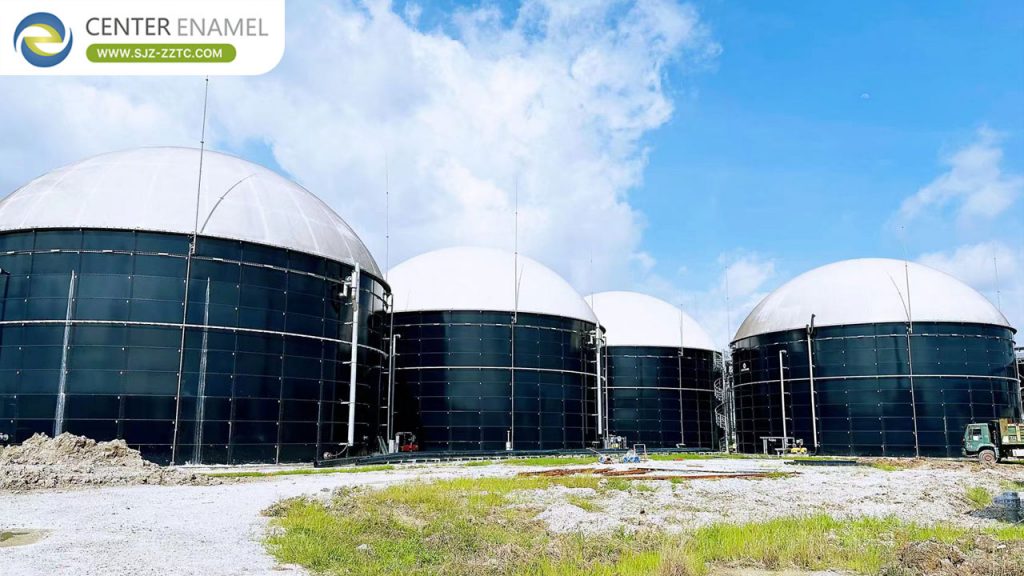
Malaysia Biogas Project — Malaysia · 2026
5 GFS Tanks · 27,000 m³ Total Volume · 22,000 m³ Biogas/Day
A large-scale biogas project in Malaysia featuring 5 Glass-Fused-to-Steel (GFS) tanks. The project achieves approximately 80% digestibility, with each single tank producing about 4,400 m³ of biogas daily, totaling 22,000 m³ per day across all 5 tanks.
Technical Specifications
Single Tank Volume: 5,400 m³ (Ø24.46 × 12 m)
Total Effective Volume: 27,000 m³ (5 tanks)
Daily Biogas Production: 22,000 m³ total
Digestibility: ≈ 80%
Gas Production Rate: 0.45 m³ / kg COD removed
Tank Type: Glass-Fused-to-Steel (GFS)
Water Quality Data
| Parameter | Inlet Water | Effluent |
| COD | ≥ 60,000 mg/L | ≥ 12,000 mg/L |
| BOD | ≤ 25,000 mg/L | ≤ 5,000 mg/L |