
Is Domestic Sewage Pure Water?
Many people confuse domestic sewage with pure water or clean water, and even think domestic sewage can be reused or discharged after simple filtration. However, the answer to the question Is domestic sewage pure water? is definitely NO. Domestic sewage is a complex mixture containing a large number of pollutants, bacteria, organic matter and nutrients, which will cause serious harm to the environment and human health without professional treatment.
In this article, we will fully explain the real components of domestic sewage, its environmental risks, why it is not pure water at all, and introduce the most advanced and reliable treatment technologies, including anaerobic digestion systems, A2O process and core equipment GFS Tanks, to show how Center Enamel provides safe and efficient solutions for global domestic and Municipal Wastewater Treatment Project.
Is Domestic Sewage Pure Water? Absolutely Not
Domestic sewage refers to the wastewater generated in daily family life, including toilet flushing water, kitchen wastewater, laundry water, bathing water, etc. It is closely related to our life, but it is completely different from pure water, clean water or tap water.
Pure water (purified water) almost only contains H₂O, without impurities, ions, organic matter, suspended solids or microorganisms. In contrast, domestic sewage contains a large number of pollutants, showing high turbidity, odor, organic matter and microorganisms.
In short:
- Pure water: colorless, odorless, non-toxic, pollution-free, can be directly drunk
- Domestic sewage: turbid, odorous, rich in organics, bacteria, nitrogen, phosphorus and oil, cannot be used directly
What Substances Are in Domestic Sewage?
Domestic sewage is a complex mixed liquid, and its main harmful ingredients include:
1. Organic Matter
Food residues, oil, proteins, carbohydrates, etc. lead to high COD and BOD values, which consume a lot of oxygen in water and cause water hypoxia and black odor.
2. Nitrogen and Phosphorus Compounds
Detergent, excrement, food waste contain a lot of nitrogen and phosphorus, which will cause water eutrophication, algal blooms, fish death and water ecological collapse.
3. Suspended Solids (SS)
Food residues, fibers, sediment, hair and other particles cause turbidity, pipeline blockage and sediment accumulation.
4. Oils and Surfactants
Kitchen oil, laundry detergent, shampoo and other products produce foam and oil film, which affect water quality and inhibit biological growth.
5. Pathogenic Microorganisms
Bacteria, viruses, parasitic eggs and other pathogens in domestic sewage can spread diseases and threaten public health.
6. Other Impurities
Heavy metal trace elements, pigments, food additives and other pollutants that are difficult to degrade.
These components prove once again: Is domestic sewage pure water? No, it is a high-pollution wastewater that must be treated strictly.
Harm of Untreated Domestic Sewage
A large amount of untreated domestic sewage is directly discharged into rivers, lakes and groundwater, which will bring continuous and irreversible hazards:
- Water hypoxia, blackening and odor
- Eutrophication, algal blooms, red tides
- Groundwater pollution, drinking water safety crisis
- Pathogen transmission, gastrointestinal diseases, skin infections
- Soil pollution, crop damage
- Ecosystem degradation, biological death
Therefore, all countries list domestic sewage as the key treatment object of Municipal Wastewater Treatment Project.
How to Treat Domestic Sewage Properly?
Domestic sewage cannot be used as pure water, but it can be turned into reusable water through professional treatment, realizing resource recycling.
Modern domestic and municipal wastewater treatment usually adopts:
Pretreatment → Anaerobic Digestion → Aerobic Treatment (A2O) → Tertiary Filtration → Disinfection → Reuse or Discharge
This combination can not only remove pollutants, but also recover biogas energy, which is efficient and environmentally friendly.
Four Core Anaerobic Processes for Domestic & Municipal Wastewater Treatment
For high-organic domestic sewage, anaerobic digestion is the most efficient pretreatment and energy recovery technology. The following four processes are widely used in Municipal Wastewater Treatment Project:
1. CSTR (Continuous Stirred-Tank Reactor)
With mechanical stirring, uniform mixing, strong anti-shock load, not easy to crust, suitable for large-scale domestic sewage and high-concentration wastewater.
2. UASB (Upflow Anaerobic Sludge Blanket)
Relies on high-activity granular sludge, high organic load, small footprint, low energy consumption, suitable for pre-treated domestic sewage.
3. USR (Upflow Solid Reactor)
Simple structure, anti-clogging, low investment, low operation cost, suitable for small and medium-sized decentralized domestic sewage projects.
4. IC (Internal Circulation Reactor)
High efficiency, 3–5 times higher than traditional reactors, compact layout, high biogas yield, suitable for large urban sewage treatment plants.
A2O Process: The Mainstream Aerobic Process for Domestic Sewage
A2O (Anaerobic-Anoxic-Oxic) is the most widely used deep treatment process for domestic sewage in the world.
- Efficiently remove nitrogen, phosphorus, organic matter
- Stable operation, low cost, strong adaptability
- Used with anaerobic processes to achieve the best effluent effect
- Fully meet national discharge and reuse standards
A2O is the core process to answer the problem of Is domestic sewage pure water? and turn sewage into reusable water.
Core Advantages of GFS Tanks in Domestic Wastewater Treatment
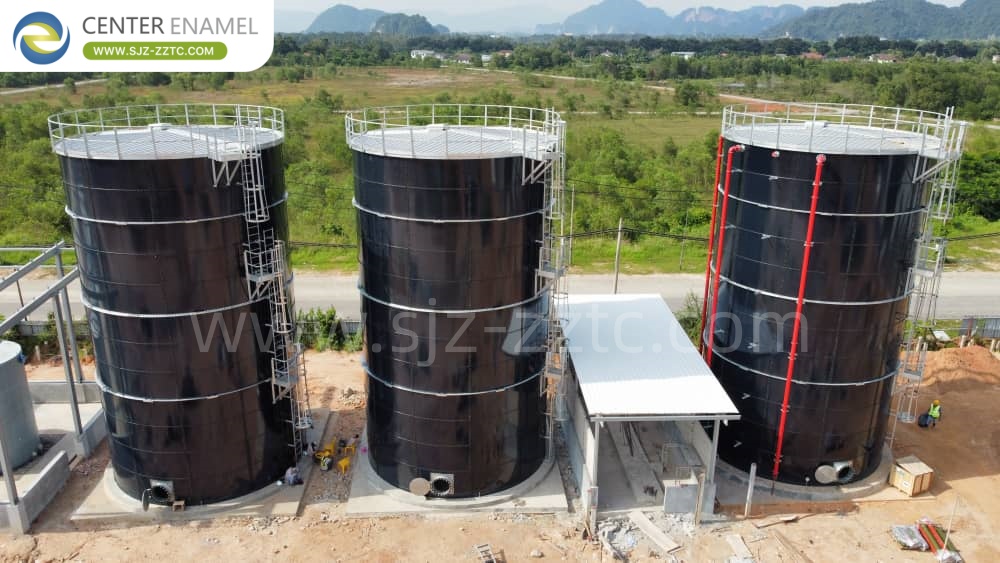
GFS Tanks (Glass-Fused-to-Steel Tanks) are the most important storage and reaction equipment in modern Municipal Wastewater Treatment Project, suitable for all kinds of domestic sewage treatment systems.
1. Ultra-High Corrosion Resistance
Enamel coating resists acid, alkali, salt and organic corrosion, service life exceeds 30 years.
2. Excellent Airtightness
Special sealing structure ensures no biogas leakage, safe and reliable.
3. Modular Bolted Installation
Factory prefabricated, fast on-site assembly, no welding, short construction period.
4. Smooth Surface, Not Easy to Scale
Reduce maintenance and cleaning costs, stable operation.
5. Flexible Expansion
Can expand capacity with project demand, suitable for long-term development.
6. Wide Applicability
Can be used for anaerobic digestion, sewage storage, water regulation, A2O system, biogas storage, etc.
GFS Tanks have become the standard configuration of high-quality domestic sewage treatment projects worldwide.
Center Enamel: Professional EPC Contractor for Domestic & Municipal Wastewater
Center Enamel is a leading global EPC service provider focusing on wastewater treatment and biogas energy, with rich experience in domestic sewage and Municipal Wastewater Treatment Project.
Our Core Strengths
- Over 200 enamel patented technologies, in line with ISO, AWWA and other international standards
- Full turnkey EPC services: design, production, transportation, installation, commissioning, training, after-sales
- Customized solutions for different water quality, climate and site conditions
- Successful projects in South Korea, Thailand, Vietnam, India, Saudi Arabia, Australia, Indonesia and other countries
- High biogas yield, stable system, low operation cost
- Professional hydraulic jacking installation team, safe and efficient
Typical Successful Projects
Case1: Saudi Arabia Municipal Wastewater Treatment Project
Tank Dimensions: φ24.06 × 4.85 m (H) — 5 Units
Total Capacity: 11,020 m³
Completion Date: 2024
Case2: Australia Municipal Drinking Water Project
Tank Dimensions: φ46.62 × 6.6 m (H) — 1 Unit
Total Capacity: 11,260 m³
Completion Date: 2020
To the question Is domestic sewage pure water?, the answer is definitely no. Domestic sewage contains a lot of organic matter, nitrogen, phosphorus, bacteria and impurities, which is a kind of wastewater that must be treated.
Through advanced anaerobic processes (CSTR, UASB, USR, IC), A2O deep treatment and high-performance GFS Tanks, domestic sewage can be efficiently purified and even reused as non-drinking water.
Center Enamel relies on leading technology, high-quality equipment and full-chain EPC services to provide safe, stable and economical solutions for global domestic sewage and Municipal Wastewater Treatment Project, helping to achieve environmental protection, energy saving and circular economy development.