
Kitchen Waste Plant: Choosing The Process For Food Waste
A kitchen waste plant converts source-separated food scraps into biogas and a stabilized residue through a short chain: receiving and sorting, size reduction and slurrying, anaerobic digestion - commonly CSTR for wet, pumped feed - then gas use and residue dewatering. The process is chosen for the waste's high moisture, high volatile solids and contamination risk. Sorting and depackaging come first because plastics and contaminants protect nothing and damage everything downstream.
Why Food Waste Suits Wet Anaerobic Digestion
Kitchen waste is wet, readily biodegradable and high in volatile solids, which makes it a good anaerobic feedstock rather than an incineration candidate. Its downside is variability and contamination: plastics, cutlery and packaging arrive with the organics. A plant must remove these before pumping the slurry. The result is methane-rich gas plus a digestate that can be dewatered. These are general guidance; the real process follows the delivered waste analysis.
| Stage | Duty | Why it is here |
| Sort / depackage | Remove contaminants | Protect pumps and digester |
| Pulping / slurry | Pumpable feed | Even reactor feeding |
| CSTR digestion | Convert volatile solids | Produce methane |
| Gas use | Use or upgrade gas | Recover energy |
Handling Contamination And Variability
Contamination is the defining design problem of a kitchen waste plant. Sorting and depackaging remove non-organics, and a consistent feed is blended before the digester. Food waste is also easy to digest, so an overload can drive volatile fatty acids up faster than the biology consumes them. Feeding a steady, measured rate is the simplest control. Where the waste is too wet or too dry, co-substrates such as grass can balance the mix.
Choosing Gas Use And Residue Handling
Recovered gas can fire a boiler, generate power or be upgraded to vehicle fuel; the choice depends on scale and local energy demand. The digestate must be dewatered and either used as a soil product where rules allow or disposed of. A plant that ignores the residue outlet is not complete. The gas and residue routes should be fixed at the same time as the digester.
| Design signal | Process consequence |
| High contamination | Stronger sorting / depackaging |
| High moisture | Wet CSTR, less dilution |
| Easy biodegradability | Control feed rate, watch VFA |
| Local heat demand | Boiler use over upgrading |
A Food-Waste Digestion Reference
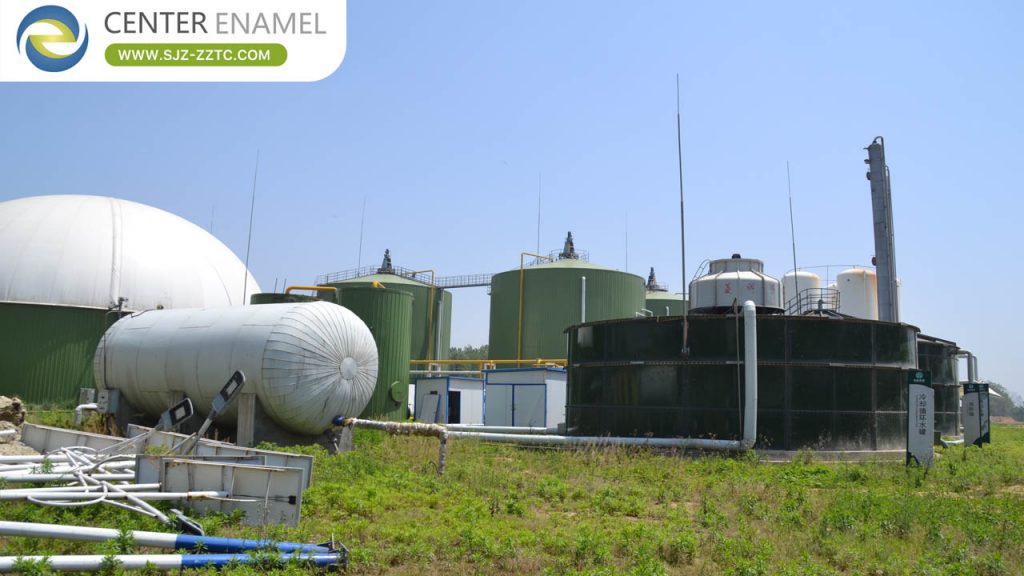
The library records a Pakistan biogas project using a CSTR process to convert food waste and napier grass into about 100 cubic metres of biogas per day, delivered with Center Enamel. It illustrates a kitchen-waste-style plant where a wet organic feed is digested and gas is recovered. The source confirms process, feedstocks and gas output; sorting equipment, contamination rates and residue handling are Not Specified in the Available Source, so the stage logic above is general guidance.
About Company
Shijiazhuang Zhengzhong Technology Co., Ltd (Center Enamel) is a comprehensive high-tech enterprise specializing in wastewater engineering, process section contracting, and equipment manufacturing. The company delivers biogas and wastewater projects through three main lines - EPC (turnkey) contracting, equipment supply, and process packages - covering livestock and municipal wastewater, biomass energy, industrial wastewater, and food waste. Its reactor portfolio spans CSTR, USR, UBF, UASB, IC, and EGSB, backed by in-house Glass-Fused-to-Steel tank manufacturing (enamel firing at 820-930 C) and certifications including ISO 9001, NSF/ANSI 61, and CE-EN 1090. With 35+ years of operation, a 150,000 m2 manufacturing base, and projects in 100+ countries, Center Enamel provides the single-responsibility engineering behind kitchen waste plants where sorting, digestion, gas use and residue handling are chosen as one process chain.
Conclusion
Choose a kitchen waste plant process around the waste itself: sort contaminants first, slurry the organics, digest in a wet reactor, and fix gas use and residue outlet together. Steady feeding keeps the easily digestible biology stable.
Frequently Asked Questions
Q1: What is a kitchen waste plant? A1: A facility that digests source-separated food scraps into biogas and residue.
Q2: Why sort first? A2: Plastics and packaging damage pumps and the digester.
Q3: Why CSTR for food waste? A3: The wet, pumped slurry suits a continuously stirred wet reactor.
Q4: Why watch volatile fatty acids? A4: Food waste digests fast; overload can sour the reactor.
Q5: Can grass be added? A5: Yes, co-substrates can balance a wet or weak mix (general guidance).
Q6: What gas options exist? A6: Boiler heat, power or upgrading, depending on scale and demand.
Q7: Is residue handling optional? A7: No - dewatering and a legal outlet are part of the plant.
Q8: Is the Pakistan sorting line known? A8: No - process/feed/gas are known; sorting detail Not Specified.
Suggested CTA
Share your delivered waste analysis with an engineer to select a right-sized kitchen waste process.