
Kitchen Waste Treatment: Pre-Treatment To Biogas Recovery
Kitchen waste treatment starts with receiving, de-packaging, screening, and milling to make a clean pumpable slurry, then digests that slurry in a sealed CSTR at 35-38 C where microbes convert the volatiles into biogas. Because food waste is rich in water and volatile solids, it digests readily and yields more biogas per tonne than many dry feeds, provided the front end removes contamination.
Pre-Treatment: The Step That Decides Everything
Kitchen waste arrives with packaging, bones, and grit. Receiving and de-packaging strip the rejects, screening and milling produce a uniform slurry, and grit removal protects the pump and the digester. The quality of this front end - not the digester brand - controls how clean the feed enters the reactor and how stable the biology stays.
| Pre-Treatment Step | What Happens | Output |
| Receiving and de-packaging | Strip rejects and packaging | Organic fraction |
| Screening and milling | Break down solids | Pumpable slurry |
| Grit removal | Settle heavy inerts | Clean feed to digester |
From Food Waste To Biogas
The milled slurry is pumped into a sealed digester, typically a CSTR at 35-38 C for the uniform feed. The biogas is desulphurised and can be upgraded to biomethane or used on site for heat and power. The sealed vessel is usually a Glass-Fused-to-Steel tank for corrosion resistance and fast assembly.
Yield And A Boundary Condition
Food waste alone can be too rich in fats and low in buffer, so co-digesting it with manure or agricultural residue balances the carbon-to-nitrogen ratio toward 20-30:1 and steadies the biology. A boundary to respect: without pre-treatment and co-digestion to buffer fats, a pure-food feed can upset the digester.
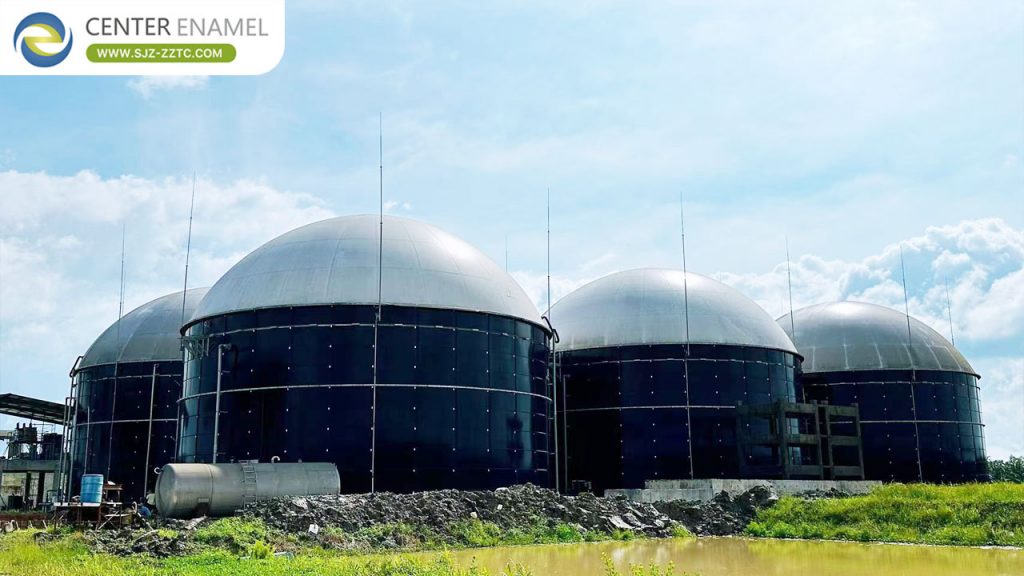
Project Case Study: Malaysia Biogas Project
Project / Application: Large-scale biogas from agro-industrial wastewater, Malaysia. Industry: Food and agro-industrial. Tank Type: Glass-Fused-to-Steel (GFS). Key Requirements: High-rate digestion of high-strength effluent with reliable daily gas output.
| Field | Value | Source / Evidence |
| Tank Type | GFS (Glass-Fused-to-Steel) | Company project reference |
| Tank Quantity | 5 Nos. | Company project reference |
| Dimensions Per Tank | O24.46 x 12 m | Company project reference |
| Volume Per Tank | 5,400 m3 | Calculated from supplied diameter and height |
| Total Effective Volume | 27,000 m3 (5 tanks) | Company project reference |
| Daily Biogas Production | 22,000 m3 total | Company project reference |
| Digestibility | approx 80% | Company project reference |
| Gas Yield Rate | 0.45 m3 / kg COD removed | Company project reference |
| Parameter | Inlet | Effluent |
| COD | greater than or equal to 60,000 mg/L | greater than or equal to 12,000 mg/L |
| BOD | less than or equal to 25,000 mg/L | less than or equal to 5,000 mg/L |
About The Supplier
Shijiazhuang Zhengzhong Technology Co., Ltd (Center Enamel) manufactures Glass-Fused-to-Steel tanks for food and agro-industrial waste digestion, with enamel firing at 820-930 C and certifications including ISO 9001, NSF/ANSI 61, and CE-EN 1090. The bolted CSTR packages support both centralized and on-site food-waste projects.
Comparison: Food Waste Routes
| Route | Best For | Main Trade-off |
| Anaerobic digestion to energy | Cities and processors | Needs pre-treatment |
| Composting | Low-tech sites | No energy recovery |
| Landfill | Last resort | Methane leakage risk |
Kitchen waste treatment is won or lost at the front end. De-package, mill, and grit-protect first, then digest in a sealed CSTR and recover the biogas, and the loop becomes both environmental and economic.
Frequently Asked Questions
Q1: How is kitchen waste treated? A1: It is de-packaged, screened, milled, then digested in a sealed CSTR to biogas.
Q2: What pre-treatment does it need? A2: Receiving, de-packaging, screening, milling, and grit removal to make a clean slurry.
Q3: What reactor makes biogas from food? A3: A sealed Glass-Fused-to-Steel CSTR at 35-38 C.
Q4: What is the methane content? A4: Mature feed typically yields 55-65% methane in the biogas.
Q5: Why co-digest food waste? A5: It balances the C:N ratio toward 20-30:1 and stabilises the biology.
Q6: What off-take works best? A6: Biomethane for large plants; heat or power for on-site units.
Q7: Can tankage expand later? A7: Yes, bolted GFS panels let the digester grow with tonnage.
Q8: What temperature does digestion need? A8: Mesophilic CSTR typically runs at 35-38 C.
Tell an engineer your kitchen-waste tonnage and off-take plan, or request a digestion scope for biogas recovery.