
Leading Biogas Project Contractor Combines with GFS Tanks for Livestock Wastewater Treatment
This article explores the evolving livestock manure treatment market-from compliance-driven to value-driven models-and presents integrated technical solutions. It details bolted GFS tanks advantages, UASB Process supporting equipment, standardized Livestock Wastewater Treatment Project trains, and advanced roofing options. The discussion emphasizes how a professional Biogas Project Contractor combines robust storage, efficient anaerobic digestion, and comprehensive services to deliver compliant, profitable systems. With global certifications and a full-service support network, Center Enamel enables projects worldwide-from North American digestate processing to Southeast Asian POME treatment-ensuring long-term operational success and resource valorization.
Market and Industry Landscape – From Compliance to Value Creation
The livestock manure treatment market is transitioning from environmental compliance-driven to dual-value-driven by energy and fertilizer valorization. The European digestate concentration fertilizer market is mature, and large-scale biogas projects in North America commonly include digestate processing centers. In terms of business model innovation, the asset-light model of farmers paying per volume treated has been piloted successfully in some countries. China's "biogas operation outsourcing" model is beginning to penetrate county-level projects. Digital technology-driven precision nutrient management platforms are emerging as new industry links connecting farms, treatment centers, and agricultural end-users. In terms of process equipment, CSTR is the mainstream anaerobic digestion process for treating livestock manure. After anaerobic digestion, manure produces biogas for power generation or grid-injection purification, while digestate is processed into organic fertilizer for farmland application. GFS tanks, with strong corrosion resistance and low maintenance costs, are widely used in manure treatment projects on large-scale farms in North America, Europe, and China, particularly suited to the corrosive environments of high ammonia-nitrogen and high hydrogen sulfide in manure.
This evolving market landscape demands a Biogas Project Contractor with both technical depth and business model flexibility. Whether integrating the UASB Process for soluble organics or deploying CSTR for complex manure, Center Enamel designs each Livestock Wastewater Treatment Project to capture both environmental credits and resource value.
GFS Tanks – Bolted Assembly for Rapid, Flexible Deployment
GFS tanks are assembled on-site from prefabricated panels, with short construction periods and support for expansion, relocation, and reuse-advantages distinctly different from immovable concrete tanks. Concrete tank pouring requires formwork, rebar tying, pouring, and long curing periods, with a single tank construction taking months. Rain, snow, and low temperatures force work stoppages and delays. Once poured, they are permanent fixed structures that cannot be dismantled, expanded, or relocated-project relocation means complete abandonment.
GFS tank panels are all factory-prefabricated, transported to site, and directly assembled in panels with simple procedures. Construction can proceed even in low-temperature, light-rain conditions, with installation time only one-third that of concrete tanks-construction schedules are controllable. For expansion, additional steel panels can be installed to increase volume; for plant relocation, tanks can be fully disassembled with panels transported to new sites for reassembly and reuse, significantly reducing material and construction costs for new construction and reconstruction. This is ideally suited for short-term environmental projects, phased expansion projects, and relocated construction projects.
For any Livestock Wastewater Treatment Project, these GFS tanks provide the physical backbone-from influent equalization to digestate storage. As a trusted Biogas Project Contractor, Center Enamel leverages this modularity to accelerate project timelines while preserving future flexibility for clients.
UASB Process – Supporting Equipment and System Integration
Core equipment includes the GFS anaerobic reactor tank, with the internal three-phase separator being the key component for gas-liquid-solid separation and sludge retention. The bottom high-precision distribution system (distribution pipes, distributors, pressure regulators) ensures uniform influent distribution, preventing short-circuiting and sludge accumulation. Supporting equipment includes influent lift pumps, equalization tanks, and flow meters to stabilize influent conditions. The top biogas collection system includes gas collection hoods, gas piping, desulfurization/dehydration equipment, and gas storage. Online temperature, pH, and COD monitoring instruments are integrated. Bottom sludge discharge pipes and pumps periodically remove excess sludge. The complete equipment package is compact, with no rotating wear parts, low equipment loss, and high operational stability.
The UASB Process equipment package is designed for simplicity and reliability-qualities that every Biogas Project Contractor should prioritize. When integrated into a full Livestock Wastewater Treatment Project, these components work seamlessly with GFS tanks to deliver consistent biogas yield with minimal operator intervention.
Livestock Wastewater – Standardized Treatment Solutions
Adapted to agricultural and rural settings, the core uses a low-cost treatment train of "solid-liquid separation + anaerobic digestion + ecological polishing," specifically addressing high-suspended-solids, high-concentration organic wastewater. Pretreatment uses solid-liquid separation equipment and sedimentation tanks to rapidly remove solid impurities like manure and feed residues, significantly reducing biochemical load. The main stage uses USR/CSTR anaerobic processes for efficient organic degradation with simultaneous biogas energy recovery. Subsequent A/O biological treatment precisely removes nitrogen and phosphorus, with final constructed wetlands or stabilization ponds for polishing. Digester tanks use Center Enamel GFS tanks, resistant to manure corrosion and with convenient assembly for rural projects. The entire process has strong shock load resistance, adapts to significant water quality and quantity fluctuations, is simple to operate, and achieves both pollution control and resource recycling.
This standardized train forms the core of every Livestock Wastewater Treatment Project delivered by Center Enamel. As an experienced Biogas Project Contractor, the company customizes each stage-from solid-liquid separation to polishing-while the UASB Process can be substituted or supplemented depending on wastewater characteristics, always with GFS tanks as the reliable containment solution.
Global Integrated Standardized Service System
Leveraging regional sales centers in China and overseas local agent networks, Center Enamel has established a complete after-sales service loop covering all markets. The system provides four core service pillars: 24/7 rapid response mechanism, on-site domestic/overseas installation services, full-project-cycle after-sales support, and long-term warranty protection-forming a complete service chain from preliminary site survey, mid-term construction management, to long-term inspection and maintenance. The entire system is uniformly adapted to both domestic and international project service standards, coordinating personnel scheduling, material support, and on-site coordination for simultaneous projects across multiple regions-significantly reducing customer multi-party coordination costs and ensuring efficient domestic and overseas project delivery.
Such comprehensive service capability distinguishes a top-tier Biogas Project Contractor. For every Livestock Wastewater Treatment Project, Center Enamel's service loop ensures that GFS tanks and UASB Process equipment are installed correctly and maintained throughout the plant's lifecycle-regardless of project location, from developed nations to remote rural areas.
Comprehensive International Authoritative Certifications
Center Enamel holds CE, NSF, WRAS, ISO9001, BSCI, ASME, and other global certifications-fully clearing EU, North American, Southeast Asian, and African project tendering barriers-providing critical hard credential advantages for large overseas project bidding.
These certifications give clients confidence when selecting a Biogas Project Contractor for their Livestock Wastewater Treatment Project. They validate that GFS tanks and UASB Process equipment meet the strictest international standards-ensuring smooth customs clearance, regulatory approval, and long-term operational compliance.
Aluminum Geodesic Dome Roof – Advanced Covering Solutions
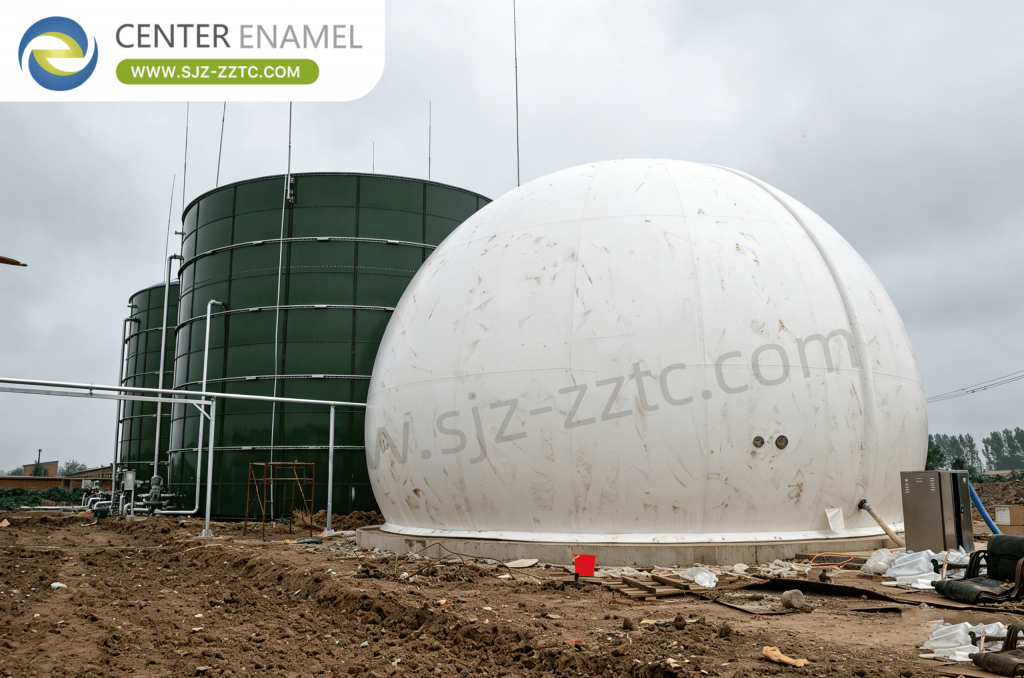
Aluminum Geodesic Dome Roof independently developed by Center Enamel is manufactured using high-strength aluminum alloy plates through integral stamping. It features a triangular grid spherical self-supporting structure, enabling large-span full coverage without internal support columns. Made of aluminum alloy, the roof offers excellent weather resistance and corrosion resistance, capable of long-term protection against acid rain, salt spray, and UV radiation, suitable for various extreme outdoor climate conditions.
The structural design complies with international AWWA D108 standards, with aluminum plate thickness, rib cross-sections, and joint connections all verified by finite element stress analysis, ensuring wind and snow load resistance that meets building code requirements across different global regions. The weight of the Aluminum Geodesic Dome Roof is only one-third to one-half of a steel roof with the same span, significantly reducing the load on the tank top and allowing direct installation without tank wall reinforcement.
The roof provides superior overall sealing performance, with double sealing between panels using specialized sealant strips and mechanical interlocking, enabling both airtight gas storage and enclosed odor control, suitable for biogas collection and storage, wastewater tank odor control, and drinking water contamination prevention. The support-column-free design does not interfere with the installation and operation of internal equipment such as mixers and water distributors. The aluminum material does not support microbial growth, requiring no anti-corrosion maintenance over long-term use, resulting in low total life-cycle costs.
For any Biogas Project Contractor, the Aluminum Geodesic Dome Roof offers an ideal complement to GFS tanks in a Livestock Wastewater Treatment Project-particularly for digesters requiring gas-tight collection or for storage tanks needing odor control. Its lightweight, corrosion-resistant design extends the service life of the entire tank farm while reducing maintenance burdens, demonstrating Center Enamel's holistic approach to complete biogas and wastewater infrastructure.
FAQ
Q1: What should I look for when choosing a Biogas Project Contractor for livestock wastewater?
Look for proven experience with the UASB Process and other anaerobic technologies, in-house manufacturing of GFS tanks, global certification (CE, NSF, ASME), and a full-service model covering design, installation, and after-sales support. A contractor with 30,000+ projects and 100+ country coverage ensures regulatory compliance and operational reliability.
Q2: How does the UASB Process benefit livestock wastewater treatment?
The UASB Process efficiently degrades soluble medium-to-high concentration organic pollutants with minimal energy input-no mechanical mixing required. It produces biogas for energy recovery, reduces downstream aerobic load, and operates stably with fluctuating wastewater quality, making it ideal for farm-based Livestock Wastewater Treatment Projects.
Q3: Why are GFS tanks preferred over concrete for livestock wastewater projects?
GFS tanks are factory-prefabricated, bolted on-site in one-third the time of concrete, and support expansion or relocation-critical for evolving farm operations. Their 30+ year corrosion resistance withstands high ammonia and hydrogen sulfide environments, while lower maintenance and lifecycle costs make them the economic choice for any Biogas Project Contractor's design.