
Leading GFS Tanks and Anaerobic Technologies for Superior Beverage Wastewater Treatment Projects
The Asia-Pacific region, particularly China, has become the world's largest industrial wastewater treatment market, with the operation and maintenance service segment's contribution continuing to rise, marking a shift from project construction to long-term operational management. The North American market focuses on upgrading existing facilities, while Europe emphasizes high-value-added resource recovery technologies. Wastewater from the new energy industry chain (lithium batteries, photovoltaics, hydrogen) has become the most notable emerging growth area due to its complex composition and high treatment difficulty, generating significant demand for customized solutions.
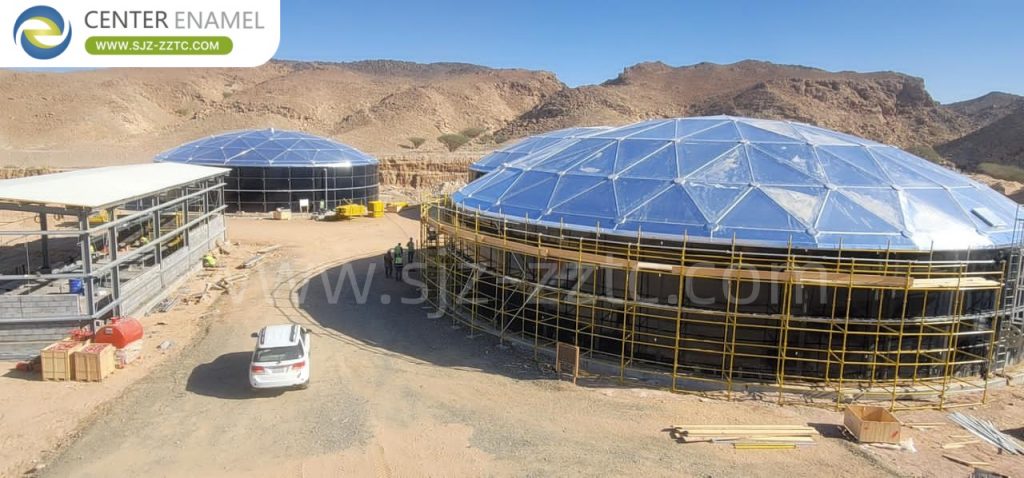
The maturity of third-party treatment models in industrial parks continues to improve, driving consolidation in the professional operation market. The Middle East has strong demand for advanced treatment and reuse of industrial wastewater due to water scarcity; manufacturing transfer in Southeast Asia drives local industrial wastewater treatment facility construction demand. These diverse regional demands highlight the need for versatile and durable treatment infrastructure, where high-performance containment systems like Glass-Fused-to-Steel (GFS) tanks have become increasingly vital. Within this dynamic landscape, the integration of robust anaerobic technologies with corrosion-resistant storage has emerged as a cornerstone for achieving both environmental compliance and operational efficiency.
The GFS Tanks Advantage: Setting a New Standard for Corrosion Resistance
Center Enamel's independently developed double-sided double-layer enameling technology is the industry's leading coating anti-corrosion technology, with corrosion resistance completely surpassing concrete tanks. Concrete tank interiors are riddled with pores, allowing wastewater and acid/alkaline media to easily penetrate and corrode the structural layer. Long-term use leads to irreversible problems such as internal wall spalling, water seepage, and rebar corrosion, which are difficult to repair and cannot be fundamentally resolved.
GFS tanks feature high-temperature enameling on both the interior and exterior surfaces of steel panels, with a dense, non-porous enamel finish that completely blocks corrosive liquids and biogas permeation. The enamel layer has extremely strong chemical stability, resisting acids, alkalis, salts, and microbial corrosion. Concrete tanks will develop extensive corrosion and leakage after 5-8 years of use, while GFS tank anti-corrosion service life can exceed 30 years, with no need for frequent internal lining repairs throughout the service life, significantly reducing long-term anti-corrosion maintenance investment and fundamentally eliminating environmental risks of medium leakage contaminating sites and groundwater. Compared to traditional concrete and FRP tanks, GFS tank coatings have no risk of peeling or blistering, and are adaptable to highly corrosive conditions such as palm oil mill effluent, livestock manure, and chemical high-salinity wastewater, with outstanding long-term comprehensive cost advantages.
This exceptional durability makes GFS tanks the preferred containment solution for demanding applications, particularly when paired with advanced biological treatment processes that rely on stable reactor conditions. As a result, they serve as the ideal vessel for housing sophisticated Anaerobic Technologies designed to treat high-strength organic effluents.
UASB Supporting Equipment for Robust Anaerobic Digestion
Core equipment includes the GFS anaerobic reactor tank, with the internal three-phase separator being the key component for gas-liquid-solid separation and sludge retention. The bottom high-precision distribution system (distribution pipes, distributors, pressure regulators) ensures uniform influent distribution, preventing short-circuiting and sludge accumulation. Supporting equipment includes influent lift pumps, equalization tanks, and flow meters to stabilize influent conditions. The top biogas collection system includes gas collection hoods, gas piping, desulfurization/dehydration equipment, and gas storage. Online temperature, pH, and COD monitoring instruments are integrated. Bottom sludge discharge pipes and pumps periodically remove excess sludge. The complete equipment package is compact, with no rotating wear parts, low equipment loss, and high operational stability.
When these proven Anaerobic Technologies are housed within Center Enamel's resilient GFS tanks, the system achieves superior organic removal rates and biogas yields. This synergy is particularly evident in the food and beverage sector, where consistent performance under variable loading conditions is paramount.
Standardized Beverage Wastewater Treatment Solutions
Uses a mature treatment train of "pretreatment + anaerobic digestion + aerobic treatment + advanced treatment," perfectly suited for high-sugar, easily biodegradable organic wastewater. Pretreatment uses screens and sieves to remove fruit pulp, tea residues, and other suspended impurities to prevent pipeline and equipment clogging. Equalization tanks balance high-concentration CIP and low-concentration wastewater to stabilize influent load. Alkali addition neutralizes acidic wastewater as needed.
The main stage uses UASB/IC anaerobic processes for high-efficiency high-concentration sugar degradation-sugars are readily anaerobically degraded with high biogas production and COD removal exceeding 80%-outstanding energy recovery benefits. Subsequent A/O or SBR aerobic processes deeply degrade residual organics and remove nitrogen/phosphorus. Final sedimentation, filtration, and disinfection ensure compliance. Anaerobic digesters use Center Enamel GFS tanks resistant to organic acid and sugar fermentation corrosion. The entire process is simple and stable, suitable for beverage industry's intermittent and seasonal discharge patterns, with high automation and convenient O&M.
For any Beverage Wastewater Treatment Project, this standardized approach delivers consistent results while maximizing energy recovery from high-sugar waste streams. The integration of Center Enamel's GFS tanks ensures long-term asset protection against corrosive organic acids.
Project Showcase: Ghana Municipal Domestic Wastewater Treatment
Completed installation in 2021, treating 1,800 m³/day of municipal wastewater using UBF anaerobic + A²/O nitrogen/phosphorus removal mature processes. Equipped with multiple Center Enamel GFS tanks including 1 UBF anaerobic reactor, 1 secondary clarifier, and 2 internal/external double-layer A²/O biological tanks. Influent has high COD, BOD, suspended solids, and nitrogen/phosphorus concentrations-after full treatment, effluent parameters are significantly reduced with pH stable at 6.5-9.0, fully meeting local environmental discharge standards. Corrosion-resistant, conveniently assembled GFS tanks efficiently solve urban domestic wastewater pollution while balancing treatment effectiveness and O&M economics-a mature municipal wastewater case in Africa. This project exemplifies how Center Enamel's integrated solutions deliver practical, lasting results across diverse geographical and regulatory environments.
Full-Category Complete Product Matrix of Center Enamel
Center Enamel has built a complete product matrix of "core storage tanks + supporting covers + specialty pressure vessels + complete environmental engineering services"-the only company globally to achieve integrated enamel frit R&D, self-manufacturing, and GFS tank application.
① Core: Proprietary GFS Tanks
Using proprietary double-sided hot-rolled double-layer enamel anti-corrosion technology-resistant to strong acids/alkalis, high salinity, and microbial corrosion-modular quick assembly-suitable for all strong-corrosion conditions in wastewater, biogas, and chemical applications.
② Supporting: Fusion Bonded Epoxy Tanks
Produced on China's first intelligent standardized production line-primarily for drinking water, fire water, and neutral medium storage.
③ Sealing: Aluminum Dome Covers
Proprietary high-strength aluminum alloy self-supporting structure-meeting international waterproof and load-bearing standards-suitable for tank sealing and biogas collection.
④ Other Tanks: Carbon Steel Tanks, Stainless Steel Tanks, Composting Tanks, Various Non-Standard Pressure Vessels.
⑤ Engineering Services: Environmental EPC General Contracting, Anaerobic Process Section Subcontracting-one-stop coverage across food waste, leachate, municipal wastewater, livestock biogas, petrochemical/metallurgical, and seawater desalination industries-customizable tank volume, corrosion protection grade, and complete process solutions with integrated equipment manufacturing and engineering construction. This comprehensive portfolio ensures that every Beverage Wastewater Treatment Project, regardless of scale, can be equipped with precisely the right combination of technologies and containment solutions.
Global Integrated Standardized Service System
Leveraging regional sales centers in China and overseas local agent networks, Center Enamel has established a complete after-sales service loop covering all markets. The system provides four core service pillars: 24/7 rapid response mechanism, on-site domestic/overseas installation services, full-project-cycle after-sales support, and long-term warranty protection-forming a complete service chain from preliminary site survey, mid-term construction management, to long-term inspection and maintenance. The entire system is uniformly adapted to both domestic and international project service standards, coordinating personnel scheduling, material support, and on-site coordination for simultaneous projects across multiple regions-significantly reducing customer multi-party coordination costs and ensuring efficient domestic and overseas project delivery. This global service infrastructure ensures that investments in GFS Tanks and Anaerobic Technologies are fully protected throughout their operational lifespan.
Frequently Asked Questions
Q1: Why are GFS Tanks preferred over concrete tanks for industrial wastewater applications?
GFS Tanks offer superior corrosion resistance with a non-porous enamel coating that withstands acidic, alkaline, and saline environments for over 30 years, whereas concrete tanks typically show extensive corrosion and leakage within 5-8 years, requiring costly repairs and presenting environmental risks.
Q2: How do Anaerobic Technologies benefit Beverage Wastewater Treatment Projects?
Anaerobic Technologies like UASB efficiently degrade high-sugar organic loads in beverage wastewater, achieving over 80% COD removal while generating methane-rich biogas for energy recovery. The process is stable, energy-efficient, and handles variable production discharge patterns effectively.
Q3: What global project support does Center Enamel provide?
Center Enamel offers a complete service loop including 24/7 rapid response, on-site installation supervision, full-project-cycle after-sales support, and long-term warranty protection through regional sales centers and overseas agent networks, ensuring efficient delivery across domestic and international projects.