
Advanced Livestock Manure Treatment: Expert Biogas Plant Design & UASB Process Solutions
The core dilemma of livestock manure treatment lies in the structural contradiction of "decentralized generation vs. centralized treatment." Manure generation surges during intensification, but supporting treatment facilities lag behind. Digestate resource utilization channels are obstructed, with safety risks from heavy metal and antibiotic residues constraining farmland application. At the enforcement level, farmers' environmental awareness varies, with illegal discharges occurring frequently; at the policy level, subsidies and incentives are insufficient to effectively drive voluntary compliance. Biogas grid connection difficulties and limited digestate transport radius further compress the economic viability of resource utilization.
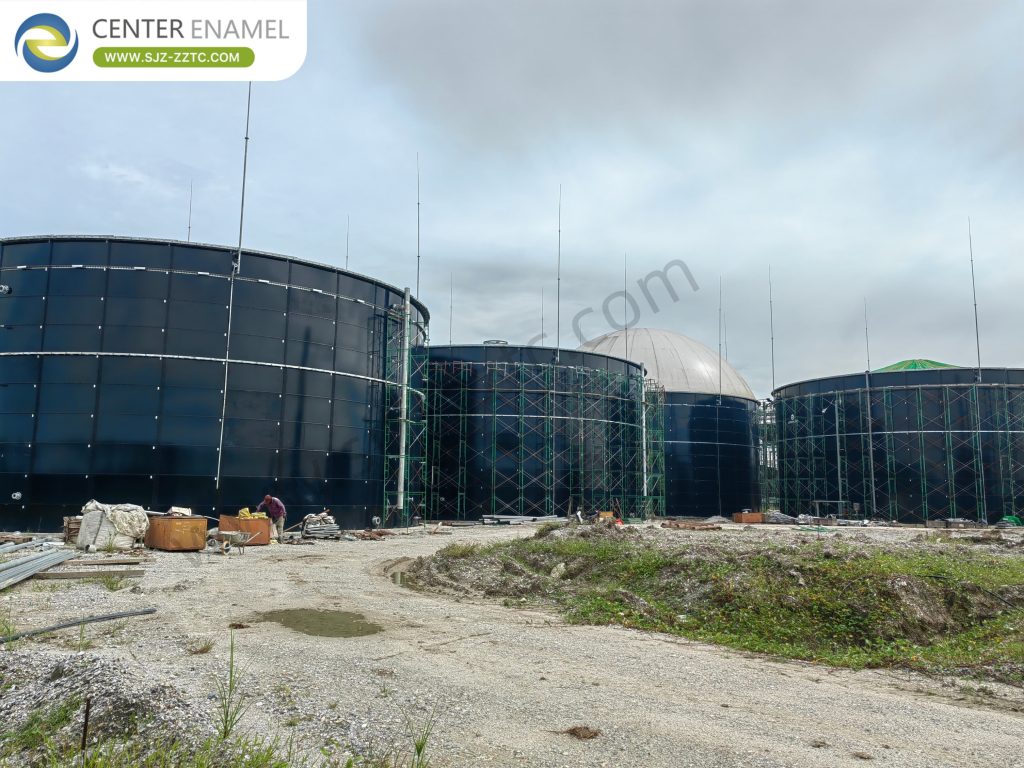
As global regulations evolve to address these environmental hurdles, the necessity for sophisticated infrastructure becomes paramount. Effective Biogas Plant Project Design serves as the vital link between decentralized waste production and sustainable, centralized treatment. By integrating professional design strategies, facilities can overcome structural constraints and ensure long-term viability.
GFS Tanks: Superior Corrosion Resistance Compared to Traditional Concrete
Center Enamel's independently developed double-sided double-layer enameling technology is the industry's leading coating anti-corrosion technology, with corrosion resistance completely surpassing concrete tanks. Concrete tank interiors are riddled with pores, allowing wastewater and acid/alkaline media to easily penetrate and corrode the structural layer. Long-term use leads to irreversible problems such as internal wall spalling, water seepage, and rebar corrosion, which are difficult to repair and cannot be fundamentally resolved.
GFS tanks feature high-temperature enameling on both the interior and exterior surfaces of steel panels, with a dense, non-porous enamel finish that completely blocks corrosive liquids and biogas permeation. The enamel layer has extremely strong chemical stability, resisting acids, alkalis, salts, and microbial corrosion. Concrete tanks will develop extensive corrosion and leakage after 5-8 years of use, while GFS tank anti-corrosion service life can exceed 30 years, with no need for frequent internal lining repairs throughout the service life, significantly reducing long-term anti-corrosion maintenance investment and fundamentally eliminating environmental risks of medium leakage contaminating sites and groundwater. Compared to traditional concrete and FRP tanks, GFS tank coatings have no risk of peeling or blistering, and are adaptable to highly corrosive conditions such as palm oil mill effluent, livestock manure, and chemical high-salinity wastewater, with outstanding long-term comprehensive cost advantages.
Selecting durable materials is the first step toward project success, but the performance of the entire system depends on the efficiency of the core reactor technology. Advanced biological treatment processes are essential for converting raw manure into renewable energy effectively. A well-engineered reactor design ensures optimal microbial activity and pollutant degradation.
UASB Supporting Equipment
Core equipment includes the GFS anaerobic reactor tank, with the internal three-phase separator being the key component for gas-liquid-solid separation and sludge retention. The bottom high-precision distribution system (distribution pipes, distributors, pressure regulators) ensures uniform influent distribution, preventing short-circuiting and sludge accumulation. Supporting equipment includes influent lift pumps, equalization tanks, and flow meters to stabilize influent conditions. The top biogas collection system includes gas collection hoods, gas piping, desulfurization/dehydration equipment, and gas storage. Online temperature, pH, and COD monitoring instruments are integrated. Bottom sludge discharge pipes and pumps periodically remove excess sludge. The complete equipment package is compact, with no rotating wear parts, low equipment loss, and high operational stability. The implementation of the UASB Process is integral to achieving these high standards of efficiency and reliability.
With the core reactor technology defined, it is equally important to standardize the broader treatment train to suit local agricultural conditions. Customized solutions help operators maintain stable performance even when facing significant fluctuations in wastewater quantity. This standardization is the key to balancing pollution control with resource recovery.
Livestock Wastewater Standardized Treatment Solutions
Adapted to agricultural and rural settings, the core uses a low-cost treatment train of "solid-liquid separation + anaerobic digestion + ecological polishing," specifically addressing high-suspended-solids, high-concentration organic wastewater. Pretreatment uses solid-liquid separation equipment and sedimentation tanks to rapidly remove solid impurities like manure and feed residues, significantly reducing biochemical load. The main stage uses USR/CSTR anaerobic processes for efficient organic degradation with simultaneous biogas energy recovery. Subsequent A/O biological treatment precisely removes nitrogen and phosphorus, with final constructed wetlands or stabilization ponds for polishing. Digester tanks use Center Enamel GFS tanks, resistant to manure corrosion and with convenient assembly for rural projects. The entire process has strong shock load resistance, adapts to significant water quality and quantity fluctuations, is simple to operate, and achieves both pollution control and resource recycling.
Delivering these comprehensive solutions requires a robust service infrastructure that supports the client at every stage. A truly globalized service system ensures that installations remain efficient and compliant throughout their entire lifecycle. Providing reliable support after the initial project handover is what guarantees long-term customer satisfaction.
Global Integrated Standardized Service System
Leveraging regional sales centers in China and overseas local agent networks, Center Enamel has established a complete after-sales service loop covering all markets. The system provides four core service pillars: 24/7 rapid response mechanism, on-site domestic/overseas installation services, full-project-cycle after-sales support, and long-term warranty protection-forming a complete service chain from preliminary site survey, mid-term construction management, to long-term inspection and maintenance. The entire system is uniformly adapted to both domestic and international project service standards, coordinating personnel scheduling, material support, and on-site coordination for simultaneous projects across multiple regions-significantly reducing customer multi-party coordination costs and ensuring efficient domestic and overseas project delivery.
To maintain such high standards, independent verification and certification play a crucial role in building trust with international clients. Aligning project components with global benchmarks ensures that every delivery is not only efficient but also universally recognized for quality. These certifications are the foundation of our ability to navigate complex international tendering processes.
Comprehensive International Authoritative Certifications
Center Enamel holds CE, NSF, WRAS, ISO9001, BSCI, ASME, and other global certifications-fully clearing EU, North American, Southeast Asian, and African project tendering barriers-providing critical hard credential advantages for large overseas project bidding.
While GFS technology is ideal for anaerobic fermentation, other scenarios require lighter, more economical solutions for non-pressurized storage needs. Providing a diverse portfolio of tank covers allows us to offer the most cost-effective and suitable solution for every customer's specific application. Choosing the right cover design is just as important as the tank itself.
FRP Roof Cover Solution
FRP Roof is a general-purpose economical roof for atmospheric pressure storage tanks without air-tightness requirements, suitable for drinking water storage, agricultural irrigation water, firewater reserve, and general production wastewater temporary storage. It is available in two styles: flat and dome, allowing flexible selection based on tank specifications and site aesthetic requirements. The roof is integrally molded from resin and fiberglass, lightweight, with natural water resistance and mild acid/alkali corrosion resistance. It will not rust or rot in long-term humid environments, eliminating the frequent anti-corrosion maintenance required for metal roofs. The dome style features excellent drainage performance due to its curved structure, resisting water accumulation, dust buildup, snow load, and strong winds. The flat style facilitates the installation of maintenance walkways, level gauges, and vents on top, making inspection and operation convenient. The product is fully insulated with no risk of galvanic corrosion, will not contaminate drinking water quality, and meets environmental standards for domestic water storage.
The modular design with low individual component weight allows for simple on-site hoisting and assembly, offering high construction efficiency and affordable procurement and installation costs. It is only suitable for atmospheric pressure water storage tanks without biogas collection or pressurization requirements, and is not recommended for anaerobic fermentation gas-producing conditions. It is widely used in rural agricultural water storage tanks, industrial park firewater tanks, waterworks buffer tanks, and small to medium-sized domestic wastewater temporary storage facilities, making it a cost-effective general-purpose roof choice for conventional water storage applications.
FAQ
1.Why is professional Biogas Plant Project Design critical for success?
Professional Biogas Plant Project Design ensures that waste management systems are optimized for maximum energy output and operational efficiency. By carefully planning site layout, material selection, and technology integration, designers can minimize maintenance costs, ensure regulatory compliance, and guarantee that facilities function reliably under diverse environmental and load conditions.
2.How does the UASB Process enhance organic waste treatment?
The UASB Process utilizes a high-concentration granular sludge bed to efficiently degrade organic matter within a compact, automated reactor. By keeping microorganisms suspended without mechanical mixing, it achieves superior pollutant removal and gas production, making it an ideal choice for high-strength industrial and agricultural wastewater treatment projects.
3.What makes GFS tanks the ideal choice for biogas projects?
Center Enamel's GFS tanks feature a dual-sided enamel coating that offers superior resistance to chemical and microbial corrosion. With a service life exceeding 30 years and requiring minimal maintenance, they provide a durable, cost-effective containment solution that fundamentally eliminates leakage risks compared to traditional concrete or standard metal tanks.