
Livestock Wastewater Treatment: Processes And Tankage For Farm Effluent
Livestock wastewater treatment starts with solid-liquid separation, then combines anaerobic digestion for energy and organic removal with aerobic polishing for nitrogen and discharge compliance. The tankage must resist the corrosive, high-ammonia manure environment, which is why bolted Glass-Fused-to-Steel (GFS) reactors are widely used on farms.
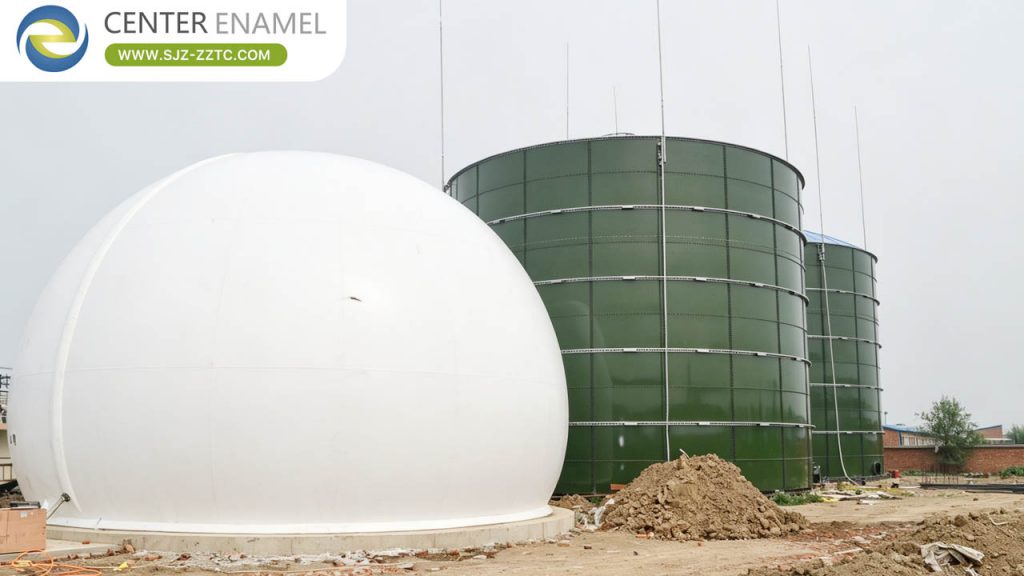
The Treatment Chain On A Farm
Manure slurry first passes a separator to split coarse solids from the liquid stream. The liquid then enters an anaerobic reactor (CSTR for uniform slurry, UASB for lower-solid warm effluent) where microbes convert volatile solids into biogas at 55-65% methane. Aerobic polishing - often an AOAO or SBR train - strips the remaining nitrogen and phosphorus before discharge.
| Step | What Happens | Typical Tank |
| Separation | Split solids from liquid | Screen and screw press |
| Anaerobic | Biogas and COD removal | GFS CSTR or UASB |
| Aerobic polish | N and P removal | GFS AOAO or SBR |
| Storage | Hold digestate | GFS storage tank |
Yield And The Numbers That Matter
Mature cattle or pig manure typically returns 0.20-0.30 m3 of biogas per kg of volatile solids, with a balanced carbon-to-nitrogen ratio near 20-30:1 keeping the biology stable. Loading rate and retention time (mesophilic CSTR at 35-38 C with a 20-40 day retention) set the reactor volume, not the other way around.
A Boundary Condition
Not every farm stream suits the same reactor. A UASB needs low solids and warm, soluble feed; high suspended solids or cold influent will wash the granular bed out. Co-digesting manure with food or agricultural residue can lift yield, but only when that extra feed is reliably available.
Project Case Study: Bangladesh Poultry Farm Waste Treatment Project
Project / Application: Poultry manure waste treatment, Bangladesh. Industry: Livestock (poultry). Tank Type: CSTR plus UASB anaerobic reactors. Key Requirements: Reliable biogas and compliant effluent from high-strength manure.
| Field | Value | Source / Evidence |
| Daily Treatment Capacity | 47 t/d (poultry manure) | Company project reference |
| Treatment Process | CSTR + UASB anaerobic reactors | Company project reference |
| Biogas Production | approx 4,900 m3/day | Company project reference |
| Power Generation | approx 9,800 kWh/day (2.0 kWh/m3 biogas) | Company project reference |
| Effluent Standard | Complies with local regulations | Company project reference |
| Installation Year | 2026 | Company project reference |
| Pollutant | Influent | Effluent Standard |
| COD | 50,000 mg/L | less than or equal to 200 mg/L |
| BOD | 25,000 mg/L | less than or equal to 100 mg/L |
| SS | 50,000 mg/L | less than or equal to 100 mg/L |
About The Supplier
Shijiazhuang Zhengzhong Technology Co., Ltd (Center Enamel) manufactures Glass-Fused-to-Steel tanks rated for livestock and agricultural wastewater, with enamel firing at 820-930 C and certifications including ISO 9001, NSF/ANSI 61, and CE-EN 1090. The bolted CSTR and UASB packages support fast on-farm deployment.
Comparison: Reactor Choices For Farms
| Reactor | Best Feed | Note |
| CSTR | Uniform manure slurry | Heated and mixed |
| UASB | Low-solid warm effluent | High loading, low energy |
| USR | High-solid coarse feed | Holds solids without fine mixing |
Livestock wastewater treatment works when separation, anaerobic digestion, and aerobic polishing are engineered as one chain. Choose the reactor from the solids and temperature, then let corrosion-resistant tankage make the system durable.
Frequently Asked Questions
Q1: How is livestock wastewater treated? A1: Separate solids, digest anaerobically for biogas, then polish aerobically for nitrogen and phosphorus.
Q2: Which process removes the organics? A2: Anaerobic digestion removes most COD and makes biogas; aerobic polishing finishes it.
Q3: What tankage resists manure corrosion? A3: A Glass-Fused-to-Steel tank with factory-fired enamel lining.
Q4: Can livestock waste make biogas? A4: Yes, mature manure yields 0.20-0.30 m3 biogas per kg volatile solids at 55-65% methane.
Q5: What temperature does digestion need? A5: Mesophilic CSTR typically runs at 35-38 C.
Q6: Why separate solids first? A6: It protects the reactor and lifts biogas quality by sending the liquid to digestion.
Q7: What is the C:N ratio for? A7: A 20-30:1 balance keeps microbes fed without ammonia inhibition.
Q8: How fast can tankage be built? A8: Bolted GFS panels erect in weeks, faster than concrete.
Share your herd size and manure volume with an engineer, or request a livestock wastewater treatment and tankage scope.