
Comprehensive Guide to Livestock Wastewater Treatment Project Design and GFS Tanks
The global biogas industry competitive landscape shows divergence. Leading companies dominate major project market shares through the "EPC + Operation" integrated model, while small and medium-sized enterprises focus on county-level distributed projects and specialized equipment segments. China's biogas equipment exports continue to expand, with generator sets primarily flowing to emerging markets. Business model innovation is accelerating, with carbon asset development becoming a standard feature of large projects, converting methane emission reductions into tradable carbon credits.
Some countries have piloted digestate fertilizer carbon credit trading, encouraging the integration of digestate application to farmland with carbon accounting. The "biogas operation outsourcing" service model is emerging, improving operational efficiency of county-level projects through professional management. From a technology and equipment perspective, anaerobic digestion is the core process of biogas engineering for every specialized Livestock Wastewater Treatment Project.
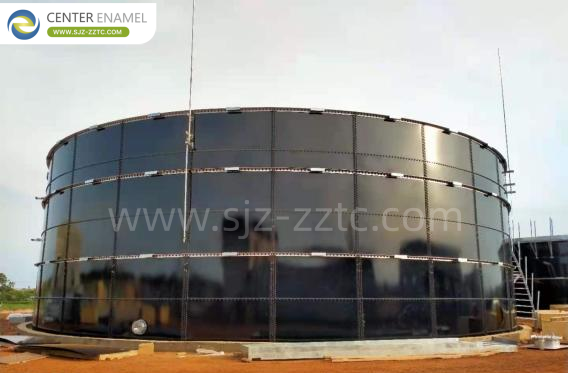
Glass-fused-to-steel (GFS) tanks, with their excellent sealing, corrosion resistance, and construction convenience, have become the mainstream choice for large anaerobic digestion tanks. Their modular design can be combined with membrane gas holders to form an integrated "fermentation + gas storage" solution, with penetration rates continuing to rise in new projects in biogas industry clusters.
CSTR Core Advantages in Livestock Wastewater Treatment Project
Excellent adaptability, with outstanding treatment results for high-solids, high-viscosity, high-suspended-solids organic wastewater, thoroughly solving the shortcomings of traditional anaerobic processes such as stratification, crusting, and low sludge utilization within any advanced Livestock Wastewater Treatment Project. The full-mix agitation mode ensures thorough contact between microorganisms and pollutants, with homogeneous and stable reaction conditions and excellent resistance to water quality and hydraulic shock loads—stable compliance even with significant influent fluctuations. The simple process structure, without complex media or three-phase separators, results in low equipment cost, short construction period, and low maintenance difficulty, with no need for frequent cleaning of clogged components and low O&M costs. The process simultaneously achieves wastewater treatment and biogas energy recovery. Sludge acclimation is fast, quickly adapting to various specialty organic wastewaters, with high process error tolerance and strong universal applicability.
Key Water Quality Characteristics in Livestock Wastewater Treatment Project
Stable water quality, simple composition, with high ammonia nitrogen, high total phosphorus, high salinity, and low COD as core characteristics—prominent eutrophication concerns managed carefully in every professional Livestock Wastewater Treatment Project. Through thorough anaerobic digestion, most macromolecular organics have been converted to methane and carbon dioxide, resulting in significantly reduced and stable COD with no easily decomposable pollutants. Nitrogen, phosphorus, and potassium nutrients are concentrated during fermentation, with ammonia nitrogen and total phosphorus far exceeding conventional discharge standards—these are the key control parameters. Moderate to high salinity with strong acid/base buffering, slightly alkaline. Clear, low-turbidity liquor with minimal odor, very low suspended solids. Moderate biodegradability, no major fluctuations, without the high pollution load characteristics of conventional organic wastewater.
Malaysia Palm Oil Biogas Project Case Study
The project uses Center Enamel GFS tanks as the core anaerobic digestion facility with 5 tanks, each with effective volume of 5,400 m³, total effective volume 27,000 m³. Influent COD ≥ 60,000 mg/L, BOD ≤ 25,000 mg/L. After anaerobic digestion, effluent COD drops to below 12,000 mg/L, BOD ≤ 5,000 mg/L—overall organic removal efficiency approximately 80%. Single tank daily biogas production 4,400 m³, total project daily biogas 22,000 m³—stable biogas yield of 0.45 m³ per kg COD removed—efficient biogas energy recovery while solving agricultural and industrial wastewater pollution, serving as a scalable reference for any regional Livestock Wastewater Treatment Project.
Center Enamel's Core R&D Capabilities and Global Certifications
Technology R&D is Center Enamel's core competitive advantage, providing robust technical backing for each deployed Livestock Wastewater Treatment Project. The company independently masters over 200 differentiated anti-corrosion enamel formulations, with full self-control over the enamel raw material chain, holding nearly 100 invention and utility patents. Products have passed NSF, WRAS, ASME, BSCI, CE, ISO9001, and other global certifications.
Company certifications and honors include: National High-Tech Enterprise, National Specialized and Sophisticated "Little Giant," Hebei Manufacturing Single Champion, Provincial Smart Factory, Provincial Green Factory; complete environmental engineering and special equipment manufacturing compliance qualifications. The company maintains long-term collaborative research with multiple universities through joint materials laboratories—continuously iterating anti-corrosion coatings and large bolted tank structural design technologies. The proprietary material technology barrier creates an irreplaceable competitive advantage, with product performance comparable to high-end imported European/American storage equipment.
Center Enamel's Extensive Global Benchmark Project Cases
Center Enamel's project portfolio covers over 100 countries across Southeast Asia, Africa, Europe, and the Americas—30,000+ mature projects—accumulating complete industry solutions across palm oil, livestock, municipal, brewing, and food waste biogas—rapidly matching customized solutions for different regional climates, water quality, and regulations.
Gas Holder and Biogas Storage Systems
Center Enamel's Gas Holder (independent double-membrane biogas holder) is a ground-mounted biogas storage device installed independently from the fermentation tank. It adopts a double-layer high-strength membrane structure, with the inner membrane forming the gas storage cavity and the outer membrane forming the protective shell. Continuous aeration between the inner and outer membranes maintains constant positive pressure, ensuring stable sealing of the gas storage cavity.
The Gas Holder is installed separately from the fermentation tank and connected via biogas transmission pipelines. Biogas produced from the fermentation tank is sent to the holder for storage after desulfurization and dehydration, then pressure-regulated and stably delivered to end-use equipment, enabling separated management of biogas production, storage, and utilization. The gasholder volume can be customized from tens to thousands of cubic meters to meet storage and peak-shaving requirements for different production rates and consumption cycles.
The Gas Holder is equipped with a comprehensive safety control system, including biogas leak detection, inner membrane overpressure protection, emergency flare stack, and lightning protection grounding, ensuring full operational safety. The membrane material uses high-strength PVDF outer membrane and biogas-corrosion-resistant inner membrane, with a service life of over 15 years. Maintenance is simple, requiring only periodic checks of membrane integrity and aeration system operation, with significantly lower lifecycle maintenance costs than steel gasholders.