
Livestock Wastewater Treatment Solution: Specifications And Scope
A livestock wastewater treatment solution is specified by the reactor volume derived from retention time and loading rate, the tankage standard that resists manure corrosion, and the single performance guarantee that ties them together. When procuring one, demand that the digester, the mixing and heating, and the aerobic polishing are defined in one scope so the effluent or biogas output is enforceable rather than arguable.
What The Scope Should Include
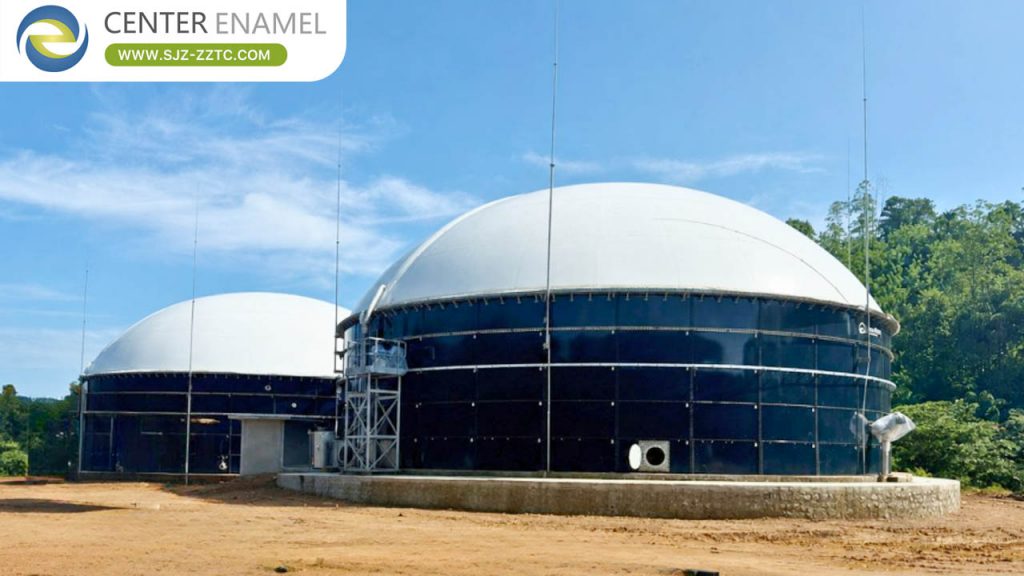
Integration means the digester tank, the biological train, the heating and controls, and the guarantee are specified together. The supplier commits that the Glass-Fused-to-Steel reactor volume, the organic loading rate, and the gas or discharge target are mutually consistent before fabrication begins.
| Scope Item | What To Specify | Acceptance Basis |
| Digester volume | From retention time and OLR | m3 and HRT stated |
| Tank standard | Enamel firing and bolts | 820-930 C, 8.8-grade bolts |
| Heating and mixing | Power and duty | Maintains 35-38 C |
| Guarantee | Single performance basis | One accountable party |
Specifying The Digester Volume
Volume is not a catalogue number; it follows from the daily manure load, the total solids, and the chosen retention time (mesophilic CSTR at 35-38 C with a 20-40 day retention). A balanced carbon-to-nitrogen ratio near 20-30:1 keeps the biology stable. Writing the guarantee around a loading rate rather than a vague "treats the farm" is what makes the contract enforceable.
Tankage Specs That Matter
The livestock environment is corrosive and high in ammonia, so the lining is the real specification. A bolted GFS tank offers a factory-fired enamel surface, 1500 V holiday testing, and 8.8-grade bolting; the shell arrives coated, so on-site recoating of a concrete digester is avoided. Cold-climate sites should additionally demand an insulated CSTR package designed for low ambient temperature.
Project Case Study: Inner Mongolia Wushenqi Cattle Farm
Project / Application: Cattle farm biogas production, Ordos, Inner Mongolia, China. Industry: Livestock. Tank Type: CSTR with insulation system. Key Requirements: Stable biogas in extreme cold climate.
| Field | Value | Source / Evidence |
| Process | CSTR with insulation system | Company project reference |
| Application | Cattle farm biogas production | Company project reference |
| Feedstock | Cattle manure | Company project reference |
| Installation Year | 2013 | Company project reference |
| Tank Dimensions | Not Provided In The Available Source | Process and application documented |
About The Supplier
Shijiazhuang Zhengzhong Technology Co., Ltd (Center Enamel) manufactures Glass-Fused-to-Steel tanks rated for livestock wastewater and biogas, with enamel firing at 820-930 C and certifications including ISO 9001, NSF/ANSI 61, and CE-EN 1090. Insulated CSTR packages support cold-climate farm projects.
Comparison: Supply Models
| Model | Best For | Main Risk |
| Bundled tank plus process | Buyers wanting one guarantee | Higher coordination upfront |
| Tank only | Buyers with own process IP | Interface gap at boundary |
| Process only | Buyers with existing tanks | Tank may not suit new load |
A livestock wastewater treatment solution is bought on the guarantee, not the brochure. Specify the volume from the load, the lining from the environment, and the performance from a single responsible party, and the system will meet the number on the contract.
Frequently Asked Questions
Q1: What should a livestock wastewater solution include? A1: The digester, heating and mixing, aerobic polishing, and controls under one scope.
Q2: How is the digester volume specified? A2: From the daily load, total solids, and retention time at 35-38 C.
Q3: What tankage specs matter most? A3: Factory-fired enamel lining, 1500 V testing, and 8.8-grade bolting for manure corrosion.
Q4: How is performance guaranteed? A4: Through a single loading-rate and retention-time basis owned by one party.
Q5: What temperature does AD need? A5: Mesophilic digestion typically runs at 35-38 C, with insulation in cold regions.
Q6: What is the methane content? A6: Mature manure typically yields 55-65% methane in the biogas.
Q7: How fast can tankage be built? A7: Bolted GFS panels erect in weeks, faster than concrete.
Q8: Can the system expand? A8: Yes, modular GFS panels add digester volume as the herd grows.
Discuss your herd size and manure volume with an engineer, or request a livestock wastewater solution specification and scope.