
Looking for a Biogas Solution Provider with GFS Tanks for Livestock Wastewater Treatment?
This article examines global livestock manure policies, UASB process advantages, pollutant characteristics, and practical implementation through a landmark Indonesian biogas project. It highlights how a professional Biogas Solution Provider combines robust GFS Tanks with proven anaerobic technologies to deliver effective Livestock Wastewater Treatment systems. With over 200 proprietary enamel formulations, 100+ patents, and global certifications including NSF, ASME, and CE, Center Enamel demonstrates material and technical leadership. The discussion also covers advanced roofing solutions-aluminum geodesic dome and FRP-that complement tank infrastructure. From policy compliance to field-proven case studies, this content showcases comprehensive capabilities for sustainable manure management worldwide.
Why Global Policies Are Driving Demand for Professional Biogas Solutions
The global livestock manure treatment policy system, with the US and EU as typical representatives, is shifting from end-of-pipe treatment to full-process nutrient management. The US establishes a manure management framework covering the entire livestock production process through Comprehensive Nutrient Management Plans. The EU, through the Nitrates Directive, strictly limits manure application amounts, with Germany and the Netherlands using tax instruments to mandate nitrogen and phosphorus recovery rates, and Denmark demonstrating distinctive features in livestock regulation and ecological compensation. The Netherlands uses a management mechanism linking manure treatment with phosphate quotas. China has issued a series of environmental regulations, with the current legal system providing comprehensive regulation of pollution from large-scale livestock operations.
Navigating this complex regulatory landscape requires a Biogas Solution Provider with both technical expertise and global compliance knowledge. By deploying GFS Tanks engineered to meet regional standards, Center Enamel ensures that every Livestock Wastewater Treatment system aligns with local policies while delivering optimal biogas recovery.
UASB Process – Core Advantages for Livestock Wastewater Treatment
No mechanical mixing equipment is required, with sludge suspension achieved through hydraulic action, resulting in very low overall energy consumption. High-concentration anaerobic granular sludge can be cultivated, with high sludge concentration, strong activity, excellent settleability, low sludge washout, and low sludge yield, significantly reducing sludge disposal costs. The integrated design combines reaction, sedimentation, and separation simultaneously, with small footprint and moderate capital investment. Simple structure with low failure rates and convenient maintenance. High volumetric loading rate with excellent organic pollutant degradation efficiency and good shock load resistance. Stable biogas production with high resource recovery value. The process is mature and widely adopted, with well-established construction, commissioning, and O&M systems, suitable for large-scale industrial wastewater treatment.
These advantages make the UASB process a cornerstone technology for any serious Biogas Solution Provider specializing in Livestock Wastewater Treatment. When paired with corrosion-resistant GFS Tanks for feed storage and digestate holding, the system delivers consistent performance with minimal energy input-a compelling value proposition for farm operators.
Understanding Livestock Wastewater – Environmental Toxicity Profile
No synthetic chemical toxicity, no hazardous substances-very low risk of acute or chronic toxicity. Pollution impacts are primarily biological and nutrient pollution. All pollutants are natural organics from livestock metabolites and feed residues, with no inhibition of microbial activity and no toxicity to soil, water, or aquatic organisms. However, they are rich in nitrogen, phosphorus, and suspended impurities, carrying E. coli, parasite eggs, and pathogens. Direct discharge without treatment rapidly causes eutrophication, black-odor conditions, mosquito breeding, and disease transmission. Long-term discharge causes soil compaction and elevated nutrient levels in groundwater-persistent ecological pollution, but no hazardous substance accumulation or carcinogenic/mutagenic risks.
This unique toxicity profile-biological and nutrient-based rather than chemical-makes Livestock Wastewater Treatment particularly well-suited for biological solutions like anaerobic digestion. A professional Biogas Solution Provider leverages this characteristic by designing GFS Tanks-based systems that convert pollutants into renewable energy and valuable fertilizer, turning an environmental liability into a resource asset.
Indonesia Palm Oil Biogas Project Case Study
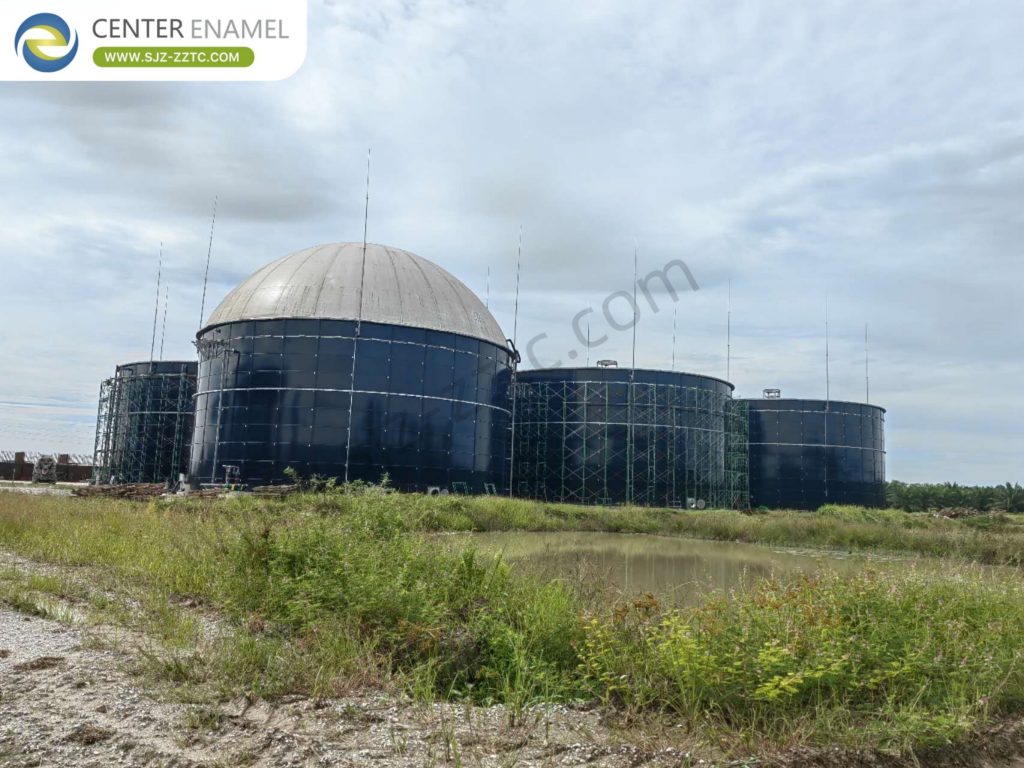
Specifically designed for high-concentration palm oil wastewater treatment with 3 GFS fermentation tanks, each 19.86 m diameter × 8.4 m height. Installation began November 2009 with only 7 construction personnel, completing all tank assembly in 40 days-highly efficient and time-saving. Tanks are fitted with dual-membrane gas storage covers for POME anaerobic digestion-degrading organics and recovering biogas energy while eliminating palm industry pollution. This is an early benchmark POME biogas treatment project in Southeast Asia.
This Indonesian case exemplifies how a capable Biogas Solution Provider executes complex Livestock Wastewater Treatment (and POME) projects in challenging tropical environments. The rapid deployment of GFS Tanks demonstrates the modular advantage that Center Enamel brings to every project-proving that high-quality treatment infrastructure can be delivered quickly, cost-effectively, and with lasting durability.
Center Enamel's Core R&D and Global Certifications – Your Quality Assurance
Technology R&D is Center Enamel's core competitive advantage. The company independently masters over 200 differentiated anti-corrosion enamel formulations, with full self-control over the enamel raw material chain, holding nearly 100 invention and utility patents. Products have passed NSF, WRAS, ASME, BSCI, CE, ISO9001, and other global certifications.
Company certifications and honors include: National High-Tech Enterprise, National Specialized and Sophisticated "Little Giant," Hebei Manufacturing Single Champion, Provincial Smart Factory, Provincial Green Factory; complete environmental engineering and special equipment manufacturing compliance qualifications. The company maintains long-term collaborative research with multiple universities through joint materials laboratories-continuously iterating anti-corrosion coatings and large bolted tank structural design technologies. The proprietary material technology barrier creates an irreplaceable competitive advantage, with product performance comparable to high-end imported European/American storage equipment.
For clients evaluating a Biogas Solution Provider, these R&D capabilities and certifications offer tangible assurance. They confirm that GFS Tanks used in Livestock Wastewater Treatment projects meet the most stringent international standards-from material formulation to structural integrity-ensuring long-term performance and regulatory acceptance across all major global markets.
Global Benchmark Projects – 30,000+ Cases Across 100+ Countries
Center Enamel's project portfolio covers over 100 countries across Southeast Asia, Africa, Europe, and the Americas-30,000+ mature projects-accumulating complete industry solutions across palm oil, livestock, municipal, brewing, and food waste biogas-rapidly matching customized solutions for different regional climates, water quality, and regulations.
This extensive track record distinguishes Center Enamel as a trusted Biogas Solution Provider with proven adaptability. Whether the Livestock Wastewater Treatment project is in a Nordic cold climate or a tropical coastal region, the company's GFS Tanks and process designs have been validated across diverse conditions-giving clients confidence that their investment is backed by real-world performance data.
FRP Roof – Economical Protection for Atmospheric Tanks
FRP Roof is a general-purpose economical roof for atmospheric pressure storage tanks without air-tightness requirements, suitable for drinking water storage, agricultural irrigation water, firewater reserve, and general production wastewater temporary storage. It is available in two styles: flat and dome, allowing flexible selection based on tank specifications and site aesthetic requirements. The roof is integrally molded from resin and fiberglass, lightweight, with natural water resistance and mild acid/alkali corrosion resistance.
It will not rust or rot in long-term humid environments, eliminating the frequent anti-corrosion maintenance required for metal roofs. The dome style features excellent drainage performance due to its curved structure, resisting water accumulation, dust buildup, snow load, and strong winds. The flat style facilitates the installation of maintenance walkways, level gauges, and vents on top, making inspection and operation convenient. The product is fully insulated with no risk of galvanic corrosion, will not contaminate drinking water quality, and meets environmental standards for domestic water storage.
The modular design with low individual component weight allows for simple on-site hoisting and assembly, offering high construction efficiency and affordable procurement and installation costs. It is only suitable for atmospheric pressure water storage tanks without biogas collection or pressurization requirements, and is not recommended for anaerobic fermentation gas-producing conditions. It is widely used in rural agricultural water storage tanks, industrial park firewater tanks, waterworks buffer tanks, and small to medium-sized domestic wastewater temporary storage facilities, making it a cost-effective general-purpose roof choice for conventional water storage applications.
While GFS Tanks used for anaerobic digestion require gas-tight covers like aluminum geodesic domes, many Livestock Wastewater Treatment facilities also include atmospheric storage tanks for influent, effluent, or irrigation water. The FRP Roof offers an economical, maintenance-free solution for these auxiliary tanks-demonstrating the comprehensive offering of a full-service Biogas Solution Provider that addresses every component of the treatment system.
FAQ
Q1: What makes a Biogas Solution Provider different from a general EPC contractor?
A specialized Biogas Solution Provider offers deep expertise in anaerobic digestion, proprietary GFS Tanks manufacturing, and process-specific knowledge for Livestock Wastewater Treatment. They provide integrated design, equipment supply, and long-term support-not just construction-ensuring optimal biogas yield and regulatory compliance throughout the project lifecycle.
Q2: Why are GFS Tanks the preferred choice for livestock wastewater treatment?
GFS Tanks are factory-engineered with over 200 anti-corrosion enamel formulations, delivering 30+ years of service life in aggressive environments (high ammonia, hydrogen sulfide). Their bolted assembly enables installation in one-third the time of concrete, supports future expansion, and allows relocation-critical for evolving farm operations.
Q3: How does the UASB process benefit livestock wastewater treatment economics?
The UASB process requires no mechanical mixing, minimizing energy costs. It produces stable biogas for on-site power or heating, while low sludge yield reduces disposal expenses. Combined with GFS Tanks for storage, it offers the highest cost-effectiveness among biological treatment options for Livestock Wastewater Treatment.