
Malaysia Farm Biogas Project: GFS Tanks + Double Membrane Roof for Manure Treatment
Malaysia is a rapidly developing nation with a growing demand for electricity, driven by industrial expansion and agricultural modernization. However, the country remains heavily dependent on fossil fuels, particularly natural gas and coal, for power generation. While renewable energy targets have been outlined under the National Energy Transition Roadmap (NETR), many rural areas-especially in states like Johor, Perak, and Sabah-still face inconsistent grid supply. Remote livestock farms often resort to diesel generators, which come with high fuel costs and logistical challenges. At the same time, Malaysia produces substantial quantities of animal manure from its poultry, swine, and cattle sectors. Rather than allowing this waste to generate methane and odor, farmers can implement a Biogas Project to convert manure into a dependable, on-farm energy source.
Advantages of Converting Animal Manure to Biogas on Malaysian Farms
Malaysia ranks among Southeast Asia’s largest poultry producers, with significant pig farming operations in states like Perak and Penang. Without proper treatment, manure accumulation leads to water pollution, greenhouse gas emissions, and complaints from nearby communities. A well-designed Biogas Project turns these liabilities into assets. Key benefits include:
Reliable on-site power: Biogas can fuel generators to supply electricity for lighting, ventilation, water pumps, and feed conveyors.
Reduction in diesel use: Farms can displace imported diesel with locally produced renewable fuel.
Lower long-term operating costs: After initial installation, the feedstock (manure) is continuously available at no cost.
Environmental compliance: Malaysia’s Department of Environment enforces stricter effluent standards; biogas helps farms meet discharge limits.
Valuable byproduct: The digestate serves as a nutrient-rich organic fertilizer, reducing the need for synthetic inputs.
Odor mitigation: Closed anaerobic systems significantly reduce foul smells compared to open lagoons.
For Malaysian palm oil-integrated cattle farms or independent piggeries, a Biogas Project offers a clear path to energy savings and regulatory compliance.
Center Enamel: Professional Biogas Project Design and EPC Services
With over 36 years of experience, Center Enamel has established itself as Asia’s largest manufacturer of Glass-Fused-to-Steel (GFS) tanks and a full-service provider of Biogas Project systems. The company began with enamel frit production and has since expanded into complete EPC (Engineering, Procurement, and Construction) delivery, including process packages and equipment supply. Center Enamel holds international certifications such as CE/EN1090, ISO9001, NSF61, WARS, and EN28765, and follows AWWA D103, OSHA, and EuroCode design standards. Their service offering encompasses feasibility studies, process engineering, equipment fabrication, installation supervision, and comprehensive operator training. For Malaysia’s varied geography-from peninsula states to East Malaysia’s Sabah and Sarawak-Center Enamel delivers robust, climate-appropriate biogas solutions.
Pretreatment Stage + CSTR Process: Core of Anaerobic Digestion
Every successful Biogas Project begins with proper feedstock conditioning. Center Enamel’s pretreatment stage is specifically configured for Malaysian farm waste characteristics:
Screening: Removes large inorganic materials such as plastic packaging, stones, feathers, and rope that could clog pumps or damage equipment.
Crushing: Reduces organic particle size, increasing the surface area available for anaerobic bacteria to attach and digest.
Sand settling: Extracts heavy grit and soil particles that would otherwise settle inside the digester and reduce active volume.
Homogenization tank: Collects and blends incoming waste to equalize flow rates and organic loading, providing a consistent feed to the main reactor.
After pretreatment, the core technology is the CSTR Process. CSTR stands for Continuous Stirred-Tank Reactor, an anaerobic digestion method where fermenting material and microbial communities remain in a constantly mixed, uniform state inside a sealed vessel. A mechanical stirring system operates either continuously or at programmed intervals while the temperature is maintained at a stable level (typically 35–37°C for mesophilic conditions). This continuous mixing achieves several critical outcomes: it keeps solid particles suspended, prevents the formation of a floating scum layer, and ensures optimal contact between microorganisms and fresh organic matter. The result is consistent Biogas Project performance with high destruction of volatile solids-even when processing challenging feedstocks such as chicken manure with bedding material or high-solids pig slurry.
Biogas rises naturally to the top of the reactor and is collected through the roof system. The remaining digestate exits the tank for solid-liquid separation and subsequent agricultural application.
GFS Tanks and Double Membrane Roof: Two Major Products for Biogas Projects
Center Enamel supplies two primary products for Biogas Project infrastructure: GFS Tanks and two roof configurations-Glass-Fused-to-Steel (GFS) roof and double membrane roof.
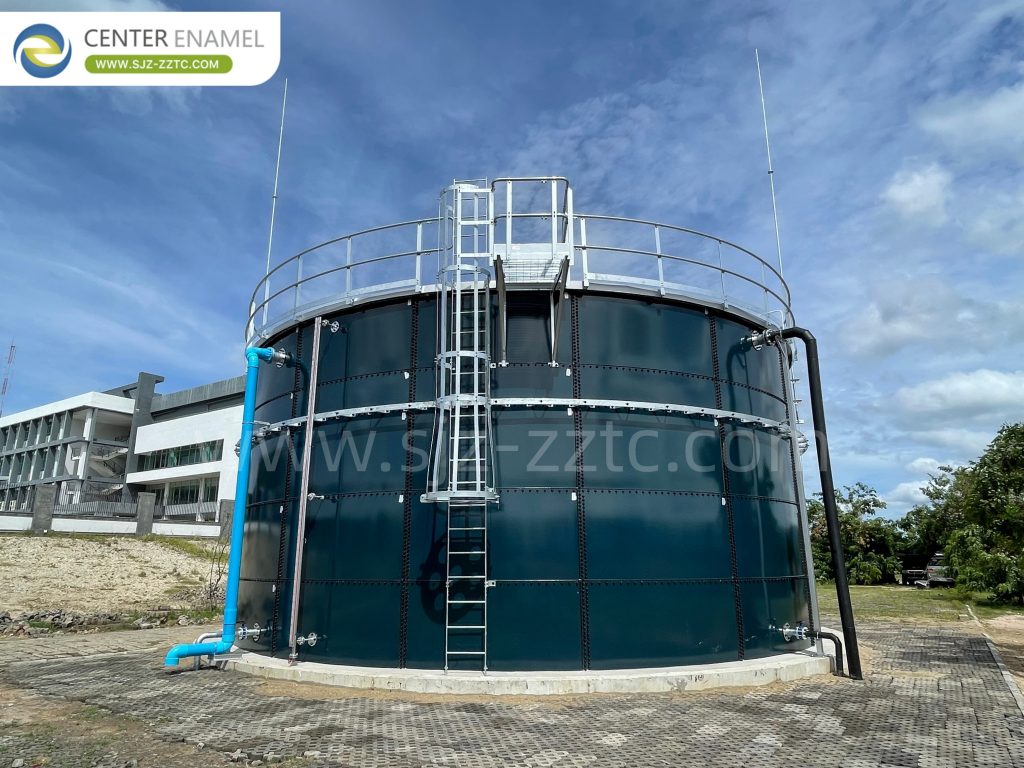
GFS Tanks (Glass-Fused-to-Steel) are widely adopted for anaerobic digesters and biogas storage across Southeast Asia. The glass coating is fused to steel at extremely high temperatures, producing a hard, smooth, and chemically inert surface. This coating resists the corrosive environment inside digesters-including hydrogen sulfide, volatile fatty acids, and fluctuating pH levels. With a manufacturing capacity of 250,000 sheets annually, Center Enamel produces bolted GFS tanks that are shipped in standardized containers and assembled on site, a significant advantage for Malaysian farms where local fabrication capacity may be limited.
Roof selection depends on local weather patterns, site constraints, and project objectives:
GFS roof is recommended for locations exposed to heavy monsoon rains, frequent thunderstorms, or coastal areas with high wind speeds. It is also suitable when a separate ground-mounted gas holder is preferred for maintenance or operational reasons. This roof type works well for tank diameters below 23 meters.
Double membrane roof is the standard choice for typical Malaysian conditions. Its key advantages include reduced material costs and a smaller land footprint-the roof integrates gas storage directly above the digester, eliminating the need for a separate ground-mounted gas holder. This saves valuable land and reduces foundation construction expenses, which is particularly beneficial for farms with space limitations.
Both roof designs are fully compatible with the CSTR Process, maintaining an airtight anaerobic seal while enabling efficient biogas collection and temporary storage.
Supporting Equipment for a Complete Biogas System
A fully operational Biogas Project requires more than just a digester. Center Enamel supplies a complete range of auxiliary equipment:
Gas Holder: Provides buffering capacity between biogas production and generator or boiler demand.
Black Membrane: Used for lined treatment ponds, emergency overflow containment, or secondary storage of effluent.
Solid-liquid Separator: Divides digestate into a solid fraction (suitable for animal bedding, composting, or sale as soil conditioner) and a liquid fertilizer fraction.
Torch System: Safely combusts surplus biogas when power generation or thermal use is not required, preventing uncontrolled release of methane.
Lifting Pump: Transfers raw manure, slurry, or digestate between different treatment stages as needed.
Dehydration and Desulfurization Tank: Removes moisture and corrosive hydrogen sulfide (H₂S) from raw biogas, protecting engines, boilers, and piping from damage.
Screw Sludge Dewatering Machine: Reduces the volume of sludge generated from pretreatment or post-digestion handling, lowering disposal costs and simplifying management.
This comprehensive equipment package ensures that Biogas Project systems run reliably, safely, and with minimal day-to-day labor intervention.
Efficient Installation Capabilities of Center Enamel
Deployment speed is a critical consideration for Malaysian projects, especially given the seasonal monsoon patterns that can delay construction. Center Enamel’s bolted GFS Tanks are prefabricated inside a 150,000 m² production facility and delivered in standardized sea-freight containers. On-site assembly requires no hot work-only bolting, sealing, and basic mechanical fastening-which dramatically shortens installation time compared to conventional methods. A complete digestion system can typically be erected in weeks rather than months, allowing farms to begin realizing Biogas Project benefits much sooner.
All components are designed for straightforward assembly by local crews under remote or on-site guidance from Center Enamel’s experienced technical supervisors. The company also provides commissioning support and structured, hands-on training for farm operators and maintenance personnel. For projects in Johor’s agricultural heartland, Perak’s pig farming regions, or Sabah’s remote palm oil estates, this efficient installation approach minimizes weather-related delays and keeps capital expenditure predictable and under control.
Center Enamel: A One-Stop Biogas Project Solution Provider for Malaysia
Center Enamel is not merely a tank supplier-it is a one-stop solution provider for complete Biogas Project systems. From initial feasibility assessments and process engineering to equipment manufacturing, on-site erection, and final commissioning, Center Enamel delivers turnkey solutions tailored to Malaysia’s agricultural and industrial environment. Their business scope includes EPC contracts, process packages, and individual equipment supply, all supported by international certifications and decades of practical field experience.
Consider a Malaysian pig farm in Perak with 8,000 head. Center Enamel can engineer a CSTR Process system using GFS Tanks fitted with a double membrane roof, plus all auxiliary equipment (pumps, desulfurization, torch, solid-liquid separator). The generated biogas can fuel a generator set that supplies electricity for water aeration, lighting, feed preparation, and staff housing-replacing expensive diesel or grid power. The separated digestate solids can be sold as organic fertilizer to nearby oil palm or vegetable growers, creating an additional revenue stream. Any excess biogas can be flared safely via the torch system.
Center Enamel manages the entire delivery process: site evaluation, permit assistance, civil works coordination, tank assembly, piping integration, generator connection, and staff training. This integrated approach reduces project risk, compresses delivery schedules, and guarantees a system that meets Malaysian safety and environmental standards.
With exports to over 100 countries and more than 500 employees dedicated to water, wastewater, and biogas projects, Center Enamel has the capacity and expertise to support Malaysia’s renewable energy ambitions under NETR. Whether for a small cooperative farm or a large integrated livestock operation, Center Enamel delivers durable, efficient, and long-lasting Biogas Project solutions.
Conclusion
Malaysia’s combination of rising energy demand, diesel dependence in rural areas, and abundant livestock waste makes Biogas Project investment highly attractive. By converting animal manure into biogas using the CSTR Process inside durable GFS Tanks with efficient double membrane roofs, farms can lower energy costs, manage waste responsibly, and generate additional revenue from digestate. Center Enamel provides everything from feedstock pretreatment to power generation-as a single, accountable partner. For Malaysian farmers, agricultural cooperatives, and project investors, choosing Center Enamel means choosing a certified, proven, and dependable biogas partner.
FAQ
Q1: What is the minimum farm size needed for a viable Biogas Project using the CSTR Process in Malaysia?
A1: For economic viability, Center Enamel typically recommends a minimum of 500–1,000 head of pigs or 50,000–100,000 head of poultry. Smaller farms can still benefit, but the payback period may be longer. Center Enamel offers scaled-down system designs and can conduct a custom financial analysis for farms of any size during the feasibility study.
Q2: How much maintenance does the CSTR Process require on a daily basis?
A2: Daily maintenance is minimal-typically 1–2 hours of routine checks including verifying pump operation, inspecting the stirrer mechanism, checking temperature readings, and recording biogas production. Weekly tasks include lubricating moving parts and inspecting seals. Center Enamel provides a detailed maintenance schedule and trains local staff to perform all required procedures.
Q3: Can the Biogas Project continue operating during Malaysia’s monsoon season when temperatures drop slightly?
A3: Yes. The CSTR Process maintains a constant mesophilic temperature (35–37°C) using internal heating, which can be powered by a portion of the biogas produced. Center Enamel’s tanks include insulation to minimize heat loss. Even during heavy monsoon rains and cooler ambient temperatures, the digester remains fully operational. Backup heating systems can be specified for farms in highland areas like Cameron Highlands.