
Municipal Sewage Plant: Reading The Pollutant Profile To Select The Process
A municipal sewage plant's process is selected from its pollutant profile - how much COD, nitrogen and phosphorus the raw sewage carries and how far each must be removed. A weak municipal flow may need only biological treatment; one with tight nitrogen and phosphorus limits needs an anaerobic-anoxic-oxic configuration. Read the load and the permit first, then choose the stages; the process follows the profile.
The Pollutants That Drive Municipal Design
Municipal sewage is dominated by biodegradable COD, ammonia, and nutrient loads, with suspended solids. Unlike industrial effluent, it is relatively steady and dilute, so the design question is less about toxicity and more about how much nutrient removal the permit demands. The profile below is general guidance; the real design uses the site's own data.
| Parameter | Typical municipal role | Process response |
| COD / BOD | Main organic load | Biological oxidation |
| Ammonia-N | Nitrification demand | Aerobic zone |
| Total N | Denitrification demand | Anoxic zone |
| Phosphorus | P limit | Anaerobic zone / chemical |
Why UBF Plus A2/O
Where a municipal works faces a high organic load alongside nutrient limits, an upflow anaerobic sludge blanket stage can remove bulk COD before an A2/O biological stage handles nitrogen and phosphorus. The anaerobic pre-stage reduces the load on the aeration system, which is often the largest energy user. It is a load-driven choice, not a default.
From Profile To Stages
Map each pollutant to the stage that removes it, then check the permit. If the phosphorus limit is tight, add a chemical precipitation step; if nitrogen dominates, extend the anoxic zone. The plant is the smallest set of stages that meets the profile-driven targets with margin.
| Profile signal | Process consequence |
| High BOD/COD | Anaerobic or high-rate aerobic core |
| High ammonia | Extended aerobic nitrification |
| Low total-N limit | Larger anoxic zone |
| Low total-P limit | Anaerobic zone + chemical dosing |
A Municipal Reference
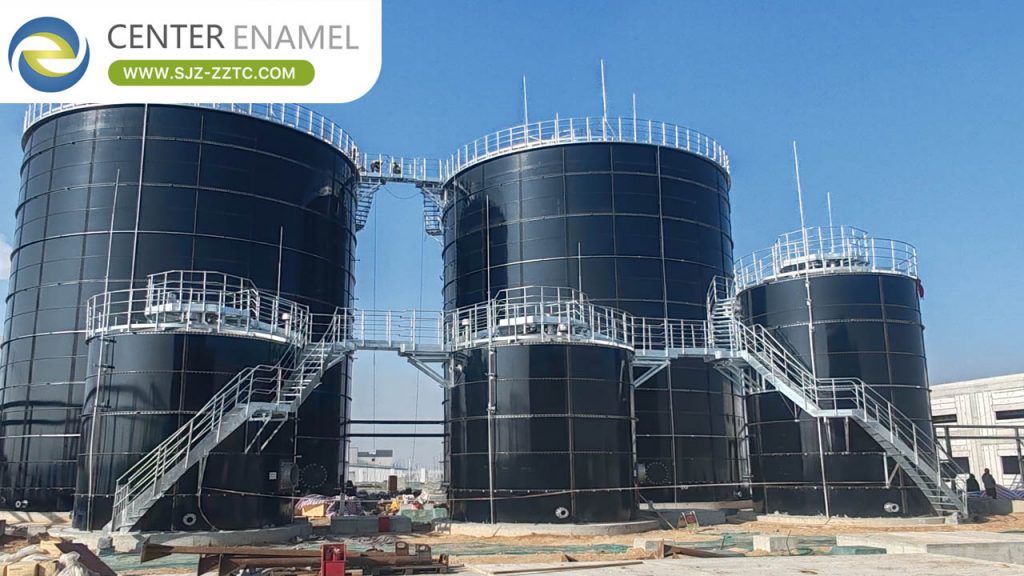
The library records a domestic sewage treatment project in Ghana at 1,800 m3/day using UBF + A2/O + sedimentation, with published tank diameters. It is a real municipal plant where an anaerobic pre-stage serves a nutrient-removal train. The source confirms capacity, process and dimensions; influent and effluent values are Not Specified in the Available Source, so no removal performance is claimed.
About Company
Shijiazhuang Zhengzhong Technology Co., Ltd (Center Enamel) is a comprehensive high-tech enterprise specializing in wastewater engineering, process section contracting, and equipment manufacturing. The company delivers biogas and wastewater projects through three main lines - EPC (turnkey) contracting, equipment supply, and process packages - covering livestock and municipal wastewater, biomass energy, industrial wastewater, and food waste. Its reactor portfolio spans CSTR, USR, UBF, UASB, IC, and EGSB, backed by in-house Glass-Fused-to-Steel tank manufacturing (enamel firing at 820-930 C) and certifications including ISO 9001, NSF/ANSI 61, and CE-EN 1090. With 35+ years of operation, a 150,000 m2 manufacturing base, and projects in 100+ countries, Center Enamel provides the single-responsibility engineering behind municipal sewage plants selected from the pollutant profile - where COD, nitrogen and phosphorus loading decide the process.
Conclusion
Select a municipal sewage plant's process from its pollutant profile and the permit. Map COD, nitrogen and phosphorus to the stages that remove them, and add only what the targets require.
Frequently Asked Questions
Q1: What drives municipal plant process choice? A1: The pollutant profile - COD, nitrogen, phosphorus - and the permit limits.
Q2: What does A2/O provide? A2: Anaerobic, anoxic and aerobic zones for phosphorus and nitrogen removal.
Q3: Why add a UBF pre-stage? A3: To remove bulk COD and reduce aeration load where the organic load is high.
Q4: Is municipal sewage toxic like industrial effluent? A4: Usually not; it is steadier and more dilute, so nutrients dominate design.
Q5: How is phosphorus removed? A5: Biologically in the anaerobic zone and, where needed, by chemical precipitation.
Q6: Are the profile values from a project? A6: No - they are general guidance; the design uses site data.
Q7: Can one stage remove everything? A7: Rarely; different pollutants need different zones.
Q8: Are the Ghana effluent values known? A8: No - Not Specified in the source, so no performance is claimed.
Suggested CTA
Send your raw sewage analysis and permit limits to an engineer to select a profile-driven municipal process.