
Need Biogas Plant Design with GFS Tanks for Livestock Wastewater Treatment?
This article reviews regional livestock manure management developments, UASB application scenarios, operational cost advantages, and a landmark Indonesian biogas project. It emphasizes how professional Biogas Plant Design integrates robust GFS Tanks with efficient anaerobic processes to deliver cost-effective Livestock Wastewater Treatment worldwide. With installation coverage across 100+ countries and a dual-service model combining in-house teams and local agents, Center Enamel ensures reliable delivery in any climate or regulatory environment. The discussion also covers comprehensive after-sales support and auxiliary roofing solutions, demonstrating full-project lifecycle capability-from initial design through long-term O&M-for sustainable manure management and biogas recovery.
Regional Progress in Livestock Manure Management – A Global Overview
Global livestock inventories such as swine remain stable. The US has developed technical models represented by integrated crop-livestock systems with on-field application and Comprehensive Nutrient Management Plans; Denmark, the Netherlands, and others have developed centralized biogas projects with digestate application systems. China's large-scale farms still have considerable room for improvement in supporting biogas project coverage, and digestate resource utilization rates lag behind advanced European levels. Greenhouse gas emissions from livestock account for a significant proportion of total global anthropogenic emissions, making manure management a critical battleground for agricultural carbon reduction. Latin American countries started later in manure management but are accelerating relevant infrastructure development.
These regional disparities create diverse opportunities for optimized Biogas Plant Design. Whether adapting to North American integrated systems or Asian centralized models, professional GFS Tanks-based solutions ensure that Livestock Wastewater Treatment facilities meet local requirements while maintaining high biogas recovery efficiency.
UASB Applicable Scenarios – Matching Technology to Wastewater Characteristics
Suitable for soluble medium-to-high concentration organic wastewater, covering light industrial wastewater from brewing, sugar refining, starch, papermaking, food processing, printing and dyeing, etc. Suitable for wastewater where organics are predominantly soluble with low suspended solids content, not suitable for high-solids, high-viscosity wastewater. Can be used alone as the primary treatment process or as a pretreatment for high-strength wastewater to reduce downstream aerobic load. Suitable for municipal wastewater anaerobic pretreatment and low-solids livestock wastewater treatment. With its low cost and stable operation advantages, it is suitable for long-term continuous, large-flow industrial wastewater treatment projects.
Understanding these scenarios is fundamental to effective Biogas Plant Design. By integrating the UASB process with durable GFS Tanks for feed and digestate storage, designers create a flexible, low-cost treatment train that excels in Livestock Wastewater Treatment applications-particularly where soluble organics predominate and flow rates are consistent.
Why Livestock Wastewater Treatment Offers Superior Economics
O&M costs are relatively low with excellent input-output ratio-the highest cost-effectiveness among the five wastewater types. Core treatment units are primarily physical separation, anaerobic digestion, and ecological polishing-no high-end precision equipment or expensive chemicals. Equipment is simple with low failure rates and low maintenance costs. Anaerobic digestion produces stable biogas for plant heating and power generation, offsetting energy costs. Ecological treatment units have virtually no ongoing O&M costs. Only periodic cleaning of sedimentation tanks and polishing ponds is required, with low labor costs. Manure solids, sludge, and digestate can be sold as resources, further reducing net treatment costs.
This exceptional cost profile is a direct outcome of thoughtful Biogas Plant Design that pairs GFS Tanks with robust biological processes. For farm operators, Livestock Wastewater Treatment systems built on this model deliver the fastest payback among wastewater treatment options-turning a regulatory cost center into a revenue-generating asset.
Indonesia Palm Oil Biogas Project – A Benchmark Case Study
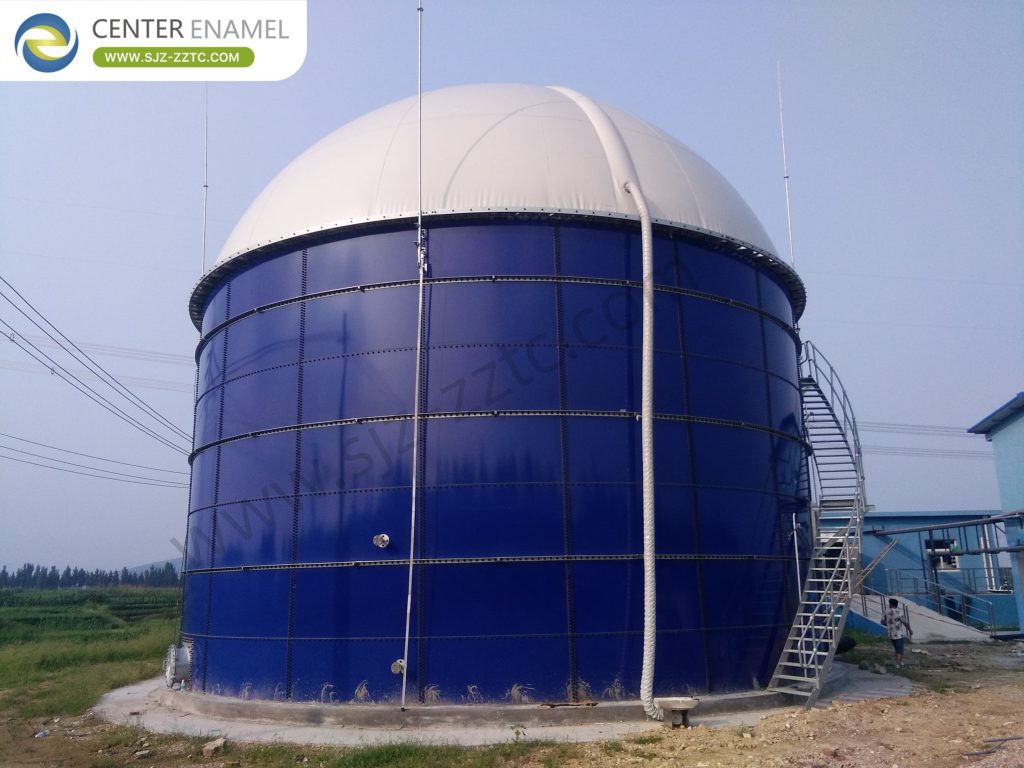
Specifically designed for high-concentration palm oil wastewater treatment with 3 GFS fermentation tanks, each 19.86 m diameter × 8.4 m height. Installation began November 2009 with only 7 construction personnel, completing all tank assembly in 40 days-highly efficient and time-saving. Tanks are fitted with dual-membrane gas storage covers for POME anaerobic digestion-degrading organics and recovering biogas energy while eliminating palm industry pollution. This is an early benchmark POME biogas treatment project in Southeast Asia.
This Indonesian project exemplifies how sound Biogas Plant Design combined with prefabricated GFS Tanks enables rapid, cost-effective implementation even in challenging tropical environments. The success of this Livestock Wastewater Treatment (and POME) installation validates the modular approach that Center Enamel brings to every project-proving that high-quality infrastructure can be deployed quickly with minimal on-site labor.
Global Installation Coverage – Delivery Capability Across 100+ Countries
Center Enamel is the pioneer of Chinese GFS equipment exports, with installation service coverage across over 100 countries and regions-possessing full delivery capability across climates, regulations, and geographies.
Overseas coverage includes Southeast Asia (Vietnam, Thailand, Malaysia, Indonesia, Cambodia, Bangladesh, Nepal, etc.), Africa (Ghana, South Africa, Mali, Guinea, Zambia, Kenya, Pakistan, etc.), Europe/Americas (Sweden, USA, Russia, etc.), the Middle East, and Latin America-adaptable to tropical rainy high-salt spray, high-altitude mountainous, Nordic severe cold, and high-standard European/American facility conditions.
The company uses a dual-service model of "own cross-border construction teams + overseas local agent coordination"-whether clients are in developed countries or remote developing regions-providing one-stop services including on-site survey, on-site installation, process commissioning, and operator training. Complete coverage covers biogas engineering, municipal wastewater, industrial wastewater, livestock manure, drinking water storage, and other global mainstream environmental engineering projects-possessing the full delivery capability to undertake large-scale tank farm projects in any country worldwide.
This global reach ensures that Biogas Plant Design can be executed anywhere, with GFS Tanks delivered and installed by experienced teams regardless of location. For Livestock Wastewater Treatment projects in remote or logistically challenging regions, this capability translates to reliable project execution and peace of mind for clients.
Center Enamel After-Sales and Technical Support
The Center Enamel after-sales team adheres to the service principles of rapid response, professional efficiency, and full-cycle support-providing 24/7 full-lifecycle O&M support to global clients.
Standard remote services include fault diagnosis, process parameter adjustment, and tank anti-corrosion maintenance guidance. For domestic and long-distance overseas clients, overseas technical service personnel can be dispatched for on-site inspection, annual inspection, and equipment refurbishment as needed. The team also maintains long-term client feedback tracking mechanisms-regularly collecting tank and anaerobic equipment operational data to continuously optimize product structure and support processes.
Supporting external technical expert teams provide specialized support for anaerobic process commissioning, biogas upgrading O&M, and wastewater upgrade/retrofit projects-ensuring long-term stable operation of domestic and overseas projects, continuously improving global client satisfaction and repurchase rates.
Comprehensive after-sales support is what transforms good Biogas Plant Design into lasting operational excellence. With GFS Tanks and Livestock Wastewater Treatment systems backed by 24/7 global service, clients can focus on their core operations while Center Enamel ensures their biogas infrastructure performs optimally year after year.
Aluminum Alloy Trough Deck Roof – Cost-Effective Covering for Storage Tanks
Aluminum Alloy Trough Deck Roof is a cost-effective economical tank cover solution for clean water and wastewater storage scenarios, primarily designed for drinking water, production wastewater, and firewater reserve tanks, balancing practicality and cost advantages. The main body is integrally formed from anti-corrosion aluminum alloy plates, paired with aluminum support trusses. Its lightweight design imposes less load on the tank foundation, reducing civil construction investment.
A naturally formed dense oxide protective layer on the surface resists rain and mild wastewater corrosion, withstands outdoor sun and rain exposure, and effectively blocks wind, rain, insects, fallen leaves, and odor volatilization, protecting water quality by preventing dust and debris from falling in and causing secondary contamination. The flat roof structure is neat and orderly, allowing installation of maintenance walkways, guardrails, vents, and level monitoring ports on top, facilitating daily inspection and equipment maintenance.
The simple sealing structure enables straightforward installation with short construction timelines, and virtually eliminates the need for anti-corrosion painting maintenance, resulting in extremely low operational costs. It is suitable for various small, medium, and large atmospheric pressure water storage tanks, and has been widely implemented in waterworks clear water tanks, industrial circulating water tanks, park firewater tanks, and domestic wastewater temporary storage facilities. It is highly compatible with water storage applications that do not require biogas collection or high-pressure sealing.
While Biogas Plant Design typically specifies gas-tight covers for digesters, the Aluminum Alloy Trough Deck Roof offers an ideal complement for auxiliary storage tanks within the same facility-such as influent equalization, treated effluent holding, or irrigation water storage. When paired with GFS Tanks, this roofing solution enhances overall plant functionality at minimal additional cost, demonstrating Center Enamel's comprehensive approach to complete Livestock Wastewater Treatment and biogas infrastructure.
FAQ
Q1: What factors should be considered in Biogas Plant Design for livestock wastewater?
Key factors include: (1) wastewater characteristics (COD, solids, ammonia levels), (2) climate and site conditions, (3) regulatory discharge standards, (4) biogas utilization pathway (power, heat, or grid injection), and (5) future expansion needs. Professional design integrating GFS Tanks and appropriate anaerobic processes ensures compliance, cost-effectiveness, and operational flexibility.
Q2: How do GFS Tanks reduce lifecycle costs in Livestock Wastewater Treatment?
GFS Tanks are factory-engineered with 30+ year corrosion resistance, eliminating frequent recoating. Their bolted assembly cuts installation time to one-third of concrete, reduces labor costs, and supports expansion/relocation-avoiding stranded asset risk. These factors combine to deliver the lowest total lifecycle cost among storage options.
Q3: What after-sales support is essential for long-term biogas plant success?
Essential support includes: (1) 24/7 remote fault diagnosis and process optimization, (2) periodic on-site inspections and preventive maintenance, (3) spare parts availability, and (4) process commissioning assistance for upgrades. Center Enamel provides all these services through a global network, ensuring sustained biogas yield and system reliability.