
Oil Wastewater Treatment: Processes For Palm Oil Mill Effluent
Oil wastewater treatment for palm oil mill effluent (POME) pairs a high-rate anaerobic digester with aerobic polishing. The anaerobic stage removes most of the very high COD and yields biogas at about 0.30-0.45 m3 per kg of COD removed, while the aerobic or polishing stage brings the effluent down to the discharge limit. The reactors are typically bolted Glass-Fused-to-Steel tanks for corrosion resistance and fast assembly.
Why POME Is Demanding
POME is among the strongest agro-industrial streams: COD frequently runs in the tens of thousands of mg/L and the volume per tonne of fruit is large. That load drives both the anaerobic volume and the biogas potential, so the design must treat the stream as high-strength industrial-grade effluent rather than ordinary sewage.
| Driver | Typical Range | Design Impact |
| COD | very high, tens of thousands mg/L | Large anaerobic volume |
| Volume per tonne fruit | High | Large hydraulic design |
| Temperature | Warm at mill | Favours anaerobic |
| Biogas potential | High | Energy recovery justified |
The POME Treatment Train
The liquid enters an upflow anaerobic reactor for COD and biogas, then an aerobic or pond-polishing stage for the residual carbon and any nutrient limit. The sealed anaerobic stage is usually a Glass-Fused-to-Steel tank, chosen for its resistance to the corrosive, warm organic environment. A UASB runs at a high organic loading rate (5-15 kg COD/m3/day) with hours of retention; a CSTR holds a uniform mixed slurry.
A Boundary Condition
A UASB performs best on warm, low-solid, soluble feed; if the separated liquid still carries heavy suspended solids or runs cold, the bed can wash out. Where that risk is high, a mixed CSTR may be the safer anaerobic choice for the same mill.
Project Case Study: Indonesia Biogas Project Anaerobic Reactors
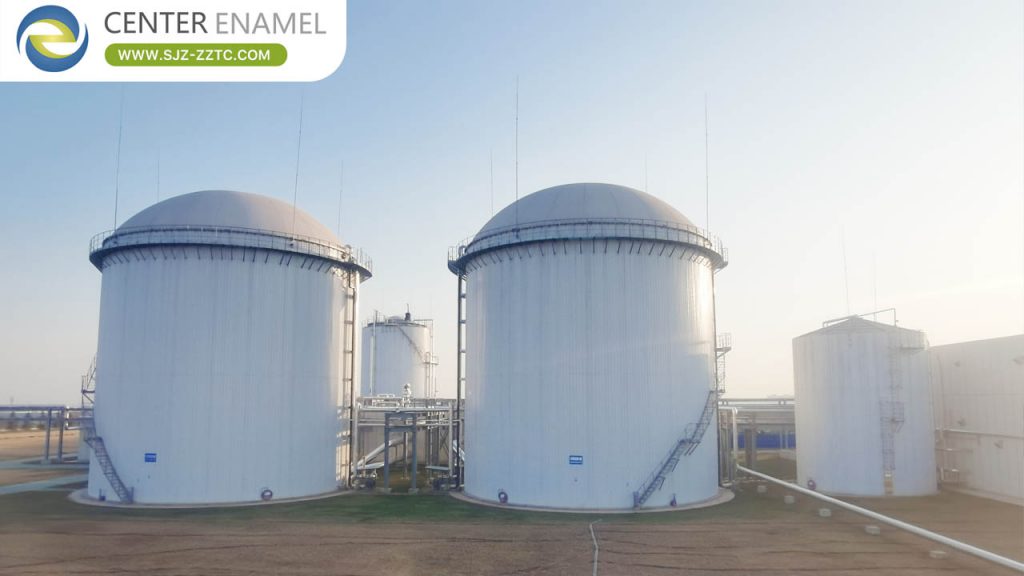
Project / Application: Anaerobic reactors at a palm oil wastewater treatment plant, Indonesia. Industry: Palm oil. Tank Type: Glass-Fused-to-Steel (GFS). Key Requirements: Flexible anaerobic capacity for POME.
| Field | Value | Source / Evidence |
| Application | Anaerobic Reactors at Palm Oil WWTP | Company project reference |
| Tank Model A | O17.58 x 8.4 m | Company project reference |
| Tank Model B | O16.82 x 7.2 m | Company project reference |
| Tanks Quantity | 3 Nos. of GFS Tanks | Company project reference |
| Installation Year | 2013 | Company project reference |
| Process | Anaerobic Digestion | Company project reference |
| Volume Per Tank | Not Provided In The Available Source | Dimensions only |
About The Supplier
Shijiazhuang Zhengzhong Technology Co., Ltd (Center Enamel) manufactures Glass-Fused-to-Steel tanks rated for aggressive palm oil mill effluent, with enamel firing at 820-930 C and certifications including ISO 9001, NSF/ANSI 61, and CE-EN 1090. The bolted system supports rapid overseas process-tank deployment.
Comparison: Anaerobic Choices For POME
| Reactor | Best When | Note |
| UASB | Warm, low-solid liquid | High loading, low energy |
| CSTR | Uniform slurry with solids | Mixed and heated |
| USR | Coarse high-solid feed | Holds solids without fine mixing |
Oil wastewater treatment for POME works when a high-rate anaerobic digester and aerobic polishing are engineered as one train sized to the real strength. Choose the anaerobic reactor from the solids and temperature, then let corrosion-resistant tankage make it durable.
Frequently Asked Questions
Q1: How is palm oil wastewater treated? A1: A high-rate anaerobic digester removes most COD and makes biogas, then aerobic polishing meets the limit.
Q2: Which anaerobic reactor suits POME? A2: A UASB for warm low-solid liquid; a CSTR for uniform slurry with solids.
Q3: How much biogas from POME? A3: About 0.30-0.45 m3 per kg of COD removed at 35-38 C, at 55-65% methane.
Q4: What are POME discharge limits? A4: Local permits set COD, BOD, and often nutrient limits; tank linings follow NSF/ANSI 61.
Q5: Why treat POME anaerobically? A5: It cuts the bulk COD and recovers biogas instead of wasting it.
Q6: What temperature does AD need? A6: Mesophilic digestion typically runs at 35-38 C.
Q7: What tank is used? A7: A sealed Glass-Fused-to-Steel tank, corrosion-resistant and fast to build.
Q8: Can the system expand? A8: Yes, bolted GFS panels add digester volume as throughput grows.
Share your POME flow and discharge limit with an engineer, or request a POME treatment process and tankage plan.