
How We Help Global Clients Optimize Biogas Plant Design with the USR Process
The global biogas industry is undergoing a phase of large-scale expansion, with different regions adopting distinct development paths. Europe's mainstream model focuses on combined heat and power (CHP) and biomethane grid injection, with active certificate trading. China, in contrast, emphasizes vehicle fuel and industrial heating while actively promoting digestate fertilizer utilization. Southeast Asian emerging markets show rapidly growing food waste treatment demand, while African and Latin American markets remain in earlier stages, primarily relying on low-cost direct application models.
This regional divergence presents a critical challenge: how do you select the right anaerobic process and reactor configuration for your specific waste stream and project conditions? For high-solids organic wastewater applications, the answer increasingly points toward the USR Process paired with advanced Biogas Plant Design principles.
What Makes the USR Process Ideal for High-Solids Wastewater
The USR Process (Upflow Solids Reactor) represents a streamlined yet highly effective approach to anaerobic digestion. High-solids organic wastewater, after simple pretreatment to remove large debris, is uniformly fed into the reactor through a bottom distribution system. The upward flow drives solid substrates and anaerobic sludge to slowly rise and thoroughly mix.
In the sealed anaerobic environment, microorganisms sequentially hydrolyze, acidify, and then methanogenically ferment, degrading macromolecular organic pollutants while generating biogas and treated water. Without complex separation structures, gentle hydraulic disturbance prevents clogging—a critical advantage when handling challenging feedstocks. The mixed liquor rises to the upper portion of the reactor where natural gas-liquid-solid separation occurs. Biogas is collected, effluent overflows, and solid sludge and unreacted substrate settle back to the lower reaction zone for continued reaction, with a small amount of aged sludge periodically discharged for continuous stable operation.
This Biogas Plant Design philosophy prioritizes simplicity, reliability, and clog-resistance over unnecessary complexity. For applications ranging from livestock manure to palm oil mill effluent, the USR Process delivers consistent performance with minimal operational intervention.
Process Comparison: USR vs. Alternative Reactor Configurations
| Reactor Type | Biomass Retention Mechanism | Suitability for High-Solids Waste | Typical Application |
| USR | Gravity settling, sludge blanket | Excellent—tolerates high SS without clogging | Livestock wastewater, POME, agricultural waste |
| UBF | Attached growth + dispersed flocs | Good—reduced plugging risk | Swine wastewater, industrial effluents |
| ASBR | Internal clarification | Good—controlled cyclic operation | High-strength organic waste |
GFS Tanks: The Structural Backbone of Modern Biogas Plant Design
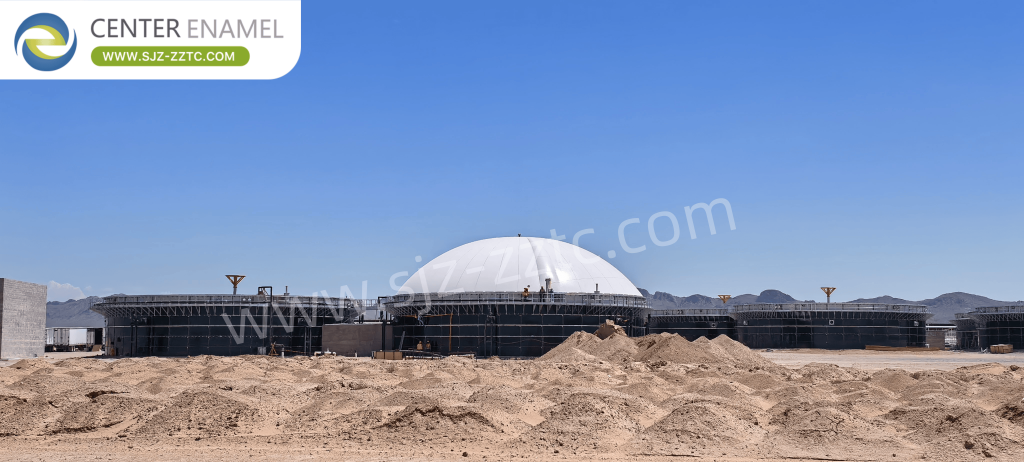
Effective Biogas Plant Design requires containment infrastructure that matches process simplicity with structural resilience. GFS (Glass-Fused-to-Steel) tanks offer flexible customization of size and appearance, with higher land utilization rates than fixed poured concrete alternatives.
Concrete tanks cannot alter volume or shape after pouring, with heavy bases occupying large areas—making placement difficult on narrow or irregular plots. GFS tank volume can be precisely customized as needed, with capacities ranging from dozens of cubic meters to 50,000 cubic meters freely selectable. Tank height and diameter can be flexibly combined to fit narrow or irregularly shaped plots, effectively saving plant land occupation. Enamel color customization is also supported, achieving visual harmony with plant buildings and environmental facilities.
During later plant expansion, GFS tanks can be directly adjusted in layout and expanded; concrete tanks, being monolithic structures, must be demolished and rebuilt. This modularity aligns well with the intensive construction and aesthetic operation and maintenance needs of modern industrial parks.
Digestate Management: Closing the Resource Recovery Loop
A well-designed Biogas Plant Design extends beyond gas production to encompass the complete resource recovery cycle. Digestate operation and maintenance costs with the USR Process are low and controllable, with outstanding resource recovery benefits.
Treatment processes are simple and mature, with no complex pretreatment or high-end degradation equipment—conventional equipment with low failure rates and simple maintenance. Stable water quality with no drastic fluctuations means no frequent parameter adjustments are needed, resulting in low labor requirements and costs. No large quantities of specialty chemicals are required, keeping chemical and energy costs controlled.
The key advantage is high resource recovery value. Compliant digestate and treated effluent can be used as ecological fertilizer for agricultural application, reducing chemical fertilizer use. Digestate can be concentrated into commercial liquid fertilizer, with resource recovery revenues generally covering routine O&M costs—delivering industry-leading economics.
Case Study: Ghana Municipal Domestic Wastewater Treatment Project
This project demonstrates the versatility of GFS tank-based treatment systems in municipal applications, complementing the industrial and agricultural focus of the USR Process.
| Parameter | Specification |
| Location | Ghana |
| Completion Year | 2021 |
| Treatment Capacity | 1,800 m³/day |
| Process | UBF Anaerobic + A²/O Nitrogen/Phosphorus Removal |
| GFS Tanks | 1 UBF Anaerobic Reactor, 1 Secondary Clarifier, 2 Internal/External Double-Layer A²/O Biological Tanks |
| Influent Characteristics | High COD, BOD, Suspended Solids, Nitrogen/Phosphorus |
| Effluent Quality | pH Stable at 6.5–9.0; Meets Local Environmental Discharge Standards |
| Key Advantage | Corrosion-Resistant, Conveniently Assembled GFS Tanks Solve Urban Domestic Wastewater Pollution |
Why Partner with Center Enamel for Your Biogas Plant Design
Center Enamel combines large-scale manufacturing with over a decade of global installation experience. Our 150,000 m² intelligent manufacturing base in Hebei operates dual-phase facilities with ISO, NSF, and CE-certified quality control, 500+ staff, and complete container shipping capabilities—placing us among the global top tier of GFS tank manufacturers.
Since our first overseas installation in Niger (2009) and China's first GFS tank export to the US (2015), we have delivered stable projects across Southeast Asia, Africa, and the Americas, covering livestock biogas, POME, municipal wastewater, and drinking water storage.
For your Biogas Plant Design, this means proven USR Process technology backed by reliable production capacity and field-proven global delivery. The decisions made at the planning stage directly impact decades of operational performance and resource recovery returns.
Ready to optimize your biogas project? Contact Center Enamel today for a customized Biogas Plant Design solution featuring our proven USR Process—our engineers will respond within 24 hours.
Frequently Asked Questions
Q1: What types of wastewater are most suitable for the USR Process in a biogas plant design?
A: The USR Process is ideal for high-solids organic wastewater including livestock manure, palm oil mill effluent (POME), and agricultural processing waste. Its clog-resistant design handles suspended solids that would impair other reactor configurations.
Q2: How do GFS tanks compare to concrete tanks for biogas plant construction?
A: GFS tanks offer customizable volumes (up to 50,000 m³), faster modular installation, 30+ year lifespan, and flexible expansion options. Concrete tanks are permanent monolithic structures that cannot be adapted, requiring demolition for capacity changes.
Q3: Can Center Enamel provide complete EPC services for biogas projects?
A: Yes. Center Enamel delivers one-stop EPC solutions covering Biogas Plant Design, equipment manufacturing, installation, commissioning, and ongoing technical support—with proven project references across 100+ countries.