
Optimizing Biogas Containment for the Anaerobic Digestion of Livestock Manure
The global agricultural landscape is undergoing a fundamental shift toward sustainability. As the demand for animal protein grows, the volume of Livestock Manure has become one of the most significant environmental management challenges facing modern farming operations. Historically treated as a waste liability that contributes to odor issues and greenhouse gas emissions, manure is now being redefined as a premier feedstock for renewable energy. The bridge between waste management and energy production is the Anaerobic Digestion of Livestock Manure. However, the economic and operational success of these projects is fundamentally dependent on the integrity of the containment system. Optimizing biogas containment is not merely an engineering preference; it is the critical factor in maximizing methane yield and ensuring the longevity of the investment.
Shijiazhuang Zhengzhong Technology Co., Ltd, operating under the industry-leading brand Center Enamel, stands at the forefront of this technological revolution. With over thirty years of experience and projects successfully commissioned in more than one hundred countries, we provide the turnkey engineering solutions required to transform Livestock Manure into a consistent stream of biogas and high-quality bio-fertilizer. Our Glass-Fused-to-Steel (GFS) technology, paired with advanced roofing systems, represents the global gold standard for agricultural biogas containment.
The Strategic Imperative for Sustainable Manure Management
Livestock production—encompassing dairy, beef, swine, and poultry—generates massive quantities of organic residue. When managed correctly through Anaerobic Digestion of Livestock Manure, these residues transition from environmental burdens to strategic assets.
1. Environmental Stewardship and Methane Mitigation
Traditional manure management, such as open storage lagoons, leads to the uncontrolled release of methane—a greenhouse gas with a global warming potential significantly higher than carbon dioxide. By enclosing the process within an engineered reactor, farms can capture this methane, reducing their carbon footprint and mitigating the risk of nutrient runoff into local watersheds.
2. Energy Autonomy and Economic Resilience
The biogas generated through this process serves as a stable, on-site source of renewable energy. Whether converted into electricity via cogeneration or upgraded to renewable natural gas for the grid, the Anaerobic Digestion of Livestock Manure provides a hedge against fluctuating energy prices and creates a new revenue stream for the farm.
Technical Foundations of Anaerobic Digestion
The practical implementation of energy recovery from Livestock Manure requires a deep understanding of the biological stages and the mechanical requirements of the reactor.
1. The Biological Sequence
The process occurs in four distinct stages:
Hydrolysis: Complex organic matter is broken down into soluble monomers.
Acidogenesis: These monomers are converted into volatile fatty acids.
Acetogenesis: Acids are further converted into acetic acid and hydrogen.
Methanogenesis: Specialized microorganisms convert these intermediates into methane.
2. Overcoming Solids and Nitrogen Challenges
Livestock Manure often contains high levels of ammonia and fibrous solids (such as bedding material). These can inhibit microbial activity or lead to the formation of crusts. Center Enamel’s reactor designs, such as the Continuous Stirred-Tank Reactor (CSTR), utilize robust mechanical mixing to ensure a homogeneous environment, maximizing the contact between bacteria and organic matter.
Engineering Excellence: The Center Enamel Containment Solution
A successful project depends on the durability of the containment infrastructure. The environment inside a digester processing Livestock Manure is highly corrosive due to the presence of organic acids and hydrogen sulfide.
1. Glass-Fused-to-Steel (GFS) Technology
Our GFS tanks combine the structural strength of steel with the superior corrosion resistance of glass.
Corrosion Immunity: The glass enamel coating is fused to the steel panels at temperatures exceeding 800 degrees, creating an inert barrier that is impervious to the aggressive chemicals produced during the Anaerobic Digestion of Livestock Manure.
Hardness and Abrasion Resistance: Manure often contains grit and sand. Our tanks feature a hard interior surface (6.0 on the Mohs scale) that resists physical wear, ensuring a service life exceeding thirty years.
Modular Versatility: The bolted design allows for rapid on-site assembly, which is essential for active farm environments where construction windows are often limited.
2. Integrated Gas Management with Double Membrane Roofs
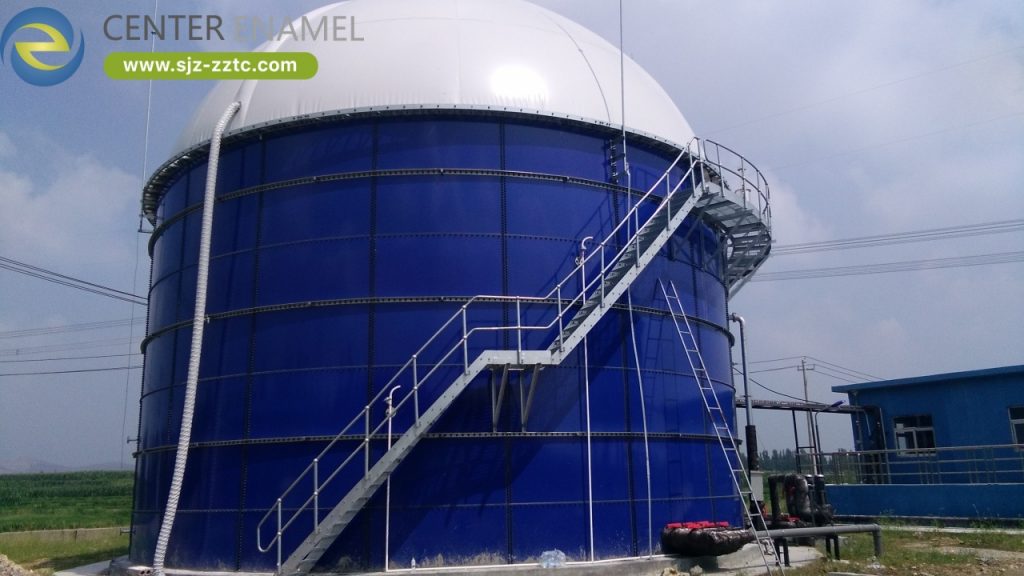
Effective gas capture is critical for maximizing energy output. Our Double Membrane Roofs function as an integrated gas holder. The flexible inner membrane expands to store biogas, while the air-pressurized outer membrane provides a protective structural shell against the elements.
3. Aluminum Dome Roofs: Maintenance-Free Protection
For the storage of treated digestate or process water, our Aluminum Dome Roofs offer an unparalleled solution.
Permanent Durability: Constructed from high-strength aluminum alloy, these geodesic domes require no maintenance and are naturally resistant to the humid, corrosive atmosphere of a farm.
Clear-Span Design: The self-supporting structure eliminates the need for internal columns, maximizing storage capacity and ensuring a professional, clean-site appearance.
The Circular Economy: Beyond Energy Production
The implementation of Anaerobic Digestion of Livestock Manure creates a closed-loop system that benefits the entire agricultural operation.
Premium Bio-Fertilizer: The digestate remaining after the process is a nutrient-rich, pathogen-free organic fertilizer that is more easily absorbed by crops than raw manure.
Odor Control: The digestion process significantly reduces the odor profile of manure management, improving the farm's relationship with the local community.
Water Recovery: Advanced treatment systems can recover water from the digestate, which can be reused for cleaning or irrigation.
Global Success Stories: Proven Manure Solutions
Center Enamel’s expertise is validated by a history of successful, high-capacity installations across diverse climates. These real-world applications demonstrate our ability to deliver reliable infrastructure for the Anaerobic Digestion of Livestock Manure.
Shandong Heze Biogas Project This significant regional initiative utilized 3 units of our high-performance GFS tanks to process organic residues. The project has become a benchmark for efficient energy production, converting organic loads into a steady stream of power for industrial use.
Inner Mongolia Hinggan League Bio-Natural Gas Project Operating in a region characterized by extreme temperature fluctuations, this project integrated 4 units of our advanced bolted tanks. The system provides the stable environment necessary for the high-efficiency production of bio-natural gas from livestock residues.
Jiangsu Xuzhou Biogas Project This major industrial project involved the deployment of 4 units of our GFS containment technology. By processing concentrated organic waste, the facility has successfully optimized the digestion process to achieve high gas purity and reliable renewable energy output.
Leading the Future of Agricultural Energy
Optimizing biogas containment for the Anaerobic Digestion of Livestock Manure is a transformative step toward a more sustainable and profitable agricultural future. By capturing the energy potential of Livestock Manure, producers can secure a reliable source of renewable energy while fulfilling their environmental responsibilities.
At Shijiazhuang Zhengzhong Technology Co., Ltd (Center Enamel), we are committed to providing the innovation and engineering excellence required to make these projects a success. Through our premier GFS tanks, Double Membrane Roofs, and Aluminum Dome Roofs, we deliver the total containment solutions that drive the global transition to green energy.