
How an EPC Contractor Turns Organic Waste into Clean Energy Through Anaerobic Digestion
The biogas industry has matured to the point where technology selection is no longer the bottleneck-delivery integration is. Leading players now win major projects through the "EPC + Operation" model, while carbon asset development has become a standard feature of bankable projects. At the center of every successful plant sits Anaerobic Digestion, the biological engine that converts organic waste into clean, revenue-generating energy. Around it sits the EPC Contractor responsible for making feedstock, tanks, process, and energy output work as one system. This article examines how that integration actually delivers results.
Market and Industry Landscape: Why Integration Now Decides Project Outcomes
The global biogas industry competitive landscape shows divergence. Leading companies dominate major project market shares through the "EPC + Operation" integrated model, while small and medium-sized enterprises focus on county-level distributed projects and specialized equipment segments. China's biogas equipment exports continue to expand, with generator sets primarily flowing to emerging markets.
Business model innovation is accelerating, with carbon asset development becoming a standard feature of large projects, converting methane emission reductions into tradable carbon credits. The "biogas operation outsourcing" service model is emerging, improving operational efficiency of county-level projects through professional management.
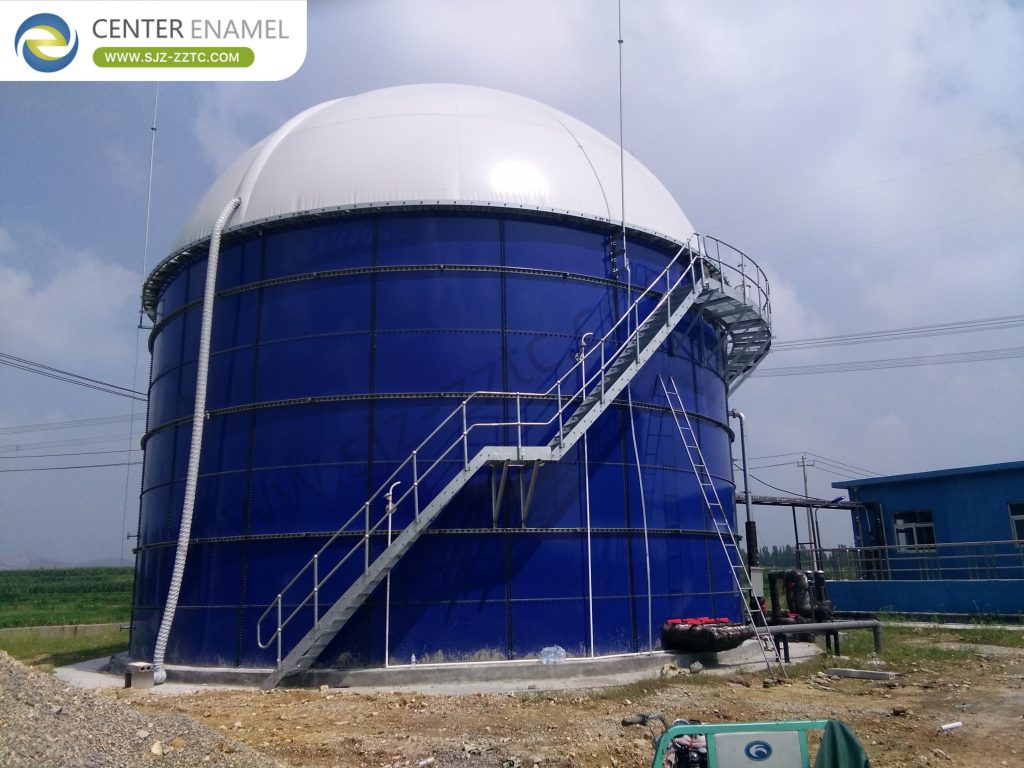
From a technology and equipment perspective, Anaerobic Digestion is the core process of biogas engineering. Glass-fused-to-steel (GFS) tanks, with their excellent sealing, corrosion resistance, and construction convenience, have become the mainstream choice for large anaerobic digestion tanks. Their modular design can be combined with membrane gas holders to form an integrated "fermentation + gas storage" solution, with penetration rates continuing to rise in new projects in biogas industry clusters. A capable EPC Contractor must therefore control both the biological process and the structural vessel-because failure in either halts clean energy production.
Industry Trends Shaping EPC Delivery
| Trend | Description | EPC Implication |
| EPC + Operation model | Leading firms dominate major project share | Single accountability from design to operation |
| Carbon asset development | Methane reductions converted to tradable credits | Documentation and monitoring built into design |
| Operation outsourcing | Professional management of county-level projects | Remote monitoring and low-maintenance equipment |
| GFS tank + membrane holder | Integrated fermentation and gas storage | Consolidated procurement and installation scope |
| Waste-to-energy conversion | Organic waste converted to biogas, power, and heat | Energy output designed as core revenue stream |
USR Process Advantages: Anaerobic Digestion Built for High-Solids Reality
High solids tolerance, clog resistance, and strong adaptability make the USR process perfectly suited for high-suspended-solids, high-impurity, high-solids organic wastewater. The equipment structure is extremely simple, with no precision wear parts, low capital investment, long service life, virtually no clogging failures, and extremely low subsequent maintenance costs.
There are no strict requirements on sludge morphology-no need to cultivate mature granular sludge; flocculent sludge can operate stably, with fast start-up and short sludge acclimation period for rapid commissioning. Gentle hydraulic disturbance results in low sludge washout and high sludge utilization, with stable organic pollutant degradation. Simple operation with low automation requirements and high error tolerance makes it suitable for remote sites, farms, and other settings with limited O&M capabilities-outstanding stability and practicality advantages within any Anaerobic Digestion portfolio managed by an EPC Contractor.
USR Process Advantages Summary
| Advantage | Technical Basis | Project Benefit |
| High solids tolerance | No three-phase separator; upflow hydraulics | Handles manure and agricultural wastewater directly |
| Clog resistance | Large-diameter distribution; gentle disturbance | Virtually no clogging failures |
| Low maintenance | No precision wear parts | Reduced O&M cost and downtime |
| No granulation needed | Flocculent sludge operates stably | Fast start-up; short acclimation |
| Low sludge washout | Gentle hydraulic regime | High sludge utilization |
| Simple operation | Low automation requirement; high error tolerance | Suitable for remote and farm sites |
Clean Energy Output: How Biogas Becomes Power, Heat, and Fuel
Through Anaerobic Digestion, organic waste is converted into biogas-a versatile clean energy carrier. After desulfurization, dehydration, and upgrading, biogas can be utilized across multiple high-efficiency pathways, turning waste treatment into a revenue-generating energy business.
Biogas CHP: Biogas is fed into gas engines or turbines for power generation-electricity can be grid-sold or self-consumed, with waste heat recovered for digester heating and plant heating-overall energy efficiency exceeding 80%.
Biogas upgrading to biomethane: After carbon dioxide removal to >95% methane purity, biogas is equivalent to pipeline natural gas and can be injected into city gas networks or compressed as CNG/LNG for vehicles.
Direct combustion for heating: Biogas can be burned directly for boiler heating, sludge drying, agricultural product drying, and greenhouse heating-replacing coal and natural gas.
Flare combustion for emergency disposal: When biogas production exceeds utilization capacity, it is flared to reduce direct methane emissions, meeting environmental compliance requirements.
Each cubic meter of biogas has a calorific value of approximately 21–25 MJ, can generate 1.5–2.0 kWh of electricity, or replace 0.7–0.8 cubic meters of natural gas. Large-scale biogas plants produce thousands to tens of thousands of cubic meters of biogas daily, with annual power generation reaching millions to tens of millions of kWh-delivering triple value in environmental management, clean energy, and carbon assets.
Clean Energy Utilization Pathways
| Pathway | Process Requirement | Typical Output / Efficiency | End Use |
| Biogas CHP | Desulfurization, dehydration | >80% overall energy efficiency; 1.5–2.0 kWh/m³ | Grid sale or self-consumption; waste heat recovery |
| Biomethane Upgrading | CO₂ removal to >95% CH₄ | Pipeline-equivalent gas; CNG/LNG | City gas network injection; vehicle fuel |
| Direct Combustion | Desulfurization | Replaces 0.7–0.8 m³ natural gas per m³ biogas | Boiler heating, drying, greenhouse heating |
| Flare Combustion | Emergency routing | Methane emission reduction | Environmental compliance |
Center Enamel's Core R&D Capabilities and Global Authoritative Certifications
Technology R&D is Center Enamel's core competitive advantage. The company independently masters over 200 differentiated anti-corrosion enamel formulations, with full self-control over the enamel raw material chain, holding nearly 100 invention and utility patents. Products have passed NSF, WRAS, ASME, BSCI, CE, ISO9001, and other global certifications.
Company certifications and honors include: National High-Tech Enterprise, National Specialized and Sophisticated "Little Giant," Hebei Manufacturing Single Champion, Provincial Smart Factory, Provincial Green Factory; complete environmental engineering and special equipment manufacturing compliance qualifications. The company maintains long-term collaborative research with multiple universities through joint materials laboratories-continuously iterating anti-corrosion coatings and large bolted tank structural design technologies. The proprietary material technology barrier creates an irreplaceable competitive advantage, with product performance comparable to high-end imported European/American storage equipment.
For an EPC Contractor deploying Anaerobic Digestion in high-corrosion environments, this material capability is the difference between a tank that lasts 30 years and one that requires relining in 10.
Certifications and R&D Credentials
| Category | Credential |
| Enamel formulations | 200+ differentiated anti-corrosion formulations |
| Patents | Nearly 100 invention and utility patents |
| Product certifications | NSF, WRAS, ASME, BSCI, CE, ISO9001 |
| Enterprise honors | National High-Tech Enterprise; National "Little Giant"; Hebei Manufacturing Single Champion |
| Factory certifications | Provincial Smart Factory; Provincial Green Factory |
| Research collaboration | Joint materials laboratories with multiple universities |
Full-Process Standardized Installation Quality Control
Demonstrating high-standard installation quality through long-term stable global project performance, Center Enamel has established full-chain quality control standards across four dimensions: factory protection, on-site assembly construction, completion inspection, and long-term warranty-ensuring quality control for every GFS tank.
At the factory stage, all enameled panels, seals, and structural components receive rust-proof and moisture-proof independent packaging with dedicated protective supports-preventing damage during sea and land transport and avoiding enamel coating damage. On-site construction strictly follows unified assembly process specifications-panel by panel tightening and leak testing in layers, with airtightness and verticality testing after each tank section completion-dual membrane covers and anaerobic piping undergo simultaneous pressure testing and acceptance.
Differentiated quality acceptance standards are customized for different regions: EU/US projects follow stringent CE/NSF inspection criteria; Southeast Asian hot humid regions receive enhanced corrosion protection and sealing acceptance; remote African sites have additional foundation settlement re-inspection procedures. Upon project completion, complete construction inspection reports, pressure test records, and anti-corrosion appearance acceptance documents are issued, with full photo/video archives retained. Over 10,000 tanks delivered globally have operated long-term without large-scale leakage or structural deformation-preventing future O&M issues at source.
Four-Dimension Quality Control Framework
| Stage | Control Measures | Regional Customization |
| Factory protection | Rust-proof, moisture-proof packaging; protective supports | Applies globally |
| On-site assembly | Panel-by-panel tightening; layered leak testing | Enhanced corrosion/sealing acceptance in hot humid Southeast Asia |
| Completion inspection | Air-tightness and verticality testing; pressure testing of covers and piping | CE/NSF criteria for EU/US projects |
| Long-term warranty | Inspection reports, pressure records, appearance documents, photo/video archives | Additional foundation settlement re-inspection for remote African sites |
Installation and Construction Team: Standardized Delivery Across 10,000+ GFS Tank Projects
The installation team has practical experience from over 10,000 GFS tank projects globally, strictly following standardized construction procedures-full control over project mobilization, civil coordination, tank assembly, piping, and commissioning schedules and quality.
The team is proficient in complete standardized installation processes for GFS tanks, dual-membrane gas storage covers, USR/CSTR/IC anaerobic reactors, and biogas desulfurization/piping systems-adaptable to large-scale farms, industrial parks, remote mountainous sites, coastal high-corrosion sites, and other complex locations-strictly implementing unified global safety construction standards.
For large overseas cross-border projects, the team can be deployed as complete units for on-site construction, technical training, and local worker practical instruction-full control over construction details, air-tightness testing, and corrosion protection-ensuring timely and stable commissioning of global environmental projects through standardized delivery capability. This execution depth is what allows an EPC Contractor to commit to Anaerobic Digestion performance guarantees rather than equipment supply alone.
Installation Team Capability Profile
| Capability | Scope |
| Project experience | 10,000+ GFS tank projects globally |
| System proficiency | GFS tanks, dual-membrane covers, USR/CSTR/IC reactors, desulfurization and piping |
| Site adaptability | Large farms, industrial parks, remote mountainous sites, coastal high-corrosion sites |
| Overseas deployment | Complete units for construction, technical training, and local worker instruction |
| Quality control | Construction details, air-tightness testing, corrosion protection |
| Standards | Unified global safety construction standards |
Center Enamel's Extensive Global Benchmark Project Cases
Center Enamel's project portfolio covers over 100 countries across Southeast Asia, Africa, Europe, and the Americas-30,000+ mature projects-accumulating complete industry solutions across palm oil, livestock, municipal, brewing, and food waste biogas-rapidly matching customized solutions for different regional climates, water quality, and regulations.
Global Project Portfolio at a Glance
| Metric | Figure |
| Countries served | 100+ |
| Regions covered | Southeast Asia, Africa, Europe, Americas |
| Total mature projects | 30,000+ |
| Core industries | Palm oil, livestock, municipal, brewing, food waste biogas |
| Customization basis | Regional climate, water quality, and regulatory requirements |
Frequently Asked Questions
Q1: What does an EPC Contractor do differently in anaerobic digestion projects?
A: An EPC Contractor holds single-point responsibility for feedstock assessment, process design, GFS Tank manufacturing, equipment supply, installation, commissioning, and warranty. This eliminates interface disputes between tank suppliers and process providers-the most common cause of delayed start-up and underperformance.
Q2: How does anaerobic digestion convert waste into clean energy?
A: Microorganisms break down organic matter in a sealed, oxygen-free environment, producing biogas-a mixture of methane and carbon dioxide. Biogas is then used for power generation, upgraded to biomethane, or burned for heat, turning waste treatment into a renewable energy revenue stream.
Q3: How does Center Enamel control quality across global projects?
A: We apply four-dimension control: factory packaging protection, on-site layered leak and air-tightness testing, completion inspection with documented records, and long-term warranty. Acceptance criteria are customized by region-CE/NSF for EU/US, enhanced corrosion sealing for humid Southeast Asia, and foundation re-inspection for remote African sites.
Let's Turn Your Organic Waste into Clean Energy
From feedstock analysis to power generation, every stage should be engineered as one energy system. Contact Center Enamel today for a free feedstock assessment and a tailored Anaerobic Digestion scope delivered under a single EPC contract.
30,000+ projects across 100+ countries stand behind our delivery record. Talk to our engineers now and receive your Anaerobic Digestion and GFS Tank budget estimate within 48 hours-clear numbers, one point of contact, no coordination burden.