
Palm Oil Mill Effluent Treatment and Biogas Resource Recovery-The Optimal Solution Provider
This article systematically analyzes the sources, characteristics, and environmental hazards of palm oil mill effluent (POME). It highlights the combined application of pretreatment and the USR anaerobic fermentation process, and showcases the core advantages of GFS tanks and double-membrane gas holders in biogas production. With Center Enamel’s one-stop service capability and real project references, this piece provides palm oil processing plants with an efficient, corrosion-resistant, and long-lasting solution for wastewater treatment and resource recovery.
What Is Palm Oil Mill Effluent (POME) and What Are Its Characteristics?
Palm oil mill effluent (POME) is a high-strength organic wastewater generated during palm oil processing. Its sources span the entire production chain:
Oil extraction stage: After de-shelling, crushing, steam sterilization, and mechanical pressing, palm fruits release large volumes of liquid waste containing oil and fibers.
Refining stage: Chemical agents are used for neutralization, bleaching, and deodorization to remove free fatty acids, pigments, and odors, producing wastewater with residual chemicals and oils.
Washing operations: Daily cleaning of presses, conveyors, storage tanks, and other equipment carries pulp residues, grease, and sediment.
Combined discharge: The above waste streams are often collected together, forming a mixed liquor with complex composition and fluctuating pollutant loads.
Typical characteristics of POME include:
Extremely high COD and BOD: Chemical oxygen demand (COD) typically ranges from 50,000 to 100,000 mg/L, while biochemical oxygen demand (BOD) falls between 20,000 and 50,000 mg/L, indicating a very heavy organic load.
High oil and grease content: Oil and grease mass fraction can reach 2%–5%, forming an oxygen-blocking film on the water surface that hinders natural re-aeration.
High suspended solids (SS): Contains palm fibers, shell fragments, cell wall residues, etc., with SS often exceeding 10,000 mg/L.
Acidic pH: Fresh POME has a pH of about 4–5, requiring neutralization before efficient biological treatment.
Elevated temperature: Discharge temperature is approximately 80°C–90°C, requiring cooling to avoid inhibiting microbial activity.
Seasonal fluctuations: Both wastewater volume and pollutant concentration rise significantly during peak fruit-bearing seasons, placing higher demands on the system’s shock-load resistance.
Multiple Environmental Hazards of Palm Oil Mill Effluent
If discharged untreated, POME poses systemic risks to ecosystems and human health:
Oxygen depletion in water bodies and soil: Large quantities of organic matter entering rivers or plantation soils rapidly deplete dissolved oxygen via aerobic decomposition, causing massive fish and benthic organism deaths, as well as soil acidification and compaction.
Aggravated greenhouse gas emissions: Open anaerobic degradation releases substantial methane (CH₄), which has a global warming potential 28 times that of CO₂. It is estimated that methane emissions from POME anaerobic decomposition account for about 80% of the total greenhouse gas emissions over the entire palm oil life cycle.
Eutrophication: Abundant ammonia-nitrogen and total phosphorus discharged into lakes or coastal waters trigger algal blooms and red tides, disrupting aquatic ecological balance.
Health risks: Hydrogen sulfide, ammonia, and volatile organic compounds emitted from the wastewater can easily cause respiratory illnesses in nearby communities and contaminate surface drinking water sources.
Pretreatment Stage-Building a Solid Foundation for Anaerobic Digestion
The goals of pretreatment are "grit removal, oil removal, homogenization, cooling, and acidification" to create optimal influent conditions for the subsequent core biogas-producing process:
Mechanical screens: Coarse screens (10–20 mm gap) and fine screens (1–5 mm gap) remove large fruit kernels, fibers, and plastic debris, protecting downstream pumps and pipelines.
Horizontal flow oil-water separator: Utilizing density differences between oil and water, with a horizontal flow velocity ≤0.3 m/s and a retention time of 1.5–2.5 hours, this step removes about 80%–90% of free oil, with recovered palm oil serving as a by-product.
Equalization/homogenization tank: This tank serves multiple functions-① buffering influent flow and concentration shocks; ② mixing wastewater from different time periods via stirring or aeration to stabilize COD and pH; ③ cooling the water temperature to 35°C–40°C through coil cooling or natural heat dissipation, meeting mesophilic anaerobic requirements; and ④ allowing preliminary hydrolytic acidification under anoxic conditions, breaking down cellulose, proteins, and other macromolecules into volatile fatty acids (VFAs), significantly improving wastewater biodegradability (BOD/COD ratio rising from 0.3 to above 0.5).
Converting POME into Biogas: USR Process + GFS Tanks + Double Membrane Roof
After pretreatment, the conversion of POME into biogas primarily relies on the USR (Upflow Solids Reactor) anaerobic process, with GFS tanks (glass-fused-to-steel tanks) and a double-membrane roof (gas holder) providing the core equipment and a gas-tight environment.
USR Reactor-Principles and Advantages:
Pretreated wastewater enters from the bottom of the reactor and flows upward through a highly active microbial sludge bed. Organic solids are decomposed by microorganisms, with the generated biogas rising and accumulating at the top, while solid particles settle naturally and remain in the reactor. This design allows solids and microbial retention times to be much longer than hydraulic retention time-perfectly suited for POME, which contains 3%–6% total solids-ensuring thorough organic decomposition and higher biogas yield.
GFS Tanks-Corrosion-Resistant and Durable Main Equipment:
As the containment vessel for the USR, GFS tanks are manufactured from hot-rolled steel panels that are double-fused with glass at 820°C–930°C, forming an inert vitreous enamel layer. This layer resists both acids (pH 1) and alkalis (pH 14), offering exceptional corrosion resistance against the organic acids and sulfides present in POME. On-site assembly requires no heavy welding equipment, shortening construction time by 30%–50% and facilitating future expansion. Today, single-tank volumes have exceeded 50,000 m³ (approximately 50,000 tonnes of water capacity), fully verifying the structural reliability and gas-tight sealing performance of glass-fused-to-steel technology in ultra-large anaerobic reactors-meeting the centralized treatment needs of large-scale palm oil mills. The design service life exceeds 30 years.
Double Membrane Roof - A Safe and Stable Gas Storage System:
Installed on the tank roof, the double-layer membrane structure consists of an outer membrane (UV-resistant, wind-load-resistant) that maintains the shape, and an inner membrane that rises and falls with gas storage volume while maintaining a constant working pressure (approximately 2–5 mbar). This integrated design eliminates the need for a separate gas holder footprint, allowing biogas to be directly collected, buffered, and output at a stable pressure, with a leak rate below 0.5%, effectively preventing methane fugitive emissions.
How to Find a One-Stop Wastewater Treatment Project Supplier?-Center Enamel Is the Best Choice
For palm oil processing enterprises, selecting an integrator with full-process service capability is critical. Center Enamel (Shijiazhuang Zhengzhong Technology Co., Ltd.) is a recognized industry leader:
Deep technical expertise: With decades of experience in the enamel tank industry, it is Asia’s first specialized GFS tanks manufacturer and China’s first company to independently master double-firing technology for hot-rolled steel sheets.
Full process chain coverage: Beyond USR, Center Enamel also offers CSTR, UASB, IC, EGSB, and other mainstream anaerobic processes, allowing flexible customization based on wastewater characteristics, site conditions, and biogas utilization pathways.
Top-tier manufacturing standards: Products are certified to AWWA D103, ISO 28765, NSF/ANSI 61, and other international standards, with world-class weatherability, gas-tightness, and sanitary safety.
Global service network: Center Enamel has provided municipal, industrial, and agricultural biogas project equipment and technical support to over 100 countries, with extensive experience in tropical regions.
Turnkey engineering services: From water quality analysis, process design, equipment manufacturing, on-site installation guidance, to operational training, the entire responsibility chain is clearly defined-clients need not coordinate with multiple parties, significantly reducing project risks and management costs.
As a leading Biogas Project Contractor, Center Enamel delivers integrated solutions that ensure seamless execution from concept to commissioning.
Two Typical Palm Oil Wastewater Treatment Project Cases
Sri Lanka Palm Oil Project (Commissioned in 2026)
Location: Sri Lanka
Treatment capacity: 250 tonnes/day
Process: SBR (Sequencing Batch Reactor, suitable for medium-to-low load advanced treatment)
Reactor specification: Φ24.46 m × 6 m, 2 sets of GFS tanks
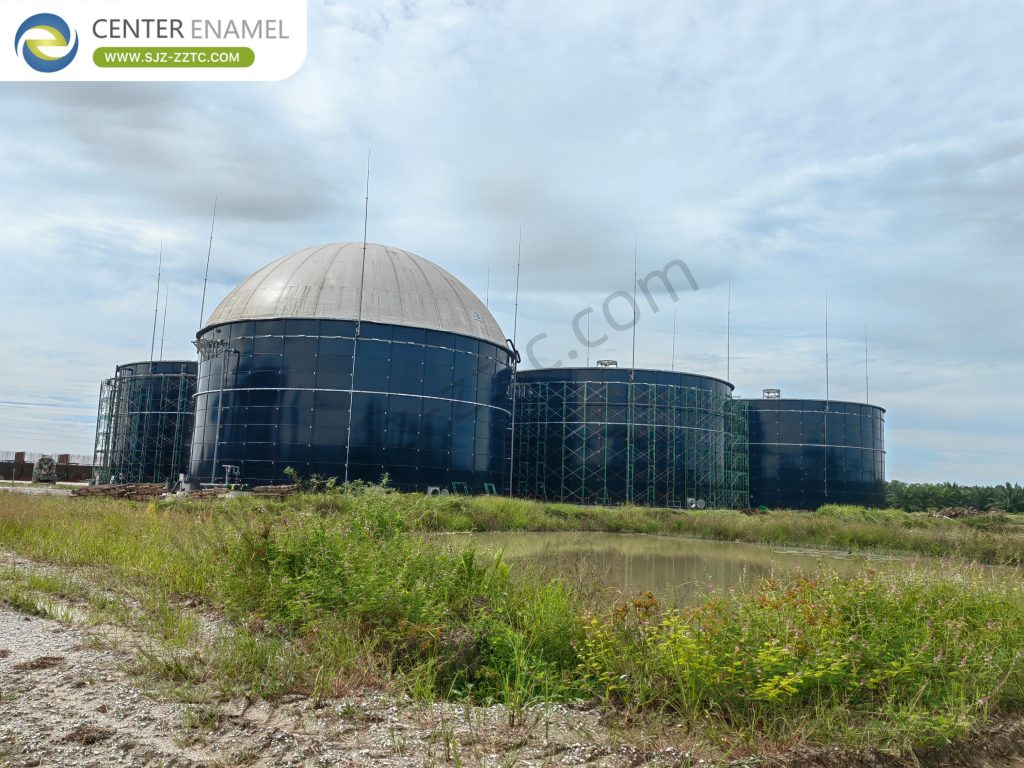
Malaysia Palm Oil Project (Commissioned in 2013, operating for over 13 years)
Location: Malaysia
Tank specification: Φ18.33 m × 8.4 m, 5 units of GFS tanks
Installation efficiency: A team of only 7 people completed all assembly and piping connections within 100 days
Three Frequently Asked Questions (FAQs)
Q1: Between USR and UASB, which is more suitable for POME?
A: USR is more suitable for wastewater with high suspended solids (SS > 2%) because its solids retention time is independently controllable and less prone to clogging. UASB is better for soluble wastewater with SS < 1%. Since POME typically has a solids content of 3%–6%, USR is the preferred process.
Q2: Are GFS tanks prone to corrosion in hot, humid environments?
A: No. The enamel coating on GFS tanks is chemically bonded to the steel through high-temperature firing, providing resistance to salt spray and organic acids. With weather-resistant sealants used during installation, there are cases in Malaysia, Indonesia, and other equatorial regions where they have operated for over 20 years without major repair.
Q3: What footprint and staffing level are required for the entire system?
A: For a daily treatment capacity of 250 tonnes of POME, the pretreatment + USR tank area + gas storage zone typically requires about 800–1,200 m². With PLC automatic control, daily operation and maintenance need only 2–3 attendants, primarily monitoring feed flow, temperature, pH, and gas production.