
Palm Oil Wastewater Treatment in Indonesia | GFS Tanks & EPC Contractor Solutions
Indonesia is the world's largest producer of palm oil. The industry drives economic growth, creates employment, and supports millions of livelihoods. However, palm oil milling generates a highly polluting byproduct: palm oil mill effluent (POME). With extremely high organic load, low pH, and high suspended solids, untreated POME can devastate rivers, kill aquatic life, and generate powerful greenhouse gas emissions.
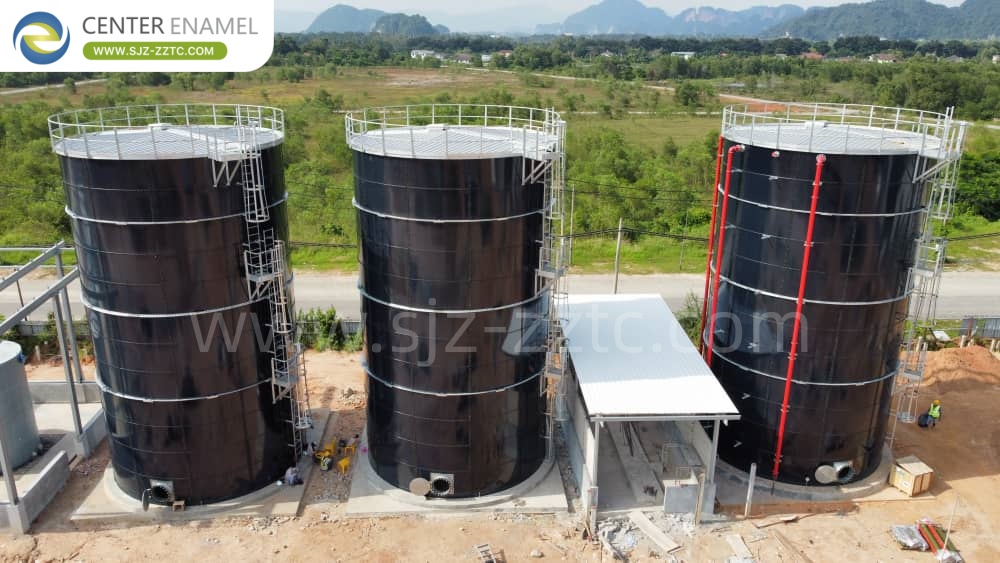
A long-standing Biogas Project in Indonesia addresses this environmental challenge. The facility treats palm oil mill wastewater using three large GFS Tanks (Glass-Fused-to-Steel) as the core anaerobic reactors. The tanks measure Ø19.86 meters in diameter by 8.4 meters in height each. Installed by a team of just 7 people over 40 days in November 2009, the plant has been operating successfully for over 15 years. An experienced EPC Contractor delivered the turnkey solution from planning through installation and commissioning.
This article details the technical specifications, installation advantages, and long-term performance of this palm oil wastewater treatment facility.
Why Palm Oil Mill Effluent (POME) Requires Robust Treatment
Palm oil milling produces large volumes of wastewater from sterilization, clarification, and hydrocyclone operations. POME is characterized by:
Extremely high organic load – COD levels typically 40,000–60,000 mg/L.
High suspended solids – Fibrous material and oil residues.
Acidic pH – Ranging from 3.5 to 5.5.
High temperature – Discharged at 80–90°C from the milling process.
Significant biogas potential – High organic content means high methane yield.
Without proper treatment, POME causes rapid oxygen depletion in receiving waters, kills fish and other aquatic life, generates foul odors, and releases methane directly to the atmosphere – a greenhouse gas 25 times more potent than CO₂.
This Biogas Project demonstrates how robust GFS Tanks provide the durable, corrosion-resistant containment needed for long-term POME treatment and biogas capture.
Project Overview: POME Treatment with Three GFS Tanks
| Parameter | Detail |
| Tank Application | Palm oil wastewater treatment plant |
| Location | Indonesia |
| Tank Model | Ø19.86m × 8.4m (H) |
| Tanks Quantity | 3 units of GFS Tanks |
| Installation Team | 7 people |
| Installation Duration | 40 days |
| Installation Date | November 2009 |
| Operating Status | Operational since 2009 (15+ years) |
| Scope by EPC Contractor | Planning, tank supply, installation, commissioning |
The three GFS tanks operate as anaerobic reactors, digesting POME and producing biogas that can be captured for renewable energy generation. The tanks have been in continuous service since 2009, demonstrating exceptional durability.
GFS Tanks: The Core Technology for POME Treatment
GFS Tanks (Glass-Fused-to-Steel) are the industry standard for anaerobic digestion of aggressive wastewater like POME. Each tank is manufactured by fusing a special glass enamel to steel panels at temperatures exceeding 820°C. This creates a molecular bond that is impervious to corrosion, chemical attack, and abrasion.
Why GFS Tanks Are Ideal for Palm Oil Wastewater
| Advantage | Benefit for POME Treatment |
| Corrosion resistance | Withstands pH 3.5–5.5 POME and H₂S produced during digestion |
| Long service life | Tanks in service for 15+ years (this project) with no degradation |
| Bolted assembly | No on-site welding; fast installation by small team |
| Factory-coated | Consistent quality; no field coating errors |
| Expandable | Additional tanks can be added as mill capacity grows |
| Low maintenance | No repainting or recoating required for decades |
Tank Specifications for This Biogas Project
Each of the three GFS tanks measures:
Diameter: 19.86 meters
Height: 8.4 meters
Volume per tank: Approximately 2,600 m³
Total volume (3 tanks): Approximately 7,800 m³
This total volume provides sufficient hydraulic retention time (HRT) for effective anaerobic digestion of POME, typically 20–30 days depending on the mill's POME output.
Anaerobic Digestion in GFS Tanks
Inside each sealed GFS tank, anaerobic bacteria break down the organic matter in POME through four stages:
Hydrolysis – Complex polymers (carbohydrates, proteins, lipids) are broken into simpler soluble compounds.
Acidogenesis – Simple compounds are converted into volatile fatty acids (VFAs), alcohols, hydrogen, and CO₂.
Acetogenesis – VFAs are converted into acetic acid, hydrogen, and CO₂.
Methanogenesis – Methanogenic archaea convert acetic acid and hydrogen into methane (CH₄) and CO₂.
The biogas produced – typically 60–65% methane – can be collected from the top of the GFS tanks using a gas-tight cover or double-membrane gas holder. This biogas can be:
Fired in a boiler to generate steam for the palm oil mill.
Used in a biogas engine to generate electricity.
Upgraded to bio-CNG for vehicle fuel.
Flared as a safety measure during maintenance.
Installation: 7 People, 40 Days
One of the most significant advantages of GFS Tanks is the speed and simplicity of installation. Unlike cast-in-place concrete tanks, which require weeks of forming, pouring, curing, and waterproofing, GFS tanks arrive as factory-coated panels and bolt together on-site.
Installation Process
For this Biogas Project, the EPC Contractor managed the following installation sequence:
Step 1 – Foundation Preparation
A concrete ring beam foundation was constructed to support the tank walls.
The foundation was leveled to ensure proper panel alignment.
Step 2 – Panel Assembly
Factory-coated GFS panels were delivered to the site.
A team of just 7 workers assembled the panels using high-strength bolts.
No welding was required – eliminating fire hazards and quality control issues associated with field welding.
Step 3 – Sealing and Testing
A sealant was applied between panels to ensure liquid and gas tightness.
Each tank was filled with water to test for leaks before commissioning.
Step 4 – Accessory Installation
Internal piping, mixing systems (if specified), and gas collection domes were installed.
Inlet and outlet connections were made to the tank.
Total installation time: 40 days from start to completion (November 2009).
Comparison with Concrete Tanks
| Factor | GFS Tanks | Cast-in-Place Concrete |
| Installation time | 40 days for 3 tanks | 3–6 months |
| Crew size | 7 people | 15–25 people |
| Welding required | No | Yes (rebar, formwork) |
| Curing time | None | 28+ days for concrete |
| Corrosion resistance | Excellent (glass coating) | Requires epoxy lining |
| H₂S resistance | Impervious | Degrades over time |
| Expandable | Yes (bolt on more panels) | No (demolish and rebuild) |
| Relocatable | Yes (disassemble and move) | No |
The speed of installation was critical for the palm oil mill owner. Faster construction meant earlier commissioning, faster environmental compliance, and quicker return on investment.
Long-Term Performance: Operational Since 2009
The three GFS Tanks have been in continuous operation since November 2009 – over 15 years at the time of this article. Key operational observations include:
No Corrosion or Coating Failure
Despite daily exposure to acidic POME (pH 3.5–5.5) and hydrogen sulfide (H₂S) generated during anaerobic digestion, the glass coating on the GFS tanks remains intact. Concrete tanks treating POME often require recoating or repair within 5–10 years due to acid attack. These GFS tanks have required no major maintenance.
Consistent Biogas Production
The anaerobic digestion process inside the tanks remains stable, producing consistent biogas volume and methane concentration. Regular feeding and proper temperature control (aided by Indonesia's warm tropical climate) maintain high microbial activity.
No Leaks or Structural Issues
The bolted panel joints remain tight. Annual inspections have not identified any leaks or structural degradation. The tanks continue to meet original design specifications.
Low Maintenance Requirements
Unlike steel tanks with field-applied coatings (which can bubble, crack, or peel), the factory-applied glass coating requires no repainting, no recoating, and no chemical-resistant liners. Maintenance consists primarily of:
Routine inspection of bolted joints.
Checking gas collection system integrity.
Monitoring sludge levels and removing excess solids as needed.
The Role of an EPC Contractor in Palm Oil Wastewater Projects
Delivering a three-tank POME treatment facility requires expertise across civil, mechanical, and biological disciplines. The EPC Contractor (Engineering, Procurement, Construction) provides single-point responsibility from concept through commissioning.
Scope Delivered by the EPC Contractor
For this Biogas Project, the EPC Contractor performed:
Planning Phase
Site assessment and topographical survey.
POME characterization and flow rate measurement.
Tank sizing calculations (volume, HRT, organic loading rate).
Foundation design and civil engineering.
Biogas utilization planning (flare or energy recovery).
Regulatory permit assistance.
Procurement Phase
Manufacture of three Ø19.86m × 8.4m GFS tanks with factory-applied glass coating.
Supply of bolting materials, sealants, and accessories.
Gas collection domes or double-membrane covers.
Inlet/outlet piping and internal mixing systems.
Safety equipment (pressure relief valves, flame arrestors).
Construction Phase
On-site supervision of ring beam foundation construction.
Tank assembly supervision (7 workers, 40 days).
Quality control and safety compliance.
Pressure testing and leak detection.
Coordination with local contractors for auxiliary works.
Commissioning Phase
Biological startup: seeding tanks with anaerobic sludge.
Gradual feeding to activate methanogenic bacteria.
Biogas flare testing.
Operator training for daily feeding, sampling, and safety protocols.
Performance testing to guarantee COD removal and biogas yield.
By engaging a single EPC Contractor, the palm oil mill owner avoided the risks of coordinating multiple vendors. The turnkey approach ensured that the three GFS tanks, piping, gas collection, and safety systems function as an integrated whole.
Environmental and Operational Benefits
Pollution Reduction
The three GFS tanks remove the vast majority of organic pollutants from the POME stream:
COD removal: 80–90% (from 50,000 mg/L to 5,000–10,000 mg/L).
BOD removal: Similar range.
Odor control: Enclosed tanks contain odors.
Pathogen reduction: Anaerobic digestion reduces pathogen levels.
The partially treated effluent (digestate) can be further polished in aerobic ponds or used as liquid fertilizer on palm oil plantations.
Biogas as a Renewable Energy Source
With three large GFS tanks treating POME from a substantial palm oil mill, biogas production is significant. Estimated output:
Biogas volume: 3,000–6,000 m³/day (depending on mill capacity).
Methane content: 60–65%.
Energy value: Equivalent to 1,500–3,000 liters of diesel fuel per day.
The biogas can power:
Steam boilers – Reducing or eliminating fossil fuel use for mill sterilization and processing.
Electricity generators – Powering the mill or exporting to the grid.
Combined heat and power (CHP) – Maximizing energy efficiency.
Reduced Methane Emissions
POME lagoons without biogas capture release methane directly to the atmosphere. By capturing and combusting the biogas, this Biogas Project avoids thousands of tons of CO₂-equivalent emissions annually – contributing to Indonesia's climate commitments.
Long-Term Asset Value
The GFS Tanks installed in 2009 remain in excellent condition after 15+ years. Their long service life and low maintenance requirements provide exceptional return on investment. The tanks can continue operating for another 20–30 years with minimal intervention.
Scaling Up: Additional Tanks for Larger Mills
The three-tank configuration provides flexibility for palm oil mills of varying sizes:
| Mill Capacity (Fresh Fruit Bunch/hour) | Typical POME Volume (m³/day) | Recommended GFS Tanks |
| 30–45 tons/hour | 300–450 | 1–2 tanks |
| 45–60 tons/hour | 450–600 | 2–3 tanks |
| 60–90 tons/hour | 600–900 | 3–4 tanks (this project) |
| 90+ tons/hour | 900+ | 4+ tanks in parallel |
The same GFS Tanks and EPC Contractor model applies directly to larger or smaller mills. Only the number and size of tanks change.
15+ Years of Proven Performance
This Biogas Project in Indonesia demonstrates that palm oil mill effluent can be treated reliably and durably using GFS Tanks as anaerobic reactors. Three tanks – each Ø19.86m × 8.4m – were installed by a team of just 7 people in 40 days (November 2009) and have been operating successfully for over 15 years. The tanks show no corrosion, no leaks, and require minimal maintenance.
The turnkey delivery by an experienced EPC Contractor – from planning through installation to commissioning – removed technical risk and ensured the plant was completed on schedule. For palm oil mills across Indonesia and Southeast Asia, this project serves as a proven, replicable benchmark.
By investing in GFS Tanks for POME treatment, palm oil producers can achieve environmental compliance, capture biogas as a renewable energy source, and benefit from decades of low-maintenance, corrosion-resistant operation.
Frequently Asked Questions (FAQs)
Q1: Why are GFS Tanks better than concrete tanks for palm oil wastewater treatment?
GFS Tanks are impervious to the acidic nature of POME (pH 3.5–5.5) and the hydrogen sulfide (H₂S) produced during anaerobic digestion. Concrete tanks require epoxy linings that degrade over 5–10 years and need recoating. The three GFS tanks in this Biogas Project have been operational since 2009 – over 15 years – with no corrosion, no coating failure, and no leaks. Concrete also requires weeks of curing; GFS tanks install in days.
Q2: How fast can a palm oil Biogas Project using GFS Tanks be installed?
Very fast. For this Biogas Project, three large tanks (Ø19.86m × 8.4m each) were installed by a team of just 7 people in 40 days. GFS tanks use factory-coated, bolted panels that assemble on-site with no welding and no concrete curing. This compares to 3–6 months for cast-in-place concrete tanks. Faster installation means earlier environmental compliance and quicker return on investment.
Q3: Can Center Enamel deliver a similar Biogas Project for my palm oil mill as the EPC Contractor?
Yes. As an EPC Contractor, Center Enamel provides complete turnkey solutions including planning, tank manufacturing, installation supervision, and commissioning. Center Enamel is a leading manufacturer of GFS Tanks with decades of experience in palm oil wastewater treatment across Indonesia and Southeast Asia. Their bolted tank design allows rapid installation even at remote mill locations. Contact their team with your mill capacity and POME flow rate for a customized proposal.