
Why Choose Center Enamel for Papermaking Anaerobic Digestion EPC?
Pulp and paper operators are no longer buying a treatment plant-they are buying an economic outcome. The question a mill asks a Papermaking Wastewater Treatment Project EPC Contractor is not simply "will it meet discharge?" but "will fiber recovery, alkali recovery and biogas revenue cover O&M for the next 20 years?" At Center Enamel, our answer is built around Anaerobic Digestion as the core biological process, wrapped in factory-standard GFS tanks, the right roof for each vessel, and a 30,000+ project global delivery and service network.
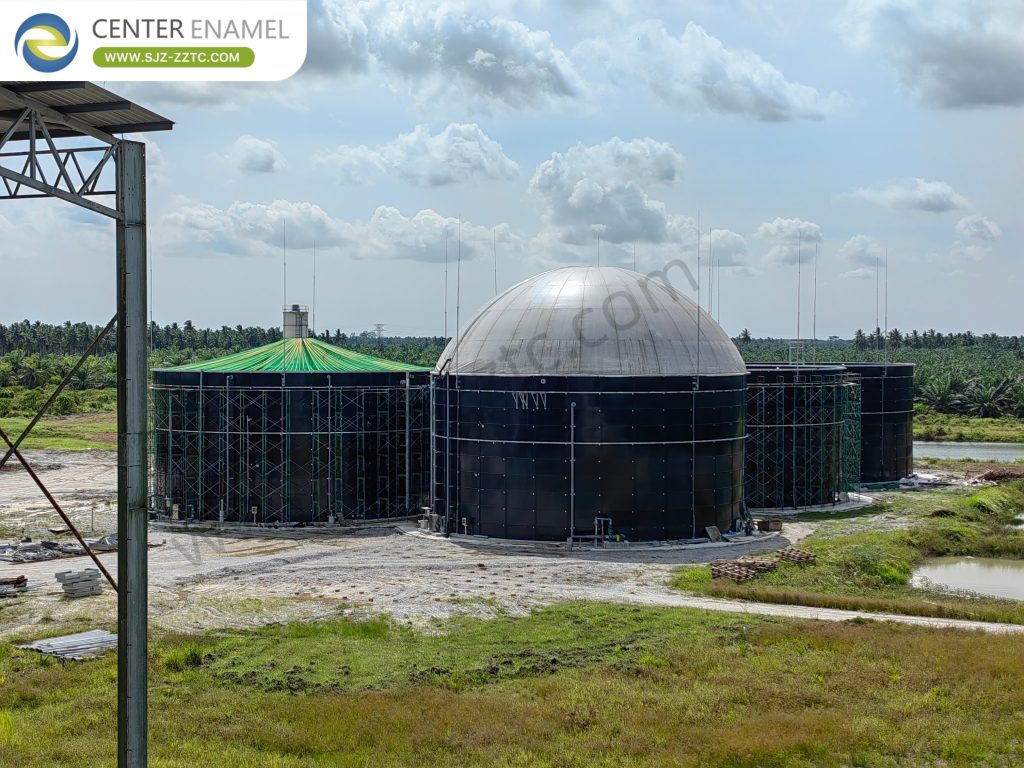
The Market Landscape Behind Modern Mill Wastewater Design
The global industrial wastewater market is diverging. Leading players are building integrated service strength through technology integration and capital operations, and industry concentration is rising. Chinese manufacturers continue to consolidate mid-tier equipment-export advantage; international giants target high-end and complex industrial effluent, while local players win mid-to-low-end and industrial-park centralized treatment on responsiveness and cost.
Within anaerobic treatment, UASB, EGSB and IC reactors dominate high-concentration organic wastewater pretreatment in food processing, pharmaceutical fermentation, alcohol brewing and chemicals-because of high loading rates, small footprints and stable operation. These reactors sit inside steel tank shells, so corrosion resistance and gas-tightness directly decide long-term performance. It is exactly this operating reality that makes glass-fused-to-steel (GFS) tanks increasingly indispensable. For a Papermaking Wastewater Treatment Project EPC Contractor, choosing the right anaerobic reactor inside the right vessel is no longer an engineering detail-it is the core purchase decision.
Why Papermaking Economics Favor Anaerobic Digestion
Papermaking wastewater is unusual among industrial effluents: its O&M economics are genuinely favorable, if the system is designed around resource recovery. White water recycling dramatically cuts the external treatment volume, and modern white-water systems recover large quantities of fiber and water-paying back their capital through direct fiber reuse. Pretreatment fiber recovery can be sold as a by-product, reducing treatment cost. Alkali recovery systems regenerate alkali and burn lignin to generate steam, delivering substantial resource-revenue credits. The downstream Anaerobic Digestion stage plus aerobic polishing is a mature, stable combination with low chemical consumption and moderate energy use. Equipment is mostly conventional pumps and aerators-simple, reliable and cheap to maintain. Fiber sludge itself is recoverable or saleable, keeping disposal costs low.
The combined effect is striking: large volume but moderate pollutant concentration creates economies of scale, and fiber recovery plus alkali recovery plus steam typically cover routine O&M. This is why a Papermaking Wastewater Treatment Project EPC Contractor should price the project not as a cost center but as a resource-recovery island. The table below maps these revenue and cost levers.
| Lever | What Is Recovered | Economic Effect |
| White water recycling | Fiber + process water | Cuts external treatment volume, lowers unit cost |
| Pretreatment fiber recovery | Saleable fiber fines | Offsets treatment O&M directly |
| Alkali recovery | Caustic soda + steam from lignin combustion | Major resource-revenue credit |
| Anaerobic Digestion | Biogas (CH₄-rich) | Energy offset, flaring or power generation |
| Fiber sludge | Recycled or sold as raw material | Minimal disposal cost |
| Scale effect | Large flow, moderate concentration | Lower unit treatment cost |
Where Anaerobic Digestion Fits: The IC Reactor Edge
Not every anaerobic reactor is the right fit for a paper mill. The IC (Internal Circulation) reactor-the high-rate form of Anaerobic Digestion-is designed for high-concentration, high-flow soluble organic wastewater, covering brewery, beverage, starch, pharmaceutical, chemical and papermaking high-strength effluent. It is the preferred choice for land-constrained projects that demand high treatment rates in large industrial facilities, and serves as the primary COD/BOD-removal step for centralized industrial-park WWTPs and large captive mill plants-especially where water quality swings are wide and pollutant concentrations are extreme.
What IC is not suited to is high-solids, high-viscosity wastewater. On a paper line, that means raw fiber-heavy streams must first be screened and equalized before the soluble fraction enters the Anaerobic Digestion reactor. Designed this way, the IC process delivers the compact footprint and biogas recovery that make the mill economics in the previous table actually pencil out.
Factory-Standard GFS Tanks Beat Site-Poured Concrete
The reactor process lives inside a tank-and that tank's quality decides whether the process performs for decades. GFS tanks are fully factory-prefabricated to standardized specifications, with consistency that poured concrete simply cannot match. Concrete tanks are built in the open air: rebar tying, pouring and curing are exposed to worker skill, temperature and rain, so wall thickness, density and strength vary batch to batch, and honeycombing, voids and thin-wall defects are common.
Center Enamel's GFS panels, seals and reinforcements are mass-produced in automated factories. Steel stamping, high-temperature enameling and CNC dimensional cutting are tightly controlled, with every panel's parameters and enamel thickness held to unified national standards. Components ship uniformly packaged, and assembly follows standardized construction drawings. Full-process inspection from raw material to finished panel eliminates the quality risks of on-site concrete-so every tank, whether in Italy, Colombia or a mill in Southeast Asia, performs to the same spec. This is the vessel backbone a Papermaking Wastewater Treatment Project EPC Contractor can stand behind.
Matching the Right Roof to the Right Tank
Inside a treatment plant, not every tank needs a gas-tight biogas roof. Equalization, neutralization, clarified water and firewater tanks only need a weather cover. Center Enamel's FRP (fiberglass-reinforced plastic) roof is the economical, general-purpose answer for atmospheric-pressure tanks with no air-tightness requirement-serving drinking water storage, agricultural irrigation, firewater reserve and temporary production-wastewater holding. It ships in flat or dome profiles, is integrally molded from resin and fiberglass, resists water and mild acid/alkali, will not rust or rot in humid environments, and needs no recurring anti-corrosion painting. The dome profile sheds rain, dust and snow; the flat profile accepts walkways, level gauges and vents. It is fully insulated, avoids galvanic corrosion and will not contaminate drinking water.
The critical caveat-for a Papermaking Wastewater Treatment Project EPC Contractor-is that FRP roofs are not for anaerobic digestion vessels. The Anaerobic Digestion reactor itself must be sealed with a gas-tight dual-membrane or aluminum geodesic cover for biogas collection and odor control. Matching FRP on utility tanks and a gas-tight roof on the digester is how an EPC contractor balances cost against compliance.
Global Delivery: 100+ Countries, 30,000+ Projects
Product quality and process design mean little without on-the-ground delivery. Center Enamel's business spans more than 100 countries and regions, with over 30,000 successful overseas projects across Europe, the Americas, the Middle East, Africa, Southeast Asia and Latin America. Domestically, the company is organized into North, South, Central, East and Southwest marketing regions covering environmental, water utility, livestock and petrochemical customers. Internationally, a "standardized product + localized adaptation" model adjusts corrosion protection, sealing and pressure standards to local water quality and regulations.
The reference portfolio includes large-volume GFS tanks in Italy, 20-meter tower water-supply tanks in Colombia, coastal seawater-treatment tanks in Costa Rica, and large municipal wastewater aluminum-dome projects in Saudi Arabia-plus long-term strategic partnerships with multiple Fortune 500 companies. The table below highlights these landmark deliveries.
| Project Location | Application | Center Enamel Solution | Why It Matters |
| Italy | Large-volume industrial storage | GFS tanks | European high-spec acceptance, benchmark quality |
| Colombia | 20 m tower water supply | GFS elevated tanks | Tall-structure engineering, mountain logistics |
| Costa Rica | Coastal seawater treatment | Corrosion-rated GFS tanks | Salt-spray resistance in marine atmosphere |
| Saudi Arabia | Large municipal wastewater | Aluminum dome roofs | Hot, arid, high-standard municipal delivery |
| Pulp & paper mill (global) | Papermaking Wastewater Treatment Project EPC Contractor package | Anaerobic Digestion (IC) + GFS digesters + gas-tight covers | Compact, resource-recovery-oriented mill delivery |
After-Sales That Protects the 20-Year Bet
A Papermaking Wastewater Treatment Project EPC Contractor relationship does not end at commissioning. Center Enamel's after-sales team runs on rapid response, professional efficiency and full-cycle support, providing 24/7 lifecycle O&M to global clients. Standard remote services cover fault diagnosis, process-parameter tuning and tank anti-corrosion maintenance guidance. For domestic and long-haul overseas clients, technicians can be dispatched for on-site inspection, annual audits and equipment refurbishment. The team also maintains long-term client feedback tracking, continuously collecting tank and anaerobic-equipment operating data to refine product structure and support processes. External technical experts provide specialized help with Anaerobic Digestion commissioning, biogas-upgrading O&M and wastewater upgrade or retrofit projects-ensuring that a mill's digester keeps performing long after handover.
Frequently Asked Questions
Q1. Why is Anaerobic Digestion economically attractive on a papermaking wastewater project?
A. Because fiber recovery, alkali recovery and steam from lignin combustion typically cover O&M, while the Anaerobic Digestion stage itself produces biogas-turning treatment from a cost center into a resource-recovery island.
Q2. What does Center Enamel deliver as a Papermaking Wastewater Treatment Project EPC Contractor?
A. We provide the IC-based Anaerobic Digestion process design, factory-standard GFS tanks, the correct roof (FRP on utility tanks, gas-tight covers on digesters), global installation across 100+ countries, and 24/7 after-sales support.
Q3. Can FRP roofs be used on anaerobic digesters?
A. No. FRP roofs suit atmospheric tanks with no biogas requirement. Anaerobic Digestion reactors need a gas-tight dual-membrane or aluminum geodesic cover for biogas collection and odor control.
Ready to size your next Papermaking Wastewater Treatment Project EPC Contractor scope? Contact us today and share your mill's daily flow, inlet COD, white-water recycle rate and target discharge standard, and our engineers will return an Anaerobic Digestion flowsheet with a GFS tank and roof layout within two business days. From the first process drawing to 24/7 remote support decades later, Center Enamel delivers one accountable, globally proven package for your mill.