
Why Choose Center Enamel for Papermaking Wastewater Anaerobic Digestion?
Every pulp and paper mill faces the same pressure: tighter discharge limits, shrinking plant land, and a growing expectation that wastewater should become a resource rather than a cost. Behind that pressure sits a technical question-how do you treat effluent that is simultaneously high in suspended fibers, strongly alkaline, loaded with refractory lignin, and discharged at tens of thousands of cubic meters per day?
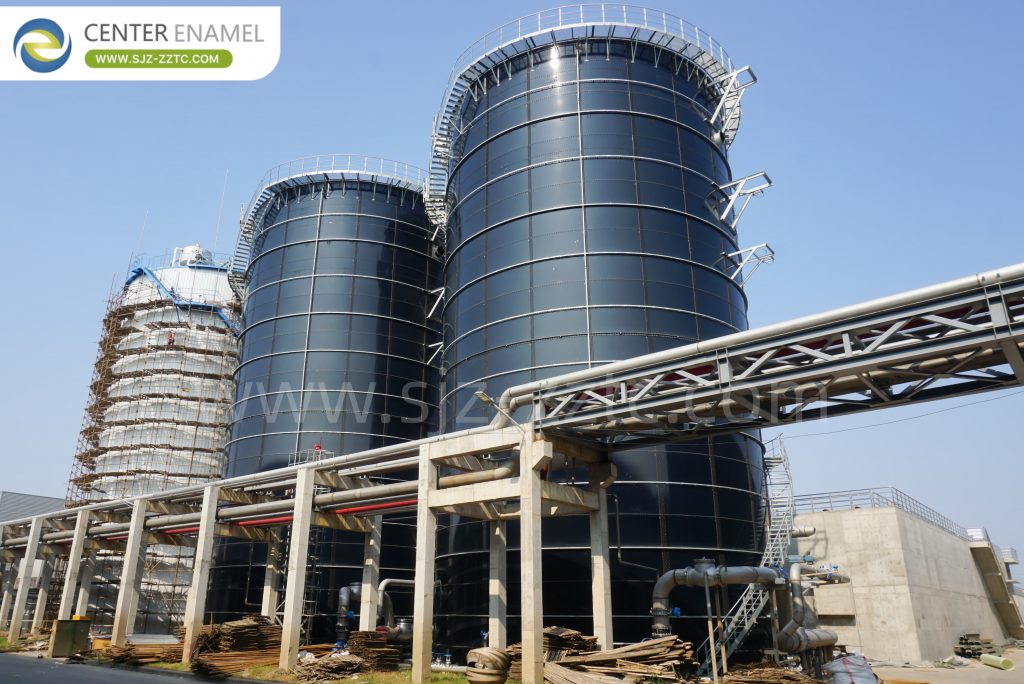
At Center Enamel, our answer combines a proven Anaerobic Digestion core, GFS tank vessels built for compact modern mills, and over a decade of global installation experience-giving pulp and paper operators a complete Papermaking Wastewater Treatment Project delivery model from first flowsheet to commissioning.
Global Policy Is Raising the Bar for Mill Effluent
Industrial wastewater policy worldwide has moved beyond simple "compliance discharge" toward mandatory resource recovery and zero liquid discharge. The EU Circular Economy Action Plan requires member states to raise industrial water reuse rates and extend carbon accounting across the full treatment lifecycle. China continues to tighten limits on total nitrogen, total phosphorus and characteristic pollutants for pulp, paper, chemicals and textile sectors, while water-scarce regions and high-polluting industries are being pushed toward near-zero liquid discharge. Germany has built a differentiated pretreatment system by industry, requiring effluent to meet strict quality thresholds before it even reaches municipal plants.
For papermakers, this means the biological stage can no longer be an afterthought. A robust, compact, energy-generating Anaerobic Digestion process is becoming the heart of any future-proof Papermaking Wastewater Treatment Project-and the tanks that hold it must fit inside increasingly dense mill layouts.
Papermaking Wastewater: A Water Quality Profile Like No Other
No two industrial effluents are identical, but papermaking wastewater sits in a category of its own. It combines high suspended solids, high COD, high alkalinity and very large continuous discharge volumes, with suspended solids being the most distinctive signature. Fibers, calcium carbonate and talc fillers, and colloidal substances push SS into the 1,000–5,000 mg/L range. COD varies widely across the mill-cooking black liquor can exceed 100,000 mg/L, while combined effluent typically lands between 1,500 and 5,000 mg/L. Black liquor pH can climb above 13, and discharge temperatures run hot at 40–60°C. BOD/COD ratios of 0.3–0.45 indicate moderate biodegradability, because lignin, cellulose, resin acids and tannins are slow or resistant to biological breakdown. The table below summarizes this profile at a glance.
| Parameter | Typical Range | Treatment Implication |
| Suspended solids (fibers, fillers) | 1,000–5,000 mg/L | Requires screening and primary sedimentation before Anaerobic Digestion |
| COD (combined mill effluent) | 1,500–5,000 mg/L | Well suited to high-rate anaerobic reactors |
| COD (cooking black liquor) | > 100,000 mg/L | Segregate, evaporate or treat separately; do not send raw to digester |
| pH (black liquor) | > 13, strongly alkaline | Neutralization needed before biological stage |
| BOD / COD ratio | 0.3–0.45 | Moderately biodegradable; refractory lignin needs polishing |
| Discharge temperature | 40–60°C | Favorable for mesophilic/thermophilic anaerobic bacteria |
| Color / organics | Brown; lignin, hemicellulose, resin acids, tannins | Color removal and tertiary polishing may be required |
This profile is exactly why a one-size-fits-all activated sludge design rarely wins for pulp and paper. A purpose-built Papermaking Wastewater Treatment Project must first screen and segregate black liquor, balance pH and temperature, and only then feed the soluble, readily biodegradable fraction into an Anaerobic Digestion core.
How Anaerobic Digestion Works Inside the IC Reactor
At the heart of most modern Papermaking Wastewater Treatment Project biological lines sits the IC, or Internal Circulation reactor. Pretreated high-strength effluent enters the lower main reaction zone from the bottom, where it mixes with recirculated sludge-water and rises rapidly. Anaerobic microorganisms break down dissolved organics and produce large volumes of biogas. The gas-lift effect of that biogas carries the mixed liquor upward to a top gas-liquid separator, where biogas is collected for flaring or energy recovery. The degassed sludge-water then falls by gravity through downcomers back to the reactor bottom-creating an autonomous internal circulation that continuously refreshes contact between granular sludge and incoming wastewater.
After multiple circulation cycles, effluent moves into the upper polishing zone for further reaction and final sludge-water separation. Trace remaining organics are degraded, sludge settles back into the lower zone, treated water overflows at the top, and excess aged sludge is withdrawn periodically. The beauty of the system is that it pumps itself: no external return pumps, no extra energy, and a footprint a fraction of that of a conventional UASB or aeration basin. That compactness is decisive on a crowded mill site-which brings us to the vessels that contain the process.
GFS Tanks: Engineered for the Modern Compact Mill Layout
Conventional poured concrete tanks cannot change volume or shape after they are poured. They require heavy foundations, occupy large, irregular footprints, and leave little room when a mill needs to debottleneck or expand. GFS (Glass-Fused-to-Steel) tanks solve this. Capacities can be specified precisely from dozens of cubic meters up to 50,000 m³, with height and diameter freely combined to fit narrow or oddly shaped plots inside an existing mill boundary. Enamel colors can be customized so the tank farm visually harmonizes with plant buildings. When production expands, GFS tanks can be reconfigured or extended in layout-something a monolithic concrete tank cannot do without demolition.
For a Papermaking Wastewater Treatment Project, this flexibility is strategic. Equalization tanks, neutralization tanks, the Anaerobic Digestion reactors themselves, and final polishing tanks can all be delivered as GFS vessels, erected in weeks rather than months, and lined up on a footprint that concrete could never occupy. The enamel surface is also inherently resistant to the mildly acidic, alkaline and sulfate-rich environment of mill effluent-eliminating the recurring repainting cycle of steel tanks.
Reference Projects: From a South African Brewery to Global Industrial Sites
The design principles above are validated in the field. Center Enamel's high-strength wastewater project in South Africa is a mature African reference: GFS tanks form the primary Anaerobic Digestion system handling brewery effluent's high-COD, high-sugar, readily decomposable load, while stainless steel tanks serve as wastewater transfer and chemical-storage vessels. The same equipment logic-GFS as the process core, stainless steel as utility support-translates directly to a Papermaking Wastewater Treatment Project. The table below places representative Center Enamel deliveries side by side.
| Project / Sector | Core Process | Main Equipment | Key Challenge | Outcome |
| South Africa Brewery | Anaerobic Digestion | GFS digesters + stainless steel tanks | High COD, high sugar, seasonal peaks | Stable, long-running African reference |
| Pulp & paper mill | Anaerobic Digestion (IC reactor) + polishing | GFS equalization, neutralization and digester tanks | High SS, alkaline black liquor, variable load | Compact footprint, compliant discharge |
| Palm oil mill (POME) | High-rate anaerobic biogas system | GFS digesters, dual-membrane or aluminum roofs | High temperature, oil and solids | Biogas recovery, effluent reuse |
| Livestock / swine farm | Anaerobic manure digestion | GFS digesters, gas-tight covers | High solids, odor, nutrient load | Odor control, biogas, nutrient stabilization |
| Municipal / drinking water | Storage and balancing | GFS tanks, aluminum trough deck roofs | Site constraints, corrosion, logistics | Fast erection, long service life |
Behind Every Project: A Manufacturing Base Built for Global Scale
A reference portfolio is only credible if the factory behind it can scale. Center Enamel's intelligent manufacturing base in Hebei Province, China, covers more than 150,000 m², with a mature Phase I facility and a Phase II high-end environmental equipment industrial park operating in parallel. The site integrates R&D offices, proprietary material laboratories and finished-product testing centers, with full-process quality control aligned to ISO, NSF and CE international standards, and is itself certified as a Provincial Green Factory. Six domestic marketing service centers underpin a nationwide production-sales network, and the base's proximity to expressways and logistics hubs supports full container shipping for simultaneous large-scale projects across continents. With over 500 staff and multiple parallel automated production lines, the facility ranks among the world's top-tier GFS tank manufacturers.
That scale matters for a Papermaking Wastewater Treatment Project: mill-sized equalization and digester tanks-often 10,000 to 30,000 m³ each-cannot be improvised in a small workshop. They require repeatable enamel firing, strict batch control and the logistics muscle to ship complete tank packages on schedule.
A Decade of Global Installation Footprint
Equipment is only half the story; installation is the other half. Center Enamel's overseas track record stretches back to 2009, when the first GFS tank crew deployed to Niger, Africa for a drinking water storage installation. In 2015, the company achieved a domestic first by exporting and installing GFS tanks in the United States, passing strict US acceptance criteria. Since then, projects have spread across Southeast Asia, Africa and the Americas, spanning livestock biogas, POME, municipal wastewater and drinking water applications. The team has accumulated specialized know-how for mountainous terrain, coastal salt-spray atmospheres, tropical high-temperature sites, and the stringent standards of European and North American facilities.
For a papermaker evaluating a Papermaking Wastewater Treatment Project, this matters: the same crews who have erected tanks under African sun and American inspection can commission the Anaerobic Digestion line on your mill site-no reliance on local subcontractors still learning GFS assembly.
Frequently Asked Questions
Q1. Is Anaerobic Digestion suitable for papermaking wastewater, given its low BOD/COD ratio?
A. Yes, for the soluble, readily biodegradable fraction. Black liquor and fiber-rich streams should be segregated, screened and pre-treated; the diluted combined effluent (B/C 0.3–0.45) works well in an IC reactor, with aerobic polishing reserved for residual lignin and color.
Q2. Why choose GFS tanks over concrete for a Papermaking Wastewater Treatment Project?
A. GFS tanks deliver volumes from dozens to 50,000 m³ on compact, flexible footprints, resist alkaline and sulfate-rich mill effluent, and can be expanded or relocated-whereas concrete is monolithic, slow to build and difficult to modify.
Q3. Can Center Enamel deliver and install a complete system overseas?
A. Yes. With a 150,000 m² certified base, container-shipping logistics, and crews installed in Africa, the Americas, Southeast Asia and the US since 2009, we deliver end-to-end Anaerobic Digestion and tank packages worldwide.
Planning a new Papermaking Wastewater Treatment Project or debottlenecking an existing line? Contact to us today, our engineers will return a tailored Anaerobic Digestion flowsheet with a GFS tank layout within two business days. From the first process drawing to the roof panels tightened on your site-whether in Asia, Africa, the Americas or Europe-Center Enamel stands behind every cubic meter of treated mill effluent.