
Why a Proven Papermaking Wastewater Treatment Project EPC Contractor Applies GFS Tanks and IC Reactors
The competitive landscape of industrial wastewater treatment is diverging fast. Leading companies are building integrated service capabilities through technical integration and capital operations, and industry concentration is gradually increasing. Chinese companies continue consolidating their advantages in mid-tier equipment exports. International giants target high-end customers and complex industrial wastewater markets, while local players occupy the mid- to low-end and industrial park centralized treatment markets through service responsiveness and cost advantages.
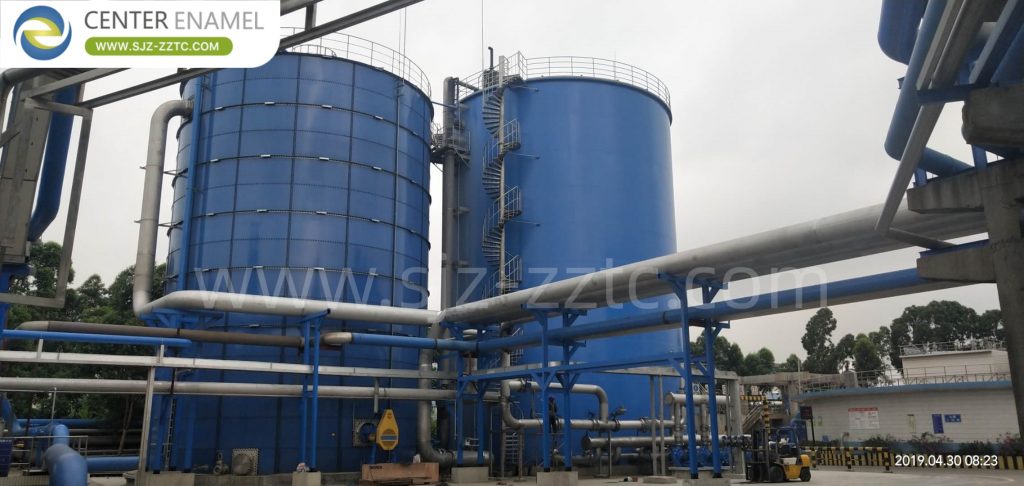
In the anaerobic process segment, UASB, EGSB, and IC anaerobic reactors-valued for high loading rates, small footprints, and stable operation-are widely used for high-concentration organic wastewater pretreatment across food processing, pharmaceutical fermentation, alcohol brewing, and chemical industries. These reactors rely on steel tank shells, and their corrosion resistance and gas-tightness directly determine long-term operational stability. That is precisely where GFS tanks prove their worth, and why selecting the right papermaking wastewater treatment project EPC contractor matters from day one.
GFS Tanks Built for Complex and Changing Media
Center Enamel has independently developed over 200 specialized enamel frit formulations and supporting patents, capable of customizing anti-corrosion enamel based on the customer's storage media-adaptability comprehensively superior to concrete tanks. Concrete tanks use a single material and suit only neutral clean water storage. When storing corrosive materials such as livestock manure, palm oil mill effluent, chemical wastewater, food waste digestate, or high-salinity wastewater, additional anti-corrosion linings must be applied. These linings are prone to failure, preventing long-term stable operation and struggling with alternating high and low concentration conditions. GFS tanks can be specifically formulated with enamels resistant to strong acids, strong alkalis, high organic content, and high salinity. A single tank can switch between multiple wastewater and fermentation feedstock storage requirements, making GFS tanks universally applicable across biogas anaerobic digestion, municipal wastewater, livestock farming, food processing, and industrial water treatment. This eliminates the need to rebuild tanks when media changes-perfectly meeting the needs of diversified, multi-condition environmental protection projects.
| Tank Type | Corrosion Resistance | Media Flexibility | Long-Term Stability |
| Concrete tank | Neutral clean water only | Requires added linings for corrosive media; linings prone to failure | Limited under alternating concentrations |
| GFS tank | 200+ enamel formulations for acids, alkalis, high organics, high salinity | Single tank handles multiple media and feedstock changes | Designed for long-term stable operation |
IC Process Advantages That Change Project Economics
For high-strength organic streams, the IC process delivers top-tier treatment efficiency with a footprint only one-third that of traditional anaerobic processes for the same treatment capacity-a significant compactness advantage on land-constrained sites. Its built-in gas-lift internal circulation requires no external recirculation equipment, achieving autonomous forced mixing of sludge and water. Strong hydraulic mixing ensures thorough microbe-pollutant contact, greatly improving degradation efficiency while withstanding high water quality and hydraulic shock loads. The dual-zone configuration combines high-efficiency degradation with deep polishing for stable effluent quality, supported by a high degree of sludge granulation, strong activity, and very low washout. Operationally, the system offers high automation, stable operation, low failure rates, large biogas production, and outstanding resource recovery benefits. Long-term energy and O&M costs run far lower than traditional anaerobic processes, making the IC process suitable for large-flow, high-concentration industrial wastewater treatment. For a papermaking wastewater treatment project EPC contractor, these advantages translate directly into lower lifecycle cost and more predictable performance.
Environmental Toxicity of Papermaking Pollutants
Understanding what the treatment train must handle is essential to designing it well. Papermaking wastewater pollutants are primarily natural plant extracts with relatively low chemical toxicity, but high suspended solids and high alkalinity cause significant pollution impacts. High-concentration suspended fibers and fillers settle on water bodies, covering riverbed sediments and blocking fish spawning grounds and benthic habitats. Lignin, cellulose, and other organics decompose and consume dissolved oxygen, causing oxygen depletion and fish suffocation. Strong alkaline black liquor directly raises receiving water pH, harming aquatic life and disrupting acid-base balance. Resin acids and tannins have some toxic effects on fish. High color affects light penetration, inhibiting aquatic plant photosynthesis. Large quantities of fibers and fillers cause siltation of rivers and reservoirs. Overall pollution is primarily physical sedimentation and oxygen-demanding organic pollution, with no heavy metals or synthetic toxics-meaning environmental recovery periods are moderate and well-designed treatment can deliver meaningful improvement.
Full-Process Installation Quality Control
Treatment technology performs only as well as its installation. Demonstrating high-standard quality through long-term stable global project performance, Center Enamel has established full-chain quality control standards across four dimensions: factory protection, on-site assembly construction, completion inspection, and long-term warranty-ensuring quality control for every GFS tank. At the factory stage, all enameled panels, seals, and structural components receive rust-proof and moisture-proof independent packaging with dedicated protective supports, preventing damage during sea and land transport and avoiding enamel coating damage.
On-site construction strictly follows unified assembly process specifications-panel-by-panel tightening and leak testing in layers, with air-tightness and verticality testing after each tank section completion. Dual-membrane covers and anaerobic piping undergo simultaneous pressure testing and acceptance. Differentiated quality acceptance standards are customized for different regions: EU and US projects follow stringent CE and NSF inspection criteria, Southeast Asian hot humid regions receive enhanced corrosion protection and sealing acceptance, and remote African sites have additional foundation settlement re-inspection procedures. Upon project completion, complete construction inspection reports, pressure test records, and anti-corrosion appearance acceptance documents are issued, with full photo and video archives retained. Over 10,000 tanks delivered globally have operated long-term without large-scale leakage or structural deformation-preventing future O&M issues at source.
| Quality Control Stage | Key Measures |
| Factory protection | Rust-proof and moisture-proof packaging with dedicated supports; prevents transport damage |
| On-site assembly | Layer-by-layer tightening, leak testing, air-tightness and verticality checks per section |
| Regional acceptance | CE/NSF for EU/US; enhanced corrosion and sealing for Southeast Asia; foundation re-inspection for Africa |
| Completion documentation | Inspection reports, pressure test records, anti-corrosion acceptance, photo/video archives |
Global Project Portfolio and Delivery Reach
Center Enamel's project portfolio covers over 100 countries across Southeast Asia, Africa, Europe, and the Americas-more than 30,000 mature projects-accumulating complete industry solutions across palm oil, livestock, municipal, brewing, and food waste biogas. This breadth allows rapid matching of customized solutions to different regional climates, water quality profiles, and regulations. For clients comparing potential papermaking wastewater treatment project EPC contractor candidates, this track record offers tangible evidence that process design, tank fabrication, and field installation can be delivered consistently across diverse regulatory and climatic conditions. It also shortens project timelines, since proven configurations can be adapted rather than engineered from scratch for every new site.
Economical Tank Covers for Water Storage
Not every tank on a papermaking site requires gas-tight sealing. The Aluminum Alloy Trough Deck Roof is a cost-effective economical tank cover solution for clean water and wastewater storage scenarios, primarily designed for drinking water, production wastewater, and firewater reserve tanks, balancing practicality with cost advantages. The main body is integrally formed from anti-corrosion aluminum alloy plates paired with aluminum support trusses. Its lightweight design imposes less load on the tank foundation, reducing civil construction investment. A naturally formed dense oxide protective layer on the surface resists rain and mild wastewater corrosion, withstands outdoor sun and rain exposure, and effectively blocks wind, rain, insects, fallen leaves, and odor volatilization, protecting water quality by preventing dust and debris from falling in and causing secondary contamination.
The flat roof structure is neat and orderly, allowing installation of maintenance walkways, guardrails, vents, and level monitoring ports on top, facilitating daily inspection and equipment maintenance. The simple sealing structure enables straightforward installation with short construction timelines, and virtually eliminates the need for anti-corrosion painting maintenance, resulting in extremely low operational costs. It suits various small, medium, and large atmospheric pressure water storage tanks and has been widely implemented in waterworks clear water tanks, industrial circulating water tanks, park firewater tanks, and domestic wastewater temporary storage facilities-highly compatible with water storage applications that do not require biogas collection or high-pressure sealing.
Frequently Asked Questions
Q: What does a papermaking wastewater treatment project EPC contractor deliver?
Full scope typically includes process design, GFS tank fabrication, IC reactor supply, installation, commissioning, and operator training from one accountable partner.
Q: Why use GFS tanks instead of concrete for anaerobic reactors?
Specialized enamel resists acids, alkalis, and high salinity without added linings, extending service life and avoiding frequent recoating under changing media.
Q: How is installation quality verified across different regions?
Layer-by-layer leak and air-tightness testing, region-specific acceptance criteria, and full documentation ensure 10,000+ tanks operate without major leakage.
Evaluating partners for an upcoming papermaking wastewater treatment project and need process and containment expertise under one roof? Send us your effluent profile and site conditions for a tailored IC reactor and GFS tank configuration. Connect with Center Enamel today and work with an EPC contractor whose quality control and global delivery record speak for themselves.