
Optimize Your Pharmaceutical Wastewater Treatment Project with Durable GFS Tanks
Global industrial wastewater treatment policies are escalating from "compliance discharge" to mandatory "resource recovery" and "zero liquid discharge." The EU, through its Circular Economy Action Plan, requires member states to increase industrial wastewater reuse rates and extends carbon footprint accounting to the full life cycle of wastewater treatment. China continuously updates and tightens industrial water pollutant discharge standards, with increasingly stringent limits on total nitrogen, total phosphorus, and characteristic pollutants for industries such as chemicals, pharmaceuticals, and printing and dyeing.
Some water-scarce regions and highly polluting industries are mandated to adopt zero or near-zero liquid discharge technologies. Germany has established a differentiated pretreatment technical standard system by industry, requiring industrial wastewater to meet specific quality requirements before discharge into municipal wastewater treatment plants, implementing strict source control.
Prefabricated GFS Tanks Ensure Quality Control
GFS tanks are fully factory-prefabricated to standardized specifications, with finished product quality stability far exceeding cast-in-place concrete tanks. All concrete tank processes are completed in the open air, with rebar tying, concrete pouring, and curing heavily influenced by worker skill, temperature, and rainfall. Wall thickness, density, and strength vary significantly between batches, with hidden defects like honeycombing, voids, and insufficient wall thickness common-quality cannot be uniformly controlled.
Center Enamel's GFS tank steel panels, seals, and reinforcement components are all mass-produced in automated factories. Steel stamping, high-temperature enameling, and dimensional cutting are all controlled by CNC equipment, with each panel's parameters and enamel thickness strictly following unified national standards. All components are uniformly packaged and transported to site, with assembly strictly following standardized construction drawings. Full-process quality inspection from raw materials to finished components ensures highly consistent product performance parameters, completely eliminating the uncontrollable quality risks of on-site concrete construction, with every tank delivering stable, consistent performance.
Supporting Equipment in CSTR Process Systems
The core equipment is a vertical sealed anaerobic reactor tank, with Center Enamel GFS tanks as the mainstream choice for high-corrosion, high-viscosity wastewater conditions. The key operating equipment is a low-speed mechanical stirrer, comprising motor, gearbox, and impeller blades, achieving uniform mixing throughout the reactor and preventing sedimentation and crusting. Supporting equipment includes corrosion-resistant feed pumps, flow control valves, and inlet piping for precise feed flow control; biogas collection systems (piping, water seals, dual-membrane gas holders, desulfurization units) for biogas collection, purification, and storage. Online monitoring equipment for temperature, pH, and liquid level is integrated for real-time reaction parameter monitoring. Sludge discharge pumps, return piping, and emergency drain systems complete the equipment package, with convenient operation and maintenance, low failure rates, and support for long-term continuous stable operation.
Standardized Treatment Solutions for Effluent
Core treatment uses a mature train of "oil separation/cooling pretreatment + CSTR/USR anaerobic digestion + aerobic treatment + advanced treatment"-perfectly suited for POME's high-concentration, high-oil, high-temperature, low-pH characteristics. Pretreatment: Raw POME first enters oil separation tanks/oil separators to remove free and dispersed oil-recovered palm oil can be sold as a resource, significantly reducing organic load. Cooling towers/heat exchangers reduce temperature from 60-80°C to 35-38°C for mesophilic anaerobic digestion. Lime/NaOH addition adjusts pH from 4.0-5.0 to 6.8-7.2 for optimal anaerobic conditions. Screens and sedimentation tanks remove fruit shell fibers, fruit pulp residues, and other large suspended solids to prevent distribution system and pipe clogging.
Main anaerobic treatment: Center Enamel CSTR or USR anaerobic reactors with GFS tanks as core reaction equipment, suited to POME's high-concentration, high-oil, high-suspended-solids conditions. CSTR mechanical mixing addresses oil floating layers, suspended solids sedimentation, and surface crusting-the three major challenges-ensuring thorough material-microbe contact. USR simplifies internal structure with anti-clogging, high-solids tolerance-suited for high-suspended-solids POME. Single GFS anaerobic tank effective volume 3,000-10,000 m³, with multiple tanks configurable for different mill capacities. Anaerobic digestion HRT 20-30 days, COD removal 80-90%, BOD removal 85-92%, with simultaneous large-volume biogas production.
Aerobic treatment: Anaerobic effluent still has COD 3,000-10,000 mg/L-requiring aerobic polishing. A/O, A²O, or SBR processes further degrade residual organics and remove nitrogen/phosphorus, reducing COD to 200-500 mg/L and BOD to 50-100 mg/L.
Advanced treatment: Depending on discharge standards or reuse requirements, BAF, coagulation/sedimentation, sand filtration, or constructed wetlands reduce COD to below 100 mg/L and ammonia to below 10 mg/L for irrigation reuse or surface discharge compliance.
Biogas utilization: POME anaerobic digestion produces exceptionally high biogas yields-8-15 m³ biogas per m³ wastewater-after desulfurization and dehydration, biogas can be used for CHP, meeting 30-50% of mill electricity demand, with waste heat used for digester heating and FFB sterilization preheating-achieving energy self-sufficiency.
Large-Scale Biogas Plant Operations
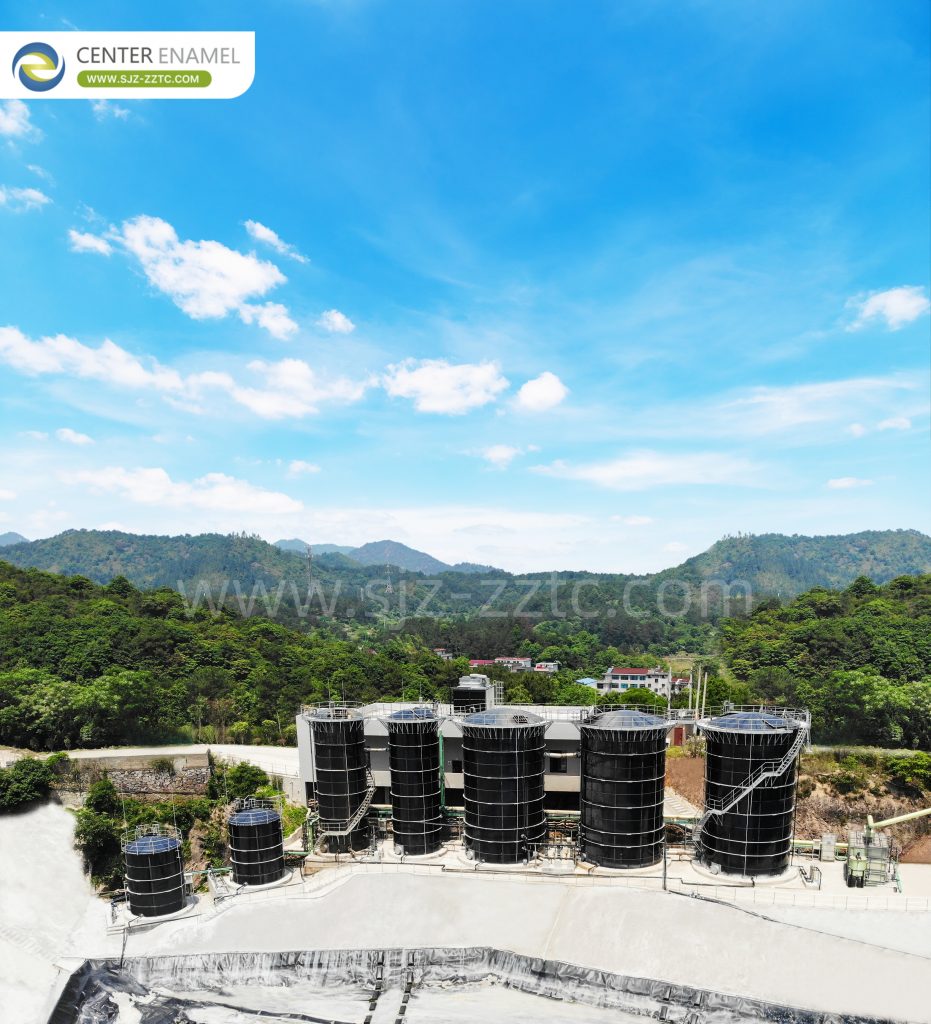
The project uses Center Enamel GFS tanks as the core anaerobic digestion facility with 5 tanks, each with effective volume of 5,400 m³, total effective volume 27,000 m³. Influent COD ≥ 60,000 mg/L, BOD ≤ 25,000 mg/L. After anaerobic digestion, effluent COD drops to below 12,000 mg/L, BOD ≤ 5,000 mg/L-overall organic removal efficiency approximately 80%. Single tank daily biogas production 4,400 m³, total project daily biogas 22,000 m³-stable biogas yield of 0.45 m³ per kg COD removed-efficient biogas energy recovery while solving palm oil processing wastewater pollution.
Global Expertise for a Wastewater Treatment Project
The marketing team brings together environmental industry multi-skilled professionals and multilingual foreign trade specialists, with deep expertise in global biogas, wastewater treatment, and biomass new energy markets-accumulating extensive practical project experience in Southeast Asia, Africa, Europe, and the Americas.
The team is proficient in various countries' wastewater discharge regulations, biogas subsidy policies, and carbon trading rules-providing one-stop preliminary site survey, solution planning, and investment return analysis consulting services. With multilingual capabilities (English, French, Spanish, Arabic), the team effectively communicates with clients worldwide-precisely matching regional industrial resources, project budgets, and environmental requirements-customizing high-cost-performance GFS tanks and anaerobic reactor solutions based on client production capacity, treatment targets, and gas production expectations. Leveraging extensive overseas project experience, the team proactively helps clients avoid risks in overseas approvals, equipment import, and construction implementation-building a globally adaptable integrated environmental equipment business service system.
International Certifications for Environmental Engineering
Center Enamel holds CE, NSF, WRAS, ISO9001, BSCI, ASME, and other global certifications-fully clearing EU, North American, Southeast Asian, and African project tendering barriers-providing critical hard credential advantages for large overseas project bidding.