
Pig Farm Wastewater Solution: Treatment And Tankage For Swine Operations
A pig farm wastewater solution combines solid-liquid separation, anaerobic treatment (often UASB), and AOAO aerobic polishing inside corrosion-resistant tankage. The train cuts the very high COD, ammonia, and pathogen load of swine effluent down to permit limits while recovering biogas from the organics.
Why Swine Effluent Is Demanding
Pig farm wastewater is among the strongest farm streams: COD commonly exceeds 10,000 mg/L and ammonia can top 1,000 mg/L. That load drives both the reactor volume and the aeration energy, so the design must treat the stream as high-strength industrial-grade effluent rather than ordinary sewage.
| Driver | Typical Range | Design Impact |
| COD | greater than or equal to 10,000 mg/L | Large anaerobic volume |
| Ammonia N | greater than or equal to 1,000 mg/L | Strong aerobic polishing |
| Total P | greater than or equal to 200 mg/L | Phosphorus capture |
| SS | greater than or equal to 10,000 mg/L | Separation upstream |
The Swine Treatment Train
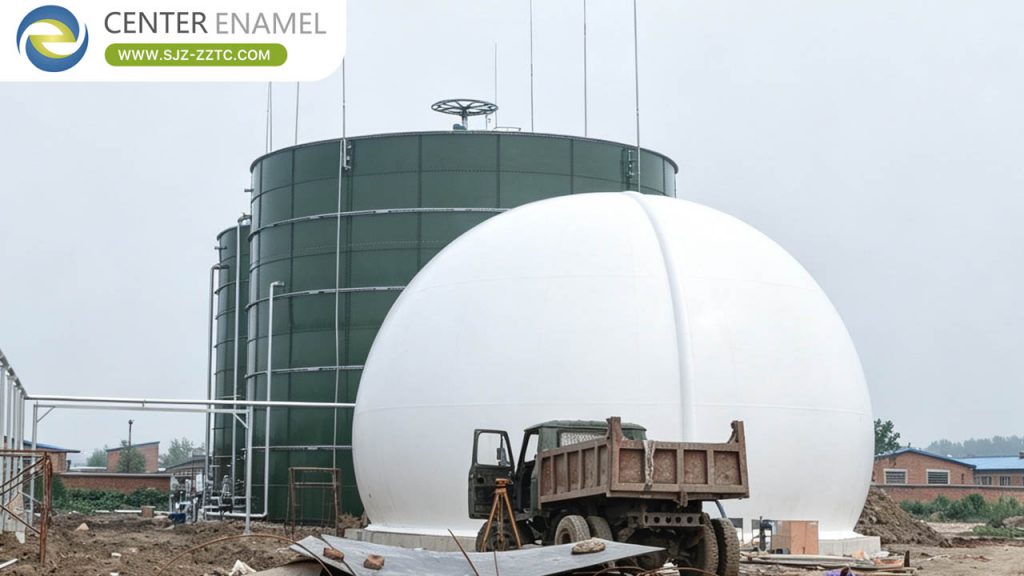
Solids are separated first, then the liquid enters an upflow anaerobic reactor for COD and biogas, followed by an anoxic-aerobic (AOAO) train for nitrogen and phosphorus. The sealed anaerobic stage is usually a Glass-Fused-to-Steel tank, chosen for its resistance to the corrosive, high-ammonia manure environment.
A Boundary Condition
A UASB performs best on warm, low-solid, soluble feed; if the separated liquid still carries heavy suspended solids or runs cold, the bed can wash out. Where that risk is high, a mixed CSTR or a USR may be the safer anaerobic choice for the same pig farm.
Project Case Study: Beijing 5S Pig Farm Wastewater Treatment Project
Project / Application: Pig farm wastewater, Beijing, China. Industry: Livestock (swine). Tank Type: UASB plus AOAO process. Key Requirements: High-strength manure wastewater treatment with pathogen reduction.
| Field | Value | Source / Evidence |
| Daily Treatment Volume | 580 m3/day | Company project reference |
| Treatment Process | UASB + AOAO | Company project reference |
| Installation Year | 2020 | Company project reference |
| Tank Dimensions | Not Provided In The Available Source | Process and capacity documented |
| Pollutant | Influent | Effluent |
| COD Cr | greater than or equal to 10,000 mg/L | less than or equal to 200 mg/L |
| Ammonia N | greater than or equal to 1,000 mg/L | less than or equal to 80 mg/L |
| Total P | greater than or equal to 200 mg/L | less than or equal to 8 mg/L |
| SS | greater than or equal to 10,000 mg/L | less than or equal to 100 mg/L |
| BOD5 | greater than or equal to 8,000 mg/L | less than or equal to 100 mg/L |
| Fecal Coliforms | greater than or equal to 5.6e6 CFU/100ml | less than or equal to 4.0e3 CFU/100ml |
About The Supplier
Shijiazhuang Zhengzhong Technology Co., Ltd (Center Enamel) manufactures Glass-Fused-to-Steel tanks for pig farm and livestock wastewater, with enamel firing at 820-930 C and certifications including ISO 9001, NSF/ANSI 61, and CE-EN 1090. The bolted system supports rapid on-farm tank delivery.
Comparison: Anaerobic Choices For Swine
| Reactor | Best When | Note |
| UASB | Warm, low-solid liquid | High loading, low energy |
| CSTR | Uniform slurry with solids | Mixed and heated |
| USR | Coarse high-solid feed | Holds solids without fine mixing |
A pig farm wastewater solution works when separation, anaerobic digestion, and AOAO polishing are engineered as one train sized to the real strength. Choose the anaerobic reactor from the solids and temperature, then let corrosion-resistant tankage make it durable.
Frequently Asked Questions
Q1: How is pig farm wastewater treated? A1: Separate solids, digest anaerobically, then polish with AOAO for nitrogen and phosphorus.
Q2: Which process cuts ammonia and COD? A2: UASB removes most COD and makes biogas; AOAO strips ammonia and phosphorus.
Q3: What tankage suits swine effluent? A3: A Glass-Fused-to-Steel tank with factory-fired enamel resists the high-ammonia corrosion.
Q4: Can a pig farm recover biogas? A4: Yes, the anaerobic stage returns biogas from the organics at 55-65% methane.
Q5: Why separate solids first? A5: It protects the reactor and improves gas quality.
Q6: What temperature does AD need? A6: Mesophilic digestion typically runs at 35-38 C.
Q7: How strong is swine effluent? A7: COD often exceeds 10,000 mg/L with ammonia above 1,000 mg/L.
Q8: How fast can tankage be built? A8: Bolted GFS panels erect in weeks, faster than concrete.
Share your swine herd size and effluent limits with an engineer, or request a pig farm wastewater treatment and tankage scope.