
Professional Biogas Plant Design with Durable GFS Tanks and UASB Process Technology
The global livestock industry generates vast quantities of organic wastewater that, if left untreated, poses significant environmental and public health risks. As nations intensify their commitments to agricultural carbon reduction, the demand for integrated treatment systems has grown exponentially. Successful Biogas Plant Design integrates multiple engineering disciplines-from waste collection and anaerobic digestion to biogas utilization and digestate management. At the heart of these systems, GFS Tanks provide the corrosion-resistant, long-lasting containment essential for stable fermentation, while the UASB Process delivers exceptional organic degradation efficiency with minimal energy consumption. Together, these technologies enable farms and industrial facilities to transform waste into renewable energy and valuable fertilizer.
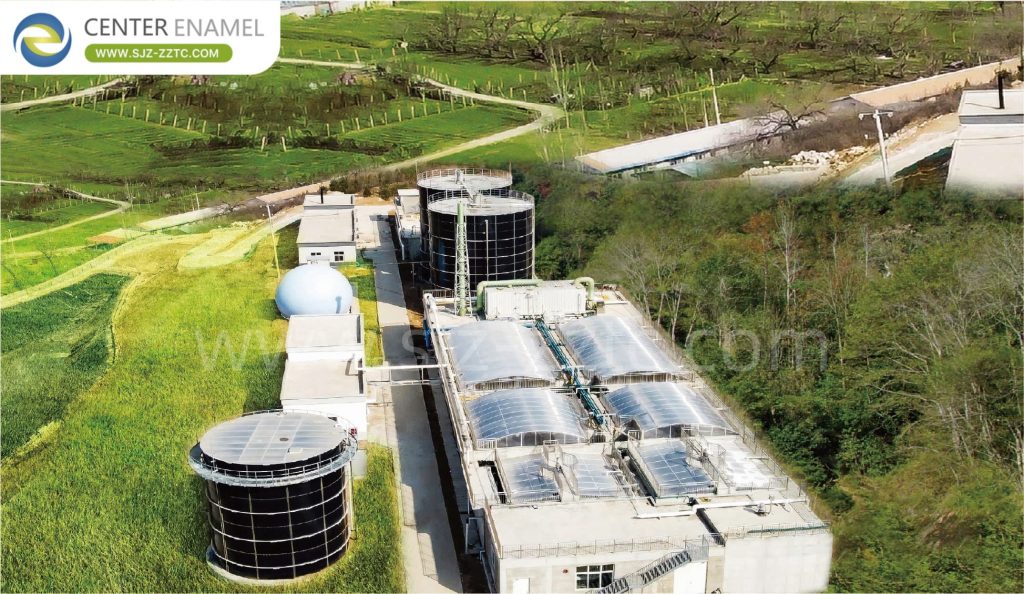
Regional Development Status: Diverse Pathways Toward Manure Management
Global livestock inventories such as swine remain stable. The US has developed technical models represented by integrated crop-livestock systems with on-field application and Comprehensive Nutrient Management Plans; Denmark, the Netherlands, and others have developed centralized biogas projects with digestate application systems. China's large-scale farms still have considerable room for improvement in supporting biogas project coverage, and digestate resource utilization rates lag behind advanced European levels. Greenhouse gas emissions from livestock account for a significant proportion of total global anthropogenic emissions, making manure management a critical battleground for agricultural carbon reduction. Latin American countries started later in manure management but are accelerating relevant infrastructure development.
This varied global landscape creates diverse opportunities for specialized Biogas Plant Design providers who can adapt proven technologies to local regulatory frameworks, climate conditions, and waste characteristics. Whether deploying GFS Tanks in the cold climates of Northern Europe or implementing the UASB Process in tropical Southeast Asia, the core engineering principles remain consistent-maximize biogas yield, minimize footprint, and ensure long-term operational reliability.
GFS Tanks: Engineered for Modern Intensive Plant Layouts
GFS Tanks offer flexible customization of size and appearance, with higher land utilization rates, ideally suited for modern compact plant layouts, with significant advantages over fixed poured concrete tanks. Concrete tanks cannot alter volume or shape after pouring, with heavy bases occupying large areas, making placement difficult on narrow or irregular plots. Their rough, uniform appearance cannot match modern facility aesthetic requirements.
GFS Tanks volume can be precisely customized as needed, with capacities ranging from dozens of cubic meters to 50,000 cubic meters freely selectable. Tank height and diameter can be flexibly combined to fit narrow or irregularly shaped plots, effectively saving plant land occupation. Enamel color customization is also supported, achieving visual harmony with plant buildings and environmental facilities. During later plant expansion, GFS Tanks can be directly adjusted in layout and expanded; concrete tanks, being monolithic structures, must be demolished and rebuilt, offering less flexibility in land resource utilization. This aligns well with the intensive construction and aesthetic operation and maintenance needs of industrial parks.
The modular nature of GFS Tanks makes them ideal for phased Biogas Plant Design implementation, allowing operators to scale capacity incrementally as waste volumes increase or energy demands grow. This flexibility is particularly valuable in rapidly developing regions where future expansion is anticipated but initial capital may be limited.
UASB Process Definition: The Benchmark Anaerobic Technology
UASB, or Upflow Anaerobic Sludge Blanket Reactor, is the benchmark mainstream technology for medium-to-high concentration soluble organic wastewater treatment. It requires no mechanical mixing or media carriers, relying on the upward flow of wastewater to suspend and expand granular sludge within the reactor, forming a stable sludge bed layer. Highly active anaerobic granular sludge efficiently degrades pollutants, with excellent settleability and high microbial concentration. The UASB Process innovatively integrates reaction, sedimentation, and gas-liquid-solid separation functions, simplifying the anaerobic treatment process with advantages of high efficiency, energy savings, and compactness. It is widely used in various medium-to-high concentration soluble organic wastewater treatment applications.
When incorporated into comprehensive Biogas Plant Design, the UASB Process enables COD removal exceeding 80% while producing biogas with methane content typically between 55-65%. Combined with GFS Tanks as the primary fermentation vessels, this configuration delivers exceptional performance in treating wastewater from livestock operations, food processing plants, breweries, and pulp and paper mills-making it a cornerstone technology for modern biogas facilities worldwide.
Livestock Wastewater Sources: Understanding the Waste Stream
Livestock wastewater is the core agricultural pollution wastewater from large-scale poultry, livestock, and aquaculture operations, generated primarily during farming operations and facility cleaning. Poultry and livestock wastewater is the main component, including wash water from pig, cattle, and poultry housing, manure and urine seepage, and facility washdown-rich in livestock metabolic residues. Aquaculture wastewater comes from periodic pond water exchange and pond cleaning, with feed residues and metabolic waste as pollutants. Wastewater is primarily generated in peri-urban and rural farming areas. Small-scale farmers lack adequate collection facilities, with wastewater discharged directly to land and water. Large-scale farms have collection systems for centralized treatment, with water production varying with production cycles and cleaning frequency.
Accurate characterization of these waste streams is essential for optimal Biogas Plant Design. The high organic loading, elevated ammonia-nitrogen, and variable flow rates characteristic of livestock wastewater demand robust treatment trains with sufficient buffering capacity. The combination of GFS Tanks for primary digestion and the UASB Process for high-rate treatment provides the necessary resilience to handle these challenging conditions while maintaining stable biogas production.
Center Enamel Professional Construction Team Manpower Reserve
Center Enamel has established its own domestic and international certified construction teams, with regular practical training on GFS Tanks installation and overseas construction standards for various countries. Domestically, regional construction teams cover multiple zones, capable of simultaneously deploying multiple teams for large tank farm projects. Internationally, cross-border professional installation teams are equipped to various country construction standards-sufficient manpower reserves ensure uninterrupted construction delivery for remote African sites, high-standard European/American facilities, and other projects.
This extensive construction capability ensures that Biogas Plant Design blueprints are translated into operational reality with precision and efficiency. Whether managing a complex UASB Process installation or erecting multiple GFS Tanks across a sprawling farm campus, Center Enamel's certified teams deliver consistent quality under diverse site conditions and regulatory regimes.
Center Enamel Innovative Material Technology
Center Enamel has independently developed over 200 anti-corrosion enamel formulations, with proprietary double-sided double-layer enameling technology-GFS Tanks anti-corrosion service life exceeds 30 years-far surpassing concrete and ordinary equipment-suitable for global high-corrosion wastewater and biogas fermentation conditions.
This material innovation is fundamental to reliable Biogas Plant Design in aggressive environments. The high sulfide, ammonia, and organic acid concentrations present in anaerobic digesters would rapidly degrade conventional steel or concrete vessels. By specifying GFS Tanks with Center Enamel's proprietary coating technology, project developers ensure that their UASB Process reactors and storage tanks maintain structural integrity and performance over decades of continuous operation, dramatically reducing lifecycle costs.
FRP Roof Cover Solution: A Cost-Effective Alternative for Non-Airtight Applications
FRP Roof is a general-purpose economical roof for atmospheric pressure storage tanks without air-tightness requirements, suitable for drinking water storage, agricultural irrigation water, firewater reserve, and general production wastewater temporary storage. It is available in two styles: flat and dome, allowing flexible selection based on tank specifications and site aesthetic requirements. The roof is integrally molded from resin and fiberglass, lightweight, with natural water resistance and mild acid/alkali corrosion resistance. It will not rust or rot in long-term humid environments, eliminating the frequent anti-corrosion maintenance required for metal roofs. The dome style features excellent drainage performance due to its curved structure, resisting water accumulation, dust buildup, snow load, and strong winds. The flat style facilitates the installation of maintenance walkways, level gauges, and vents on top, making inspection and operation convenient.
The product is fully insulated with no risk of galvanic corrosion, will not contaminate drinking water quality, and meets environmental standards for domestic water storage. The modular design with low individual component weight allows for simple on-site hoisting and assembly, offering high construction efficiency and affordable procurement and installation costs. It is only suitable for atmospheric pressure water storage tanks without biogas collection or pressurization requirements, and is not recommended for anaerobic fermentation gas-producing conditions. It is widely used in rural agricultural water storage tanks, industrial park firewater tanks, waterworks buffer tanks, and small to medium-sized domestic wastewater temporary storage facilities, making it a cost-effective general-purpose roof choice for conventional water storage applications.
While GFS Tanks equipped with aluminum geodesic domes are preferred for biogas collection in UASB Process applications, the FRP roof solution provides an economical covering option for auxiliary tanks within the broader Biogas Plant Design. This allows operators to optimize capital allocation-investing in high-performance sealing systems for digesters while using cost-effective covers for clarification, equalization, and storage tanks that do not require gas-tight containment.
Frequently Asked Questions
Q1: What factors influence Biogas Plant Design for livestock wastewater?
Key factors include waste characteristics (COD, ammonia-nitrogen, suspended solids), climate conditions, available land area, and end-use requirements for biogas (CHP generation or grid injection). The UASB Process within GFS Tanks is widely selected for high-strength soluble organic wastewater due to its low energy consumption, compact footprint, and excellent COD removal efficiency (>80%).
Q2: Why are GFS Tanks preferred over concrete for UASB Process reactors?
GFS Tanks offer superior corrosion resistance to acidic biogas environments, high hydrogen sulfide, and ammonia. Their modular design enables rapid installation (40-60 days) and future expansion without demolition. The smooth glass surface prevents biofilm buildup and simplifies cleaning, while the 30-year design life and minimal maintenance deliver significantly lower lifecycle costs compared to concrete alternatives.
Q3: What construction support does Center Enamel provide for international projects?
Center Enamel maintains domestic and internationally certified construction teams with regular training on GFS Tanks installation and overseas standards. Cross-border teams can be deployed to remote African sites, high-standard European/American facilities, and other complex locations. Sufficient manpower reserves ensure uninterrupted project delivery, with full coordination of civil works, tank assembly, piping, and commissioning.