
Professional Biogas Project Contractor: Engineering Success with GFS Tanks and UASB Process
Global livestock inventories such as swine remain stable. The US has developed technical models represented by integrated crop-livestock systems with on-field application and Comprehensive Nutrient Management Plans; Denmark, the Netherlands, and others have developed centralized biogas projects with digestate application systems. China's large-scale farms still have considerable room for improvement in supporting biogas project coverage, and digestate resource utilization rates lag behind advanced European levels. Greenhouse gas emissions from livestock account for a significant proportion of total global anthropogenic emissions, making manure management a critical battleground for agricultural carbon reduction. Latin American countries started later in manure management but are accelerating relevant infrastructure development.
As global demand for sustainable energy grows, the need for professional infrastructure becomes more pressing. Entrusting your site to a reliable Biogas Project Contractor ensures that international best practices are seamlessly integrated into local operations. A strong partnership at this stage lays the foundation for decades of environmental compliance and energy efficiency.
GFS Tanks: Superior Corrosion Resistance Compared to Traditional Concrete
Center Enamel's independently developed double-sided double-layer enameling technology is the industry's leading coating anti-corrosion technology, with corrosion resistance completely surpassing concrete tanks. Concrete tank interiors are riddled with pores, allowing wastewater and acid/alkaline media to easily penetrate and corrode the structural layer. Long-term use leads to irreversible problems such as internal wall spalling, water seepage, and rebar corrosion, which are difficult to repair and cannot be fundamentally resolved.
GFS tanks feature high-temperature enameling on both the interior and exterior surfaces of steel panels, with a dense, non-porous enamel finish that completely blocks corrosive liquids and biogas permeation. The enamel layer has extremely strong chemical stability, resisting acids, alkalis, salts, and microbial corrosion. Concrete tanks will develop extensive corrosion and leakage after 5-8 years of use, while GFS tank anti-corrosion service life can exceed 30 years, with no need for frequent internal lining repairs throughout the service life, significantly reducing long-term anti-corrosion maintenance investment and fundamentally eliminating environmental risks of medium leakage contaminating sites and groundwater. Compared to traditional concrete and FRP tanks, GFS tank coatings have no risk of peeling or blistering, and are adaptable to highly corrosive conditions such as palm oil mill effluent, livestock manure, and chemical high-salinity wastewater, with outstanding long-term comprehensive cost advantages.
Beyond structural durability, the biological efficiency of a biogas plant is defined by its core treatment technology. Mastering the conversion of waste into energy requires a sophisticated approach to anaerobic digestion. This critical process is what ultimately determines the project's output and operational stability.
UASB Reaction Process
After pretreatment through screens and equalization tanks to remove impurities and balance water quality and flow, wastewater is uniformly fed into the reactor through the bottom distribution system. The wastewater rises at a constant rate through the high-concentration granular sludge bed at the bottom, where anaerobic microorganisms rapidly degrade most organic matter, converting it into biogas, clean water, and a small amount of sludge. Gentle hydraulic mixing maintains sludge suspension, expanding microbial contact area. Remaining pollutants continue to degrade in the mid-section suspended sludge layer, with the mixed liquor finally entering the top three-phase separator for gas, solid, and liquid separation. Biogas is collected upward for utilization, sludge settles back to the reaction zone, treated effluent overflows from the top, and aged sludge is periodically discharged-fully automated continuous operation. Implementing the UASB Process ensures that your facility achieves peak degradation performance consistently.
Effective wastewater treatment also relies on a deep understanding of the specific waste characteristics at hand. By analyzing the unique water quality challenges, engineers can optimize the system for long-term reliability. A tailored design approach mitigates risks and enhances the overall performance of the treatment cycle.
Livestock Wastewater Key Water Quality Characteristics
Typical high-concentration organic wastewater with "four highs"-high COD, high ammonia nitrogen, high total phosphorus, and high suspended solids-very high pollution load. Livestock wastewater COD can exceed 8,000 mg/L, with high turbidity and suspended solids. Nitrogen and phosphorus levels far exceed discharge standards, being the primary cause of eutrophication. Wastewater is rich in manure, feed residues, and metabolic waste, readily turning black and odorous. Water quality fluctuates significantly with production cycles, seasons, and washing frequency. Aquaculture wastewater has lower pollutant concentrations but significant nitrogen/phosphorus accumulation issues, causing algal blooms and water quality deterioration with long-term discharge.
To support such technically demanding projects, robust manufacturing capabilities are absolutely essential. A state-of-the-art production base ensures that every component meets rigorous international quality standards. This level of production excellence is what allows us to deliver large-scale equipment to any destination worldwide.
Center Enamel's Smart Manufacturing Base Scale
Center Enamel's core intelligent manufacturing base is located in Hebei Province, China, covering a total area of over 150,000 m², with Phase I mature manufacturing facility and Phase II high-end environmental equipment industrial park-dual-base synergy ensures stable production capacity. The base includes dedicated R&D office buildings, proprietary material laboratories, and finished product testing centers, with full-process quality control systems meeting ISO, NSF, CE, and other international standards. The facility operates to green manufacturing standards, certified as a Provincial Green Factory-balancing efficient production with energy conservation and emission reduction. The company has 6 marketing service centers across China, establishing a nationwide production-sales network ensuring stable global order delivery. The base is adjacent to expressway networks and major logistics hubs, with complete container shipping capabilities-supporting simultaneous large-scale tank projects globally. The base employs over 500 staff, with multiple parallel automated production lines-facility scale and production capacity firmly placing it among the global top tier of GFS tank equipment manufacturers.
Precision in engineering design is the final bridge between raw materials and a fully functional plant. Expert design teams work to ensure that all local environmental and safety requirements are met with precision. By considering every site-specific variable, we guarantee a bespoke solution that delivers lasting value.
Center Enamel Design Team
The design team includes senior engineers registered in the Hebei Provincial Science and Technology Expert Database, with design standards aligned with strict European/American high-end equipment safety standards. The team can provide complete integrated design for differentiated overseas projects in livestock biogas, POME, municipal wastewater, hazardous waste storage, seawater desalination, etc.-covering tank structure, anti-corrosion/sealing systems, biogas piping, and anaerobic process integration.
Pre-design thoroughly investigates local seismic zone, wind pressure, soil bearing capacity, water quality corrosivity, and local environmental discharge standards-applying thickened panels, reinforced anchored bases, and optimized sealing/corrosion structures as needed. Complete customized equipment solutions can be tailored to customer plant area, wastewater load, treatment targets, and budget-balancing safety, economics, and local adaptation-providing compliant, stable, and highly adaptable equipment structural design support for global environmental projects.
Complementing our structural design, we utilize advanced roof solutions to maximize containment and efficiency. These innovations not only protect the integrity of the treatment process but also ensure seamless integration with internal equipment. Every detail is engineered to perform reliably under the most challenging global conditions.
Aluminum Geodesic Dome Roof
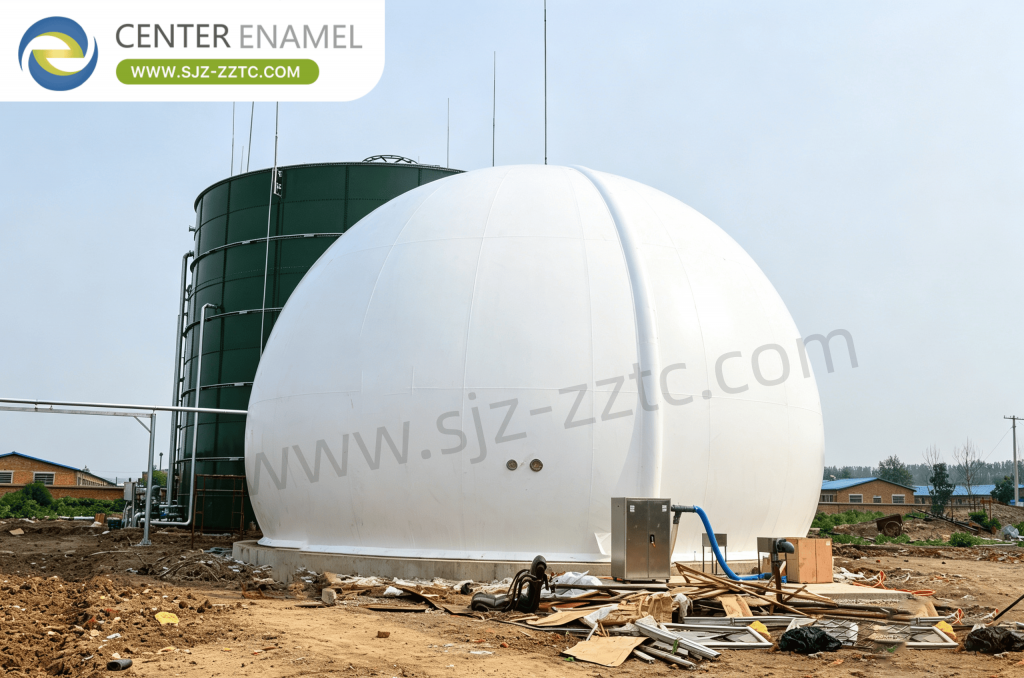
Aluminum Geodesic Dome Roof independently developed by Center Enamel is manufactured using high-strength aluminum alloy plates through integral stamping. It features a triangular grid spherical self-supporting structure, enabling large-span full coverage without internal support columns. Made of aluminum alloy, the roof offers excellent weather resistance and corrosion resistance, capable of long-protection against acid rain, salt spray, and UV radiation, suitable for various extreme outdoor climate conditions. The structural design complies with international AWWA D108 standards, with aluminum plate thickness, rib cross-sections, and joint connections all verified by finite element stress analysis, ensuring wind and snow load resistance that meets building code requirements across different global regions. The weight of the Aluminum Geodesic Dome Roof is only one-third to one-half of a steel roof with the same span, significantly reducing the load on the tank top and allowing direct installation without tank wall reinforcement. The roof provides superior overall sealing performance, with double sealing between panels using specialized sealant strips and mechanical interlocking, enabling both airtight gas storage and enclosed odor control, suitable for biogas collection and storage, wastewater tank odor control, and drinking water contamination prevention. The support-column-free design does not interfere with the installation and operation of internal equipment such as mixers and water distributors. The aluminum material does not support microbial growth, requiring no anti-corrosion maintenance over long-term use, resulting in low total life-cycle costs.
FAQ
1.What is the role of a professional Biogas Project Contractor?
A professional Biogas Project Contractor provides end-to-end management of biogas facility construction, including site assessment, customized design, equipment procurement, and installation. They ensure that projects are compliant with international environmental standards while maximizing energy output and operational efficiency through integrated technological solutions.
2.How does the UASB Process ensure efficient organic degradation?
The UASB Process uses a high-concentration granular sludge bed to degrade organic matter in a compact, automated reactor. By keeping microorganisms suspended without mechanical mixing, it achieves high microbial concentration and efficient gas-liquid-solid separation, making it an ideal technology for handling high-strength industrial and agricultural wastewater.
3.Why choose Center Enamel's GFS tanks for biogas projects?
Center Enamel's GFS tanks feature a dual-sided enamel coating that offers superior resistance to corrosion compared to concrete, lasting over 30 years with minimal maintenance. This durability eliminates environmental risks of leakage and spalling, providing a cost-effective, long-term containment solution for highly corrosive environments like livestock manure or POME.