
Relaible Biogas Plant Design & UASB Process for Brewing Wastewater Treatment
Global industrial wastewater treatment policies are escalating from "compliance discharge" to mandatory "resource recovery" and "zero liquid discharge." The EU, through its Circular Economy Action Plan, requires member states to increase industrial wastewater reuse rates and extends carbon footprint accounting to the full life cycle of wastewater treatment. China continuously updates and tightens industrial water pollutant discharge standards, with increasingly stringent limits on total nitrogen, total phosphorus, and characteristic pollutants for industries such as chemicals, pharmaceuticals, and printing and dyeing. Some water-scarce regions and highly polluting industries are mandated to adopt zero or near-zero liquid discharge technologies. Germany has established a differentiated pretreatment technical standard system by industry, requiring industrial wastewater to meet specific quality requirements before discharge into municipal wastewater treatment plants, implementing strict source control.
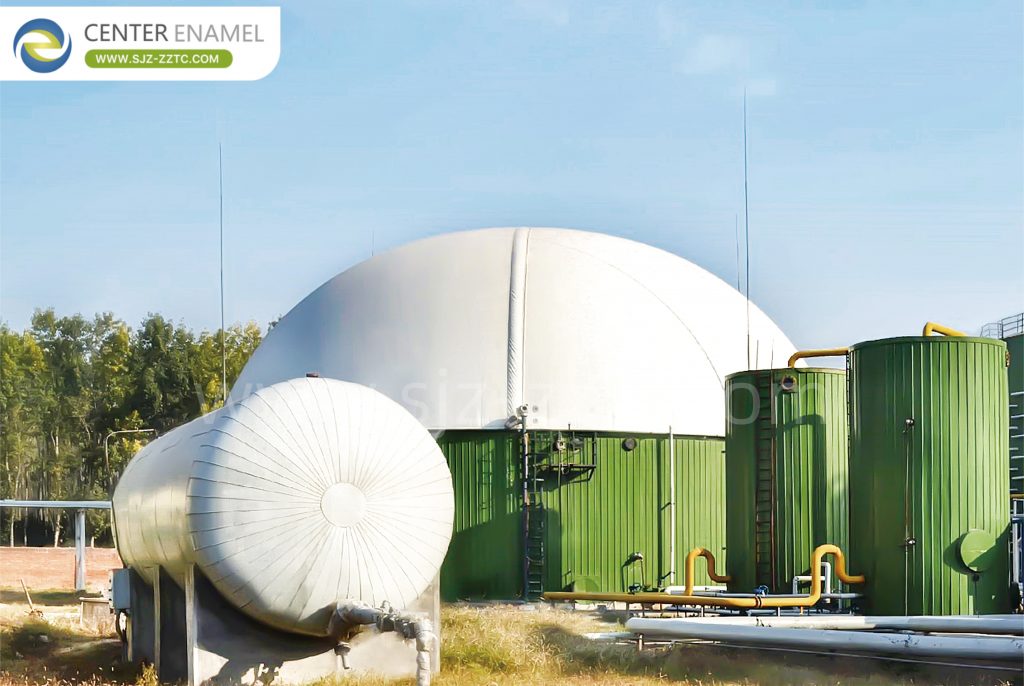
Against this tightening global regulatory backdrop, project owners need reliable storage infrastructure matched with proven anaerobic technologies to hit resource-recovery targets. Robust tank systems become foundational hardware whether you carry out biogas plant design or deliver industrial wastewater retrofits. Without corrosion-resistant storage assets, even advanced treatment workflows will struggle to satisfy new discharge and reuse rules.
GFS Tanks Adaptable to Complex Operating Conditions Across All Industries
Center Enamel has independently developed over 200 specialized enamel frit formulations and supporting patents, capable of customizing anti-corrosion enamel based on customer storage media, with adaptability comprehensively superior to concrete tanks. Concrete tanks use a single material, only suitable for neutral clean water storage. When storing corrosive materials such as livestock manure, palm oil mill effluent, chemical wastewater, food waste digestate, high-salinity wastewater, etc., additional anti-corrosion linings must be applied. These linings are prone to failure, preventing long-term stable operation and cannot adapt to alternating high/low concentration storage conditions.
GFS tanks can be specifically formulated with specialized enamels resistant to strong acids, strong alkalis, high organic content, and high salinity. A single tank can switch between multiple wastewater and fermentation feedstock storage requirements. They are universally applicable across biogas anaerobic digestion, municipal wastewater, livestock farming, food processing, and industrial water treatment scenarios, eliminating the need to rebuild tanks for media changes, perfectly meeting the needs of diversified, multi-condition environmental protection projects.
High-performance GFS tanks create stable preconditions for core biological treatment units, such as those used within the UASB Process. Consistent feedstock storage avoids fluctuating inlet quality that would otherwise impair anaerobic reactor performance. These bolted enamel tanks also serve as key supporting vessels when executing biogas plant design for cross-industry organic waste treatment projects.
UASB Process Advantages
No mechanical mixing equipment is required, with sludge suspension achieved through hydraulic action, resulting in very low overall energy consumption. High-concentration anaerobic granular sludge can be cultivated, with high sludge concentration, strong activity, excellent settleability, low sludge washout, and low sludge yield, significantly reducing sludge disposal costs. The integrated design combines reaction, sedimentation, and separation simultaneously, with small footprint and moderate capital investment. Simple structure with low failure rates and convenient maintenance. High volumetric loading rate with excellent organic pollutant degradation efficiency and good shock load resistance. Stable biogas production with high resource recovery value. The process is mature and widely adopted, with well-established construction, commissioning, and O&M systems, suitable for large-scale industrial wastewater treatment.
Thanks to its cost-saving and biogas-generating strengths, the UASB Process is frequently selected for brewing wastewater treatment as well as other high-strength organic waste streams. When integrated with GFS storage tanks for equalization and feed holding, the whole system delivers stable inlet water quality for anaerobic reactors. This matching combination forms one mature technical route adopted in biogas plant design for food-sector wastewater recycling.
Brewery Wastewater Environmental Toxicity of Pollutants
No chemical toxicity-purely natural organic wastewater with very low ecotoxicological risk and easy environmental restoration. All pollutants are natural organics from grain fermentation-starches, sugars, alcohols, amino acids, proteins-containing no heavy metals, bacteriostats, or persistent toxic organics. They do not inhibit biochemical bacteria and have no acute or chronic toxicity to soil, water, or plants. The core pollution is only high-concentration oxygen-demanding organics-direct discharge rapidly depletes dissolved oxygen, causing oxygen depletion, black-odor conditions, algal blooms, and channel siltation. Pollutants have no bioaccumulation potential and are rapidly decomposed by microorganisms and natural water bodies-no long-term persistent ecological harm.
This unique pollutant profile makes brewing wastewater treatment ideally suited for anaerobic workflows represented by the UASB Process. Instead of costly chemical dosing, facilities convert brewery organic pollutants into usable biogas energy. For investors, this creates tangible economic returns during biogas plant design by turning waste into renewable energy.
Center Enamel's Core R&D Capabilities and Global Authoritative Certifications
Technology R&D is Center Enamel's core competitive advantage. The company independently masters over 200 differentiated anti-corrosion enamel formulations, with full self-control over the enamel raw material chain, holding nearly 100 invention and utility patents. Products have passed NSF, WRAS, ASME, BSCI, CE, ISO9001, and other global certifications.
Company certifications and honors include: National High-Tech Enterprise, National Specialized and Sophisticated "Little Giant," Hebei Manufacturing Single Champion, Provincial Smart Factory, Provincial Green Factory; complete environmental engineering and special equipment manufacturing compliance qualifications. The company maintains long-term collaborative research with multiple universities through joint materials laboratories-continuously iterating anti-corrosion coatings and large bolted tank structural design technologies. The proprietary material technology barrier creates an irreplaceable competitive advantage, with product performance comparable to high-end imported European/American storage equipment.
Solid R&D strength supports customized project delivery across biogas plant design, UASB-supported industrial wastewater facilities and brewing wastewater treatment projects worldwide. Beyond standardized tank products, our technical team can adjust material specifications to match site-specific water quality, climate and local regulatory requirements for overseas EPC projects.
Professional Installation and Construction Team
The installation team has practical experience from over 10,000 GFS tank projects globally, strictly following standardized construction procedures-full control over project mobilization, civil coordination, tank assembly, piping, and commissioning schedules and quality.
The team is proficient in complete standardized installation processes for GFS tanks, dual-membrane gas storage covers, USR/CSTR/IC anaerobic reactors, and biogas desulfurization/piping systems-adaptable to large-scale farms, industrial parks, remote mountainous sites, coastal high-corrosion sites, and other complex locations-strictly implementing unified global safety construction standards. For large overseas cross-border projects, the team can be deployed as complete units for on-site construction, technical training, and local worker practical instruction-full control over construction details, air-tightness testing, and corrosion protection-ensuring timely and stable commissioning of global environmental projects through standardized delivery capability.
Even well-designed biogas plant design and UASB process layouts cannot perform well without professional on-site execution. Our construction workforce handles full-scope delivery for brewing wastewater treatment and other industrial wastewater projects, from tank erection to anaerobic reactor piping and biogas system commissioning. Site-adapted construction services reduce project risks for customers operating in geographically challenging regions.
FRP Roof Cover Solution for Biogas Projects
FRP Roof is a general-purpose economical roof for atmospheric pressure storage tanks without air-tightness requirements, suitable for drinking water storage, agricultural irrigation water, firewater reserve, and general production wastewater temporary storage. It is available in two styles: flat and dome, allowing flexible selection based on tank specifications and site aesthetic requirements.
The roof is integrally molded from resin and fiberglass, lightweight, with natural water resistance and mild acid/alkali corrosion resistance. It will not rust or rot in long-term humid environments, eliminating the frequent anti-corrosion maintenance required for metal roofs. The dome style features excellent drainage performance due to its curved structure, resisting water accumulation, dust buildup, snow load, and strong winds. The flat style facilitates the installation of maintenance walkways, level gauges, and vents on top, making inspection and operation convenient. The product is fully insulated with no risk of galvanic corrosion, will not contaminate drinking water quality, and meets environmental standards for domestic water storage.
The modular design with low individual component weight allows for simple on-site hoisting and assembly, offering high construction efficiency and affordable procurement and installation costs. It is only suitable for atmospheric pressure water storage tanks without biogas collection or pressurization requirements, and is not recommended for anaerobic fermentation gas-producing conditions. It is widely used in rural agricultural water storage tanks, industrial park firewater tanks, waterworks buffer tanks, and small to medium-sized domestic wastewater temporary storage facilities, making it a cost-effective general-purpose roof choice for conventional water storage applications.
It is critical to distinguish FRP roof use-cases when doing biogas plant design or specifying accessories for UASB-linked tankage. For biogas-producing anaerobic fermentation tanks, air-tight dual-membrane covers should be selected rather than FRP roofs. Meanwhile, FRP roofs remain a cost-effective add-on for non-fermentation buffer tanks inside brewing wastewater treatment and municipal water facilities.
Frequently Asked Questions
FAQ 1: Why choose the UASB Process for brewing wastewater treatment?
Brewery wastewater carries high concentrations of biodegradable organic compounds without heavy-metal contaminants. The UASB Process delivers low-energy anaerobic degradation while capturing usable biogas, reducing organic loading before downstream aerobic treatment. It also features compact footprint and moderate investment, which makes it a preferred core unit for brewing wastewater treatment within biogas plant design schemes.
FAQ 2: Can GFS tanks work alongside UASB reactors in biogas plant design projects?
Absolutely. GFS tanks can serve as equalization tanks, pre-storage vessels and post-treatment buffer tanks. Custom anti-corrosion enamel formulations resist variable organic and salinity loads, stabilize inlet water quality for UASB reactors, and match the full-system lifecycle requirements for biogas plant design and industrial wastewater projects.
FAQ 3: Is the FRP roof compatible with anaerobic biogas-generating tanks in wastewater projects?
No. The FRP roof is designed for atmospheric-pressure non-gas-collection scenarios. For biogas-producing tanks within biogas plant design, air-tight dual-membrane gas covers are required. FRP roofs are suitable for fire-water tanks, drinking-water storage and temporary wastewater holding tanks in brewing wastewater treatment and municipal facilities.