
Reliable Biogas Solution Provider: High-Performance GFS Tanks for Global Industrial Wastewater Treatment
Global industrial wastewater regulations are shifting from simple compliance to mandatory resource recovery and zero liquid discharge . This transformation demands robust infrastructure that can withstand aggressive chemical environments while enabling energy recovery. As a professional Biogas Solution Provider, Center Enamel delivers advanced GFS (Glass-Fused-to-Steel) tanks and complete anaerobic treatment systems for industrial wastewater treatment applications. Our proprietary double-sided enameling technology provides superior corrosion resistance exceeding 30 years, while integrated UASB and CSTR processes convert organic pollutants into valuable biogas-helping breweries, food processors, and palm oil mills meet stringent discharge standards while generating renewable energy.
Industrial Wastewater Global Policy Framework
Global industrial wastewater treatment policies are escalating from "compliance discharge" to mandatory "resource recovery" and "zero liquid discharge." The EU, through its Circular Economy Action Plan, requires member states to increase industrial wastewater reuse rates and extends carbon footprint accounting to the full life cycle of wastewater treatment . China continuously updates and tightens industrial water pollutant discharge standards, with increasingly stringent limits on total nitrogen, total phosphorus, and characteristic pollutants for industries such as chemicals, pharmaceuticals, and printing and dyeing. Some water-scarce regions and highly polluting industries are mandated to adopt zero or near-zero liquid discharge technologies. Germany has established a differentiated pretreatment technical standard system by industry, requiring industrial wastewater to meet specific quality requirements before discharge into municipal wastewater treatment plants, implementing strict source control .
These converging regulatory pressures create an urgent need for treatment infrastructure that goes beyond basic compliance. As a Biogas Solution Provider, Center Enamel helps industrial facilities transform these regulatory challenges into opportunities by capturing methane that would otherwise escape to the atmosphere, converting it into baseload renewable energy while ensuring full regulatory compliance .
GFS Tanks: Superior Corrosion Resistance for Industrial Wastewater
Center Enamel's independently developed double-sided double-layer enameling technology is the industry's leading coating anti-corrosion solution, with corrosion resistance completely surpassing concrete tanks. Concrete tank interiors are riddled with pores, allowing wastewater and acid/alkaline media to easily penetrate and corrode the structural layer. Long-term use leads to irreversible problems such as internal wall spalling, water seepage, and rebar corrosion-issues that prove difficult to repair and cannot be fundamentally resolved .
GFS tanks feature high-temperature enameling on both the interior and exterior surfaces of steel panels, with a dense, non-porous enamel finish that completely blocks corrosive liquids and biogas permeation. The enamel layer has extremely strong chemical stability, resisting acids, alkalis, salts, and microbial corrosion. Concrete tanks will develop extensive corrosion and leakage after 5-8 years of use, while GFS tank anti-corrosion service life can exceed 30 years, with no need for frequent internal lining repairs throughout the service life .
This durability is particularly valuable for industrial wastewater treatment applications where effluent contains aggressive organic acids, cleaning chemicals, and hydrogen sulfide. Compared to traditional concrete and FRP tanks, GFS tank coatings have no risk of peeling or blistering, and are adaptable to highly corrosive conditions such as palm oil mill effluent, livestock manure, and chemical high-salinity wastewater-with outstanding long-term comprehensive cost advantages .
UASB Process Advantages: The Core Technology for Biogas Recovery
No mechanical mixing equipment is required for the UASB process, with sludge suspension achieved through hydraulic action, resulting in very low overall energy consumption. High-concentration anaerobic granular sludge can be cultivated, with high sludge concentration, strong activity, excellent settleability, low sludge washout, and low sludge yield-significantly reducing sludge disposal costs. The integrated design combines reaction, sedimentation, and separation simultaneously, with small footprint and moderate capital investment .
Simple structure with low failure rates and convenient maintenance. High volumetric loading rate with excellent organic pollutant degradation efficiency and good shock load resistance. Stable biogas production with high resource recovery value-producing approximately 0.35 m³ of biogas per kilogram of COD removed . The process is mature and widely adopted, with well-established construction, commissioning, and O&M systems, suitable for large-scale industrial wastewater treatment .
The UASB process has demonstrated its carbon-neutral potential in industrial applications, achieving 98.5% COD removal while generating recoverable methane . As a comprehensive Biogas Solution Provider, Center Enamel integrates this proven technology with our GFS tank manufacturing expertise to deliver complete anaerobic digestion systems that maximize energy recovery while minimizing environmental impact.
Environmental Toxicity of Pollutants
Brewery and food processing wastewater contains primarily natural organics from fermentation-starches, sugars, alcohols, amino acids, proteins-with no synthetic toxic substances or heavy metals. They do not inhibit biochemical bacteria and have no acute or chronic toxicity to soil, water, or plants. The core pollution is only high-concentration oxygen-demanding organics-direct discharge rapidly depletes dissolved oxygen, causing oxygen depletion, black-odor conditions, algal blooms, and channel siltation .
Pollutants have no bioaccumulation potential and are rapidly decomposed by microorganisms and natural water bodies-no long-term persistent ecological harm. However, the high organic loading (COD typically 5,000-25,000 mg/L) demands effective treatment before discharge. This is precisely where anaerobic digestion excels-capturing the methane potential of these organics while preventing environmental damage .
For any Industrial Wastewater Treatment project involving organic-rich effluent, the combination of UASB technology and GFS tank containment provides an ideal solution that addresses both environmental compliance and energy recovery objectives.
Full-Process Standardized Installation Quality Control
Demonstrating high-standard installation quality through long-term stable global project performance, Center Enamel has established full-chain quality control standards across four dimensions: factory protection, on-site assembly construction, completion inspection, and long-term warranty-ensuring quality control for every GFS tank .
At the factory stage, all enameled panels, seals, and structural components receive rust-proof and moisture-proof independent packaging with dedicated protective supports-preventing damage during sea and land transport and avoiding enamel coating damage. On-site construction strictly follows unified assembly process specifications-panel by panel tightening and leak testing in layers, with air-tightness and verticality testing after each tank section completion-dual-membrane covers and anaerobic piping undergo simultaneous pressure testing and acceptance .
Differentiated quality acceptance standards are customized for different regions: EU/US projects follow stringent CE/NSF inspection criteria; Southeast Asian hot humid regions receive enhanced corrosion protection and sealing acceptance; remote African sites have additional foundation settlement re-inspection procedures . As a trusted Biogas Solution Provider, Center Enamel ensures that every project delivers consistent quality regardless of location.
Center Enamel's Extensive Global Benchmark Project Cases
Center Enamel's project portfolio covers over 100 countries across Southeast Asia, Africa, Europe, and the Americas-30,000+ mature projects-accumulating complete industry solutions across palm oil, livestock, municipal, brewing, and food waste biogas-rapidly matching customized solutions for different regional climates, water quality, and regulations .
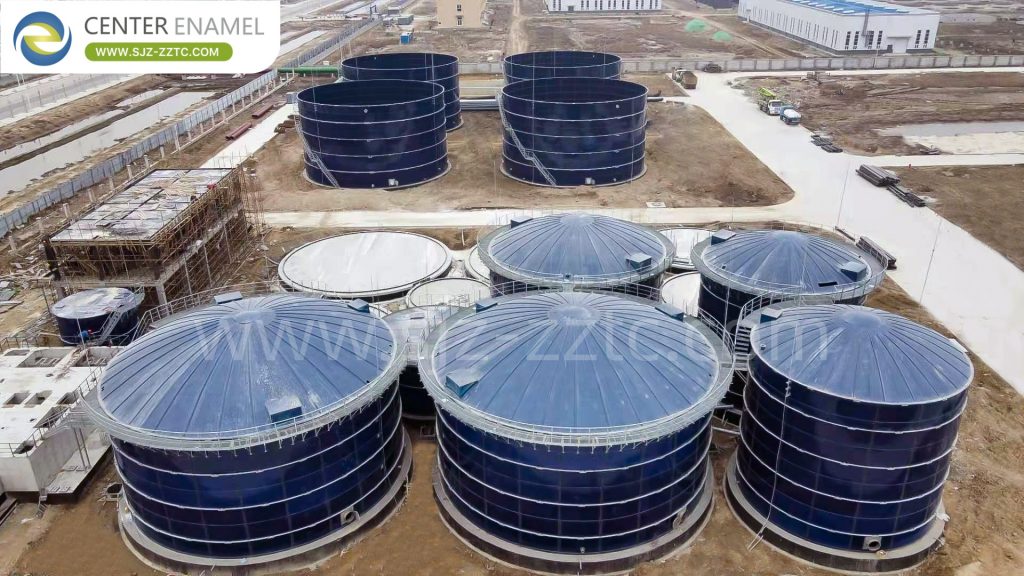
Notable projects include the Mozambique Wastewater Treatment Project (2019), featuring a comprehensive GFS tank array including a UASB digester for biogas recovery, equalization tanks, aeration tanks, and MBR permeate tanks-demonstrating the versatility of GFS technology across the entire treatment lifecycle . The Indonesia Palm Oil Biogas Upgrade Project further validates the technology's applicability in challenging tropical environments .
For breweries and food processors seeking a reliable partner for their industrial wastewater treatment needs, these global case studies demonstrate Center Enamel's proven capability to deliver robust, long-lasting solutions that meet diverse regulatory requirements and operational conditions.
FRP Roof Cover Solution
FRP Roof is a general-purpose economical roof for atmospheric pressure storage tanks without air-tightness requirements, suitable for drinking water storage, agricultural irrigation water, firewater reserve, and general production wastewater temporary storage. It is available in two styles: flat and dome, allowing flexible selection based on tank specifications and site aesthetic requirements.
The roof is integrally molded from resin and fiberglass, lightweight, with natural water resistance and mild acid/alkali corrosion resistance. It will not rust or rot in long-term humid environments, eliminating the frequent anti-corrosion maintenance required for metal roofs. The dome style features excellent drainage performance due to its curved structure, resisting water accumulation, dust buildup, snow load, and strong winds .
The modular design with low individual component weight allows for simple on-site hoisting and assembly, offering high construction efficiency and affordable procurement and installation costs. It is only suitable for atmospheric pressure water storage tanks without biogas collection or pressurization requirements, and is not recommended for anaerobic fermentation gas-producing conditions . For biogas applications, Center Enamel recommends Aluminum Geodesic Dome Roofs or Double Membrane Gas Holders specifically engineered for gas-tight containment.
FAQs
Q1: Why choose Center Enamel as your Biogas Solution Provider for industrial wastewater treatment?
Center Enamel offers integrated EPC services with proprietary GFS tank technology, delivering 30+ years of corrosion resistance and gas-tight containment essential for maximum methane recovery. Our 30,000+ global projects across 100+ countries demonstrate proven reliability for diverse industrial applications .
Q2: How do GFS tanks compare to concrete tanks for industrial wastewater applications?
GFS tanks provide superior corrosion resistance against acidic wastewater and H₂S in biogas, with a dense glass enamel surface preventing leaks and structural degradation for 30+ years. They install 3x faster than concrete tanks, require no curing, and can be expanded or relocated-offering significant lifecycle cost advantages .
Q3: What makes the UASB process ideal for biogas recovery from high-strength industrial wastewater?
The UASB process achieves 90–94% COD removal without mechanical mixing, reducing energy costs. It produces ~0.35 m³ biogas per kg COD removed, which can generate both electricity and heat via CHP-delivering project payback typically within 3–5 years .