
Reliable EPC Contractor with GFS Tanks for Sustainable Biogas Projects - Center Enamel
Global livestock inventories such as swine remain stable. The US has developed technical models represented by integrated crop-livestock systems with on-field application and Comprehensive Nutrient Management Plans; Denmark, the Netherlands, and others have developed centralized biogas projects with digestate application systems. China's large-scale farms still have considerable room for improvement in supporting biogas project coverage, and digestate resource utilization rates lag behind advanced European levels. Greenhouse gas emissions from livestock account for a significant proportion of total global anthropogenic emissions, making manure management a critical battleground for agricultural carbon reduction. Latin American countries started later in manure management but are accelerating relevant infrastructure development.
As the global demand for sustainable manure management intensifies, selecting the right infrastructure is paramount. Advanced engineering solutions are essential to bridge the gap between traditional practices and modern environmental standards. As a premier EPC Contractor, we integrate these global best practices into every project we undertake.
GFS Tanks Adaptable to Extreme Climates
GFS Tanks can undergo customized wind and seismic design based on project site climate and geological conditions, with environmental adaptability far superior to concrete tanks. Concrete tanks are cast-in-place monolithic structures, with seismic and wind resistance entirely dependent on on-site construction quality. In remote areas, typhoon-prone zones, and earthquake belts, construction quality is difficult to control. Under strong earthquakes or typhoons, concrete tanks are prone to cracking and base settlement damage, with subsequent reinforcement costs equivalent to rebuilding.
GFS tanks undergo collection of local seismic intensity, maximum wind pressure, and foundation bearing capacity data before construction, with customized thickened steel panels, stiffening ribs, and anchored base components-all factory-prefabricated to standardized specifications. The bolted panel structure has excellent stress distribution capability, making it less prone to overall fracture under seismic and typhoon impacts, and minor foundation settlement will not cause through-cracking. Structural parameters can be flexibly adjusted for mountainous, coastal typhoon-zone, and high-seismic-zone projects, providing long-term protection against extreme natural climate damage.
Beyond structural integrity, the core of any efficient waste treatment plant lies in its internal biological processing unit. Optimizing these reactors is crucial for maximum energy recovery and pollution reduction. Implementing a highly efficient UASB Process ensures that your facility operates at peak biological performance.
UASB Reaction Process
After pretreatment through screens and equalization tanks to remove impurities and balance water quality and flow, wastewater is uniformly fed into the reactor through the bottom distribution system. The wastewater rises at a constant rate through the high-concentration granular sludge bed at the bottom, where anaerobic microorganisms rapidly degrade most organic matter, converting it into biogas, clean water, and a small amount of sludge. Gentle hydraulic mixing maintains sludge suspension, expanding microbial contact area. Remaining pollutants continue to degrade in the mid-section suspended sludge layer, with the mixed liquor finally entering the top three-phase separator for gas, solid, and liquid separation. Biogas is collected upward for utilization, sludge settles back to the reaction zone, treated effluent overflows from the top, and aged sludge is periodically discharged-fully automated continuous operation.
Understanding the mechanical and biological aspects of treatment is only part of the challenge; designers must also account for the specific nature of the influent. Managing complex waste streams requires tailored strategies that address the unique chemical composition of the feedstock. This knowledge is fundamental when our team develops specialized treatment protocols for your facility.
Livestock Wastewater Key Water Quality Characteristics
Typical high-concentration organic wastewater with "four highs"-high COD, high ammonia nitrogen, high total phosphorus, and high suspended solids-very high pollution load. Livestock wastewater COD can exceed 8,000 mg/L, with high turbidity and suspended solids. Nitrogen and phosphorus levels far exceed discharge standards, being the primary cause of eutrophication. Wastewater is rich in manure, feed residues, and metabolic waste, readily turning black and odorous. Water quality fluctuates significantly with production cycles, seasons, and washing frequency. Aquaculture wastewater has lower pollutant concentrations but significant nitrogen/phosphorus accumulation issues, causing algal blooms and water quality deterioration with long-term discharge.
Successfully managing these challenging water characteristics requires real-world experience and proven project implementation. Seeing these technologies in action highlights the tangible benefits of our specialized equipment and design. The following project serves as a prime example of our capabilities in large-scale industrial applications.
Indonesia Palm Oil Biogas Project
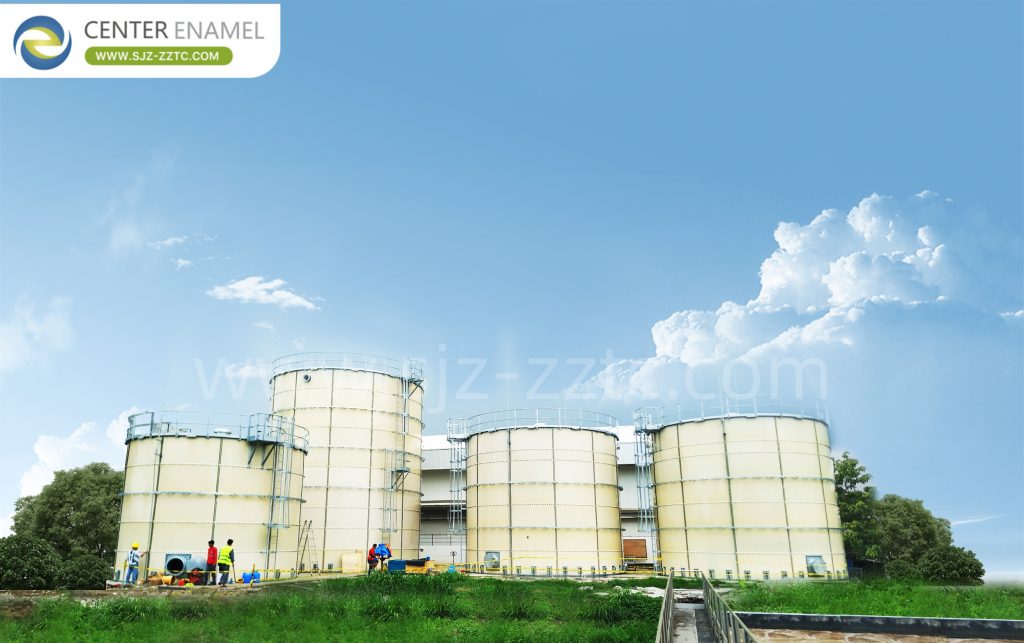
Specifically designed for high-concentration palm oil wastewater treatment with 3 GFS fermentation tanks, each 19.86 m diameter × 8.4 m height. Installation began November 2009 with only 7 construction personnel, completing all tank assembly in 40 days-highly efficient and time-saving. Tanks are fitted with dual-membrane gas storage covers for POME anaerobic digestion-degrading organics and recovering biogas energy while eliminating palm industry pollution. This is an early benchmark POME biogas treatment project in Southeast Asia.
The success of such international projects is rooted in robust manufacturing standards and institutional capacity. Ensuring consistency and quality across every component is what sets an industry leader apart from the competition. Our manufacturing base provides the necessary foundation for delivering this level of global excellence.
Center Enamel's Smart Manufacturing Base Scale
Center Enamel's core intelligent manufacturing base is located in Hebei Province, China, covering a total area of over 150,000 m², with Phase I mature manufacturing facility and Phase II high-end environmental equipment industrial park-dual-base synergy ensures stable production capacity. The base includes dedicated R&D office buildings, proprietary material laboratories, and finished product testing centers, with full-process quality control systems meeting ISO, NSF, CE, and other international standards. The facility operates to green manufacturing standards, certified as a Provincial Green Factory-balancing efficient production with energy conservation and emission reduction. The company has 6 marketing service centers across China, establishing a nationwide production-sales network ensuring stable global order delivery. The base is adjacent to expressway networks and major logistics hubs, with complete container shipping capabilities-supporting simultaneous large-scale tank projects globally. The base employs over 500 staff, with multiple parallel automated production lines-facility scale and production capacity firmly placing it among the global top tier of GFS tank equipment manufacturers.
A strong manufacturing backbone allows for the seamless execution of projects on a global scale. With over a decade of dedication to international markets, we have refined our processes to handle diverse environments and regulatory requirements. Our history of global installations reflects our commitment to long-term operational success.
Over a Decade of Global Installation Experience
Unmatched global practical experience among domestic peers-over a decade covering multiple regions and all industry sectors. In 2009, Center Enamel completed the first overseas GFS tank installation-sending a team to Niger, Africa for drinking water storage tank installation. In 2015, it broke industry ground with China's first GFS tank export and installation to the US-passing strict US acceptance standards. All installed projects have operated stably for many years, covering livestock biogas, POME, municipal wastewater, and drinking water storage applications. Construction has covered Southeast Asia, Africa, the Americas, and other regions-accumulating specialized solutions for complex sites including mountainous terrain, coastal salt spray, tropical high temperatures, and high-standard European/American facility conditions-maturely addressing global special construction requirements.
Frequently Asked Questions (FAQ)
What makes GFS Tanks superior for biogas projects?
GFS Tanks provide exceptional durability, corrosion resistance, and structural integrity under extreme weather conditions. Their factory-prefabricated, bolted design ensures high quality and fast, efficient installation compared to traditional concrete structures, making them the ideal choice for modern, long-term biogas facility containment.
How does the UASB Process benefit industrial wastewater treatment?
The UASB Process offers highly efficient anaerobic degradation of organic matter in high-concentration wastewater. By utilizing a granular sludge bed, it maximizes microbial contact, resulting in high biogas recovery rates, reduced energy consumption, and significant pollution load removal, which is critical for sustainable industrial waste management.
Why should I choose Center Enamel as my EPC Contractor?
Center Enamel offers comprehensive, turnkey EPC services backed by over a decade of global experience and a massive, state-of-the-art smart manufacturing base. We provide integrated solutions-from design and material supply to installation-ensuring high-standard compliance, efficient project delivery, and long-term stability for international wastewater and biogas projects.