
How Center Enamel Delivers Reliable Livestock Wastewater Treatment with the USR Process
Livestock wastewater is difficult to treat not only because of its strength, but because of its structure-manure is generated in a decentralized way across farms, while treatment requires centralized, dependable infrastructure. Center Enamel addresses this through a complete Livestock Wastewater Treatment Project model that combines the USR Process, corrosion-resistant GFS tanks, standardized treatment trains, and global service support.
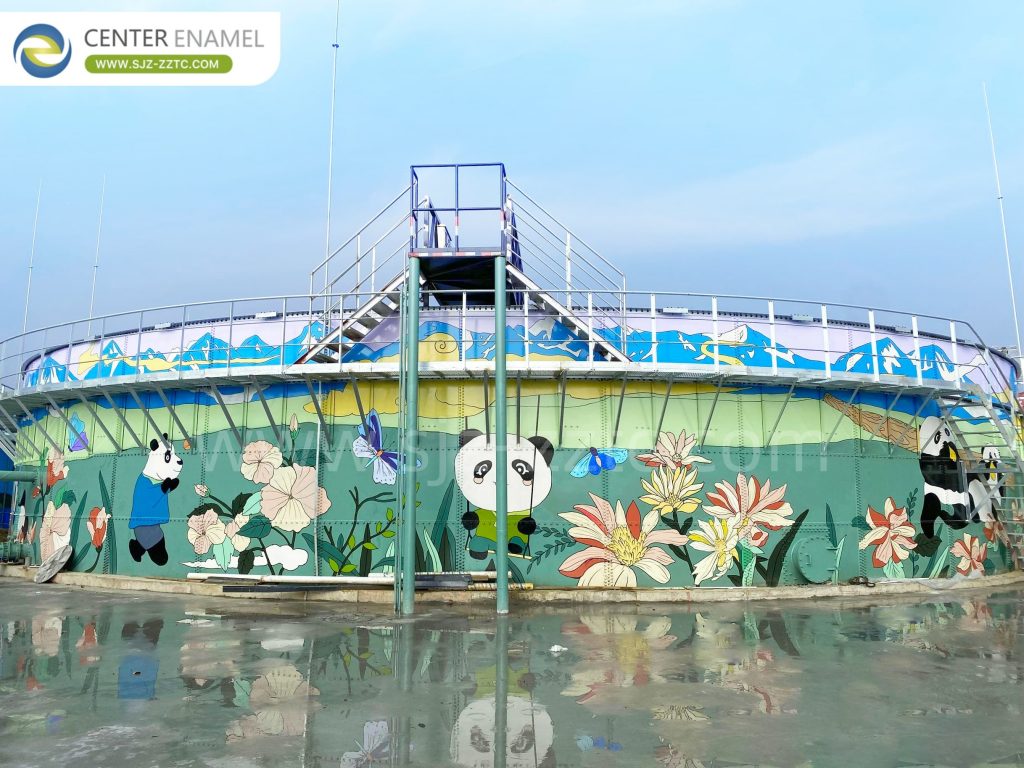
The result is a system that tolerates high solids, resists clogging, recovers biogas, and remains practical for rural operations with limited technical staffing. This article examines the industry challenges, the supporting equipment behind the USR Process, the standardized treatment solution, a proven reference project, and the service infrastructure that sustains every installation.
The Structural Challenge Holding Back Livestock Manure Treatment
The core dilemma of livestock manure treatment lies in the structural contradiction of "decentralized generation vs. centralized treatment." Manure generation surges during intensification, but supporting treatment facilities lag behind. Digestate resource utilization channels are obstructed, with safety risks from heavy metal and antibiotic residues constraining farmland application.
At the enforcement level, farmers' environmental awareness varies, with illegal discharges occurring frequently. At the policy level, subsidies and incentives are insufficient to effectively drive voluntary compliance. Biogas grid connection difficulties and limited digestate transport radius further compress the economic viability of resource utilization.
These barriers explain why a Livestock Wastewater Treatment Project must be designed for real-world conditions-robust, low-maintenance, and economically defensible. The USR Process, supported by the right equipment and service model, is Center Enamel's answer to these constraints.
Supporting Equipment That Makes the USR Process Work in the Field
A process is only as effective as the equipment around it. In Center Enamel's USR Process systems, the core equipment is the GFS tank with no complex media or precision three-phase separators, featuring a rugged clog-resistant structure. The bottom large-diameter anti-clogging distribution system is suitable for high-solids wastewater, preventing pipe clogging.
Supporting equipment includes influent lift pumps, simple pretreatment screens, and equalization tanks for impurity removal and water quality balancing. Simple top gas collection devices and biogas conveying and desulfurization equipment enable biogas resource recovery. Temperature, level, and pH online monitoring equipment provides operational visibility. Bottom large-diameter sludge discharge pipes and pumps allow rapid removal of high-concentration residual sludge, suitable for high-solids conditions.
The complete system has extremely low failure rates, outstanding wear and clog resistance, and is far easier to maintain than conventional anaerobic processes-an essential attribute for any Livestock Wastewater Treatment Project in a rural setting.
A Standardized Livestock Wastewater Treatment Project for Rural Conditions
With equipment established, the full treatment train must be configured for agricultural realities. Adapted to agricultural and rural settings, Center Enamel's standardized solution uses a low-cost treatment train of "solid-liquid separation + anaerobic digestion + ecological polishing," specifically addressing high-suspended-solids, high-concentration organic wastewater.
Pretreatment uses solid-liquid separation equipment and sedimentation tanks to rapidly remove solid impurities like manure and feed residues, significantly reducing biochemical load. The main stage uses USR/CSTR anaerobic processes for efficient organic degradation with simultaneous biogas energy recovery. Subsequent A/O biological treatment precisely removes nitrogen and phosphorus, with final constructed wetlands or stabilization ponds for polishing. Digester tanks use Center Enamel GFS tanks, resistant to manure corrosion and with convenient assembly for rural projects. The entire process has strong shock load resistance, adapts to significant water quality and quantity fluctuations, is simple to operate, and achieves both pollution control and resource recycling.
Proven Results-The Bangladesh Poultry Farm Livestock Wastewater Treatment Project
The effectiveness of this standardized approach is best demonstrated by a benchmark installation. The Bangladesh Large-Scale Poultry Farm Manure Resource Recovery Project targets local poultry farm manure resource recovery with daily treatment of 47 tons.
Influent COD, BOD, and SS measure as high as 50,000 mg/L, 25,000 mg/L, and 50,000 mg/L. After CSTR + UASB anaerobic treatment, all three parameters are reduced to below 200 mg/L, 100 mg/L, and 100 mg/L-effluent compliant with local environmental discharge standards. The project produces approximately 4,900 m³ of biogas daily. Each cubic meter of biogas can generate 2 kWh of electricity, with daily power generation of 9,800 kWh-simultaneously achieving pollutant reduction and clean energy recovery. This is a benchmark project for livestock waste recycling in Southeast Asia.
Table 1: Bangladesh Poultry Farm Project-Treatment Performance
| Parameter | Influent Concentration | After Anaerobic Treatment | Removal Rate |
| COD | 50,000 mg/L | Below 200 mg/L | >99.6% |
| BOD | 25,000 mg/L | Below 100 mg/L | >99.6% |
| SS | 50,000 mg/L | Below 100 mg/L | >99.8% |
| Daily Treatment Capacity | 47 tons poultry manure | - | - |
| Biogas Production | 4,900 m³/day | - | - |
| Power Generation | 9,800 kWh/day | - | 2 kWh per m³ biogas |
Global Service System That Supports Every Project Stage
Delivering a Livestock Wastewater Treatment Project across regions requires more than technology-it requires sustained service capability. Leveraging regional sales centers in China and overseas local agent networks, Center Enamel has established a complete after-sales service loop covering all markets.
The system provides four core service pillars: a 24/7 rapid response mechanism, on-site domestic and overseas installation services, full-project-cycle after-sales support, and long-term warranty protection-forming a complete service chain from preliminary site survey, mid-term construction management, to long-term inspection and maintenance. The entire system is uniformly adapted to both domestic and international project service standards, coordinating personnel scheduling, material support, and on-site coordination for simultaneous projects across multiple regions-significantly reducing customer multi-party coordination costs and ensuring efficient domestic and overseas project delivery. For USR Process installations, this service backbone protects performance over the full operational life of the project.
A Marketing Team Fluent in Global Regulations and Project Finance
Behind successful projects is a team that understands the regulatory and financial context clients operate in. The Center Enamel marketing team brings together environmental industry multi-skilled professionals and multilingual foreign trade specialists, with deep expertise in global biogas, wastewater treatment, and biomass new energy markets-accumulating extensive practical project experience in Southeast Asia, Africa, Europe, and the Americas.
The team is proficient in various countries' wastewater discharge regulations, biogas subsidy policies, and carbon trading rules-providing one-stop preliminary site survey, solution planning, and investment return analysis consulting services. With multilingual capabilities in English, French, Spanish, and Arabic, the team effectively communicates with clients worldwide-precisely matching regional industrial resources, project budgets, and environmental requirements-customizing high-cost-performance GFS tanks and anaerobic reactor solutions based on client production capacity, treatment targets, and gas production expectations. Leveraging extensive overseas project experience, the team proactively helps clients avoid risks in overseas approvals, equipment import, and construction implementation-building a globally adaptable integrated environmental equipment business service system.
Table 2: Center Enamel Project Service and Consulting Capabilities
| Service Area | Capability | Client Benefit |
| After-Sales Support | 24/7 rapid response mechanism | Continuous operational assurance |
| Installation | Domestic and overseas on-site teams | Reliable project execution |
| Lifecycle Coverage | Survey, construction, inspection, maintenance | Single long-term partner |
| Multi-Region Coordination | Personnel and material scheduling | Reduced coordination costs |
| Regulatory Expertise | Discharge rules, biogas subsidies, carbon trading | Informed investment decisions |
| Languages | English, French, Spanish, Arabic | Effective global communication |
| Consulting | Site survey, planning, return analysis | Bankable project proposals |
FRP Roof Cover-An Economical Option for Non-Gas Storage Tanks
Not every tank in a livestock facility needs gas-tight sealing. The FRP Roof is a general-purpose economical roof for atmospheric pressure storage tanks without air-tightness requirements, suitable for drinking water storage, agricultural irrigation water, firewater reserve, and general production wastewater temporary storage. It is available in two styles: flat and dome, allowing flexible selection based on tank specifications and site aesthetic requirements.
The roof is integrally molded from resin and fiberglass, lightweight, with natural water resistance and mild acid and alkali corrosion resistance. It will not rust or rot in long-term humid environments, eliminating the frequent anti-corrosion maintenance required for metal roofs. The dome style features excellent drainage performance due to its curved structure, resisting water accumulation, dust buildup, snow load, and strong winds. The flat style facilitates the installation of maintenance walkways, level gauges, and vents on top, making inspection and operation convenient.
The product is fully insulated with no risk of galvanic corrosion, will not contaminate drinking water quality, and meets environmental standards for domestic water storage. The modular design with low individual component weight allows for simple on-site hoisting and assembly, offering high construction efficiency and affordable procurement and installation costs. It is only suitable for atmospheric pressure water storage tanks without biogas collection or pressurization requirements, and is not recommended for anaerobic fermentation gas-producing conditions. It is widely used in rural agricultural water storage tanks, industrial park firewater tanks, waterworks buffer tanks, and small to medium-sized domestic wastewater temporary storage facilities.
From USR Process design to GFS tank supply, installation, and lifelong service, Center Enamel delivers complete livestock wastewater treatment solutions built for real farm conditions. Contact our team today to request a site assessment and customized treatment proposal. Let us show you how our standardized approach and global service network have supported livestock projects across Southeast Asia, Africa, Europe, and the Americas.
Frequently Asked Questions
Why is the USR Process suited to livestock wastewater treatment projects?
USR tolerates high suspended solids and impurities, resists clogging, requires no granular sludge cultivation, and operates with low automation-ideal for rural farms with fluctuating loads and limited technical staffing.
What does a complete livestock wastewater treatment project include?
It includes solid-liquid separation, USR or CSTR anaerobic digestion, biogas collection and desulfurization, A/O nutrient removal, and ecological polishing-housed in corrosion-resistant GFS tanks.
How does Center Enamel support projects after handover?
We provide 24/7 remote diagnostics, on-site installation and inspection, long-term warranty protection, and consulting on discharge regulations, subsidies, and carbon trading rules.