
Sewage Treatment Project: Scope, Process Trains And Capacity
A municipal sewage treatment project collects and cleans domestic and similar wastewater through a staged train - preliminary screening and grit removal, primary sedimentation, secondary biological treatment, and tertiary polishing - to a discharge or reuse standard, and it is sized first by average and peak flow rather than by a fixed unit. The project also includes sludge handling and disinfection; the exact train is set by the receiving limit, not by a template.
What The Project Covers
A sewage project is more than a reactor. It starts with the collection network and pumping, then the plant: preliminary treatment removes rags and grit that would damage equipment; primary sedimentation drops settleable solids; secondary biology removes the dissolved organic load; tertiary steps add nutrient removal and disinfection. Sludge from the primary and secondary stages is separately thickened, stabilized and dewatered. The scope is the whole chain, and omitting any stage simply moves the problem downstream.
| Stage | Removes | Typical unit |
| Preliminary | Rags, grit | Screen, grit chamber |
| Primary | Settleable solids | Sedimentation tank |
| Secondary | Dissolved BOD/COD | ASP / biofilm / MBR |
| Tertiary | N, P, pathogens | Filter + disinfection |
Conventional Trains
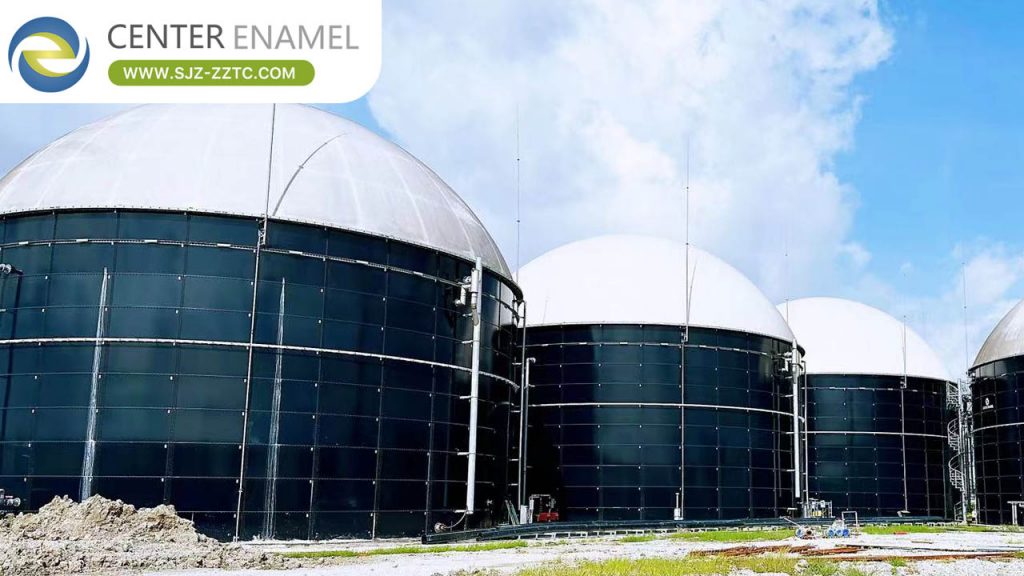
Most plants use an activated-sludge or fixed-film secondary process, sometimes combined with anaerobic or anoxic zones for nitrogen and phosphorus. For smaller or modular scopes, package plants and tank-based enclosures (including GFS bolted tanks) provide the secondary and equalization volume without heavy civil works. Where land is constrained, membrane bioreactors compress the footprint. The choice is driven by flow, the limit and available area - not by fashion.
Capacity And Sizing
Capacity is set by average daily flow, peak factors and the receiving limit. A design is meaningless without both: a plant sized only to average flow overflows on storm peaks, while a plant sized only to a number - with no limit - may over- or under-treat. Real scopes in the library span from a 1,800 m3/day municipal plant to a 50,000 t/day municipal works, showing how dramatically scale changes the engineering.
Project Reference - Domestic Sewage Treatment Project In Ghana
A municipal domestic sewage treatment plant in Ghana operates at a capacity of 1,800 m3/day using a UBF + A2/O + sedimentation train across four reactor sets. Published data shows location, process and capacity; water-quality or tank-dimension figures beyond these are not released, so this is cited as a scoped municipal application rather than a performance claim.
| Attribute | Value | Note |
| Location | Ghana | Published |
| Process | UBF + A2/O + sedimentation | 4 reactor sets |
| Capacity | 1,800 m3/day | Published |
| Application | Municipal domestic sewage | Scoped |
About Company
Shijiazhuang Zhengzhong Technology Co., Ltd (Center Enamel) is a comprehensive high-tech enterprise specializing in wastewater engineering, process section contracting, and equipment manufacturing. The company delivers biogas and wastewater projects through three main lines - EPC (turnkey) contracting, equipment supply, and process packages - covering livestock and municipal wastewater, biomass energy, industrial wastewater, and food waste. Its reactor portfolio spans CSTR, USR, UBF, UASB, IC, and EGSB, backed by in-house Glass-Fused-to-Steel tank manufacturing (enamel firing at 820-930 C) and certifications including ISO 9001, NSF/ANSI 61, and CE-EN 1090. With 35+ years of operation, a 150,000 m2 manufacturing base, and projects in 100+ countries, Center Enamel provides the single-responsibility engineering behind municipal sewage projects such as the Ghana UBF + A2/O reference, where a modest 1,800 m3/day scope shows the full preliminary-to-tertiary chain applied at municipal scale - a scoped application rather than a generic claim.
A sewage treatment project is the full chain from collection to tertiary polishing, sized by average and peak flow against a receiving limit - the limit, not a template, decides the train.
Frequently Asked Questions
Q1: What is a sewage treatment project? A1: The full chain - collection, preliminary, primary, secondary and tertiary - that cleans municipal wastewater to a limit.
Q2: What are the main stages? A2: Preliminary, primary sedimentation, secondary biology, tertiary polishing, plus sludge handling and disinfection.
Q3: How is a sewage project sized? A3: By average daily flow, peak factors and the receiving discharge or reuse limit.
Q4: What secondary process is common? A4: Activated sludge or fixed film, often with anoxic/anaerobic zones for nitrogen and phosphorus.
Q5: What capacity do municipal plants run? A5: The library spans 1,800 m3/day to 50,000 t/day municipal scopes.
Q6: Can tanks be bolted instead of concrete? A6: Yes - GFS bolted tanks provide secondary and equalization volume with less civil work.
Q7: What is tertiary treatment for? A7: Nutrient (N/P) removal and disinfection to meet the receiving limit.
Q8: What happens to the sludge? A8: It is thickened, stabilized and dewatered as a separate stream.
Suggested CTA
Send your average and peak flow and the receiving limit to an engineer, or read the companion article on delivering a sewage treatment project solution.