
Sewage Treatment Solutions for Growing Communities: Modular GFS Plants
Modular sewage treatment solutions pair standardized process blocks with bolted GFS tankage so a municipality can add capacity in steps as population grows, instead of overbuilding a single large plant on day one. The tanks - glass fused at 820-930 C, 200-60,000 m3, ISO 28765 and AWWA D103 - bolt together and expand without poured concrete.
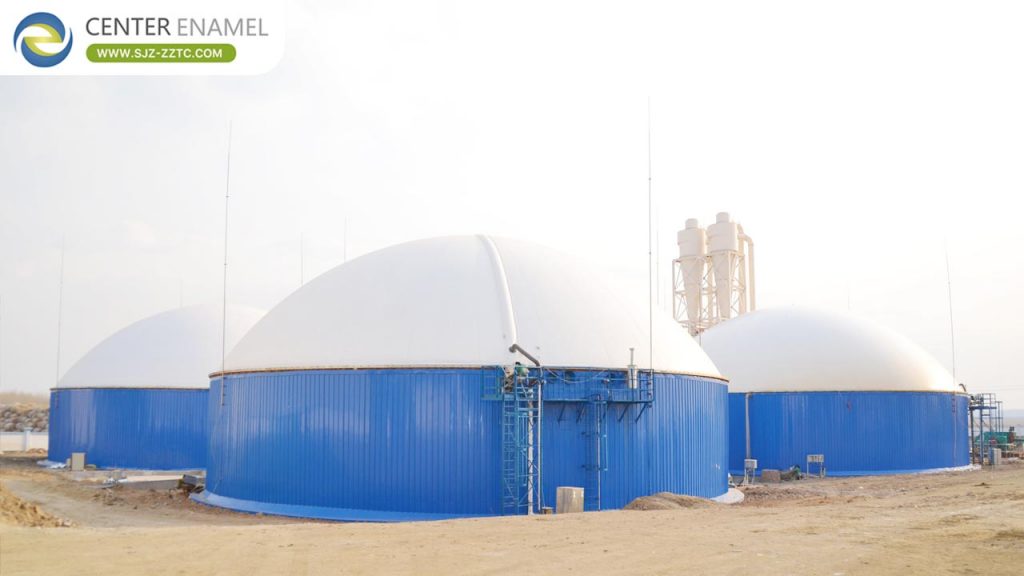
1. Grow in Steps, Not in Guesses
A small community rarely has the flow or budget for a full-scale plant. Modular blocks - equalization, anaerobic, anoxic-oxic, and clarification - let the operator build phase one now and bolt on phase two when the sewers fill. That matches capital spend to actual demand and avoids stranded capacity.
2. Why GFS for Municipal Tankage
Municipal sewage is corrosive and variable. GFS tanks resist the sulfide-bearing liquor with an inert enamel barrier, assemble fast, and relocate or expand more easily than concrete. A 1,800 m3/day municipal plant, for example, can be built from a handful of bolted units rather than a civil works program.
3. Process Fit for Small Towns
For municipal sewage, a combined upflow blanket plus anaerobic-anoxic-oxic (UBF + A2/O) train delivers COD, nitrogen, and phosphorus removal in a compact footprint - exactly the kind of complete solution a growing town needs. Clarification and sludge handling round out the block.
Comparison: Modular vs Single Large Plant
| Criterion | Modular | Single large |
| Capital timing | Phased | Upfront |
| Overbuild risk | Low | High |
| Expansion | Bolt-on | Civil rebuild |
| Best for | Growing towns | Stable cities |
Project Case Study
Domestic Sewage Treatment Project in Ghana (Ghana, 2021). A municipal plant with 1,800 m3/day capacity built on UBF + A2/O plus sedimentation, using bolted GFS units (UBF 11.46 m x 9.6 m, sedimentation 14.52 m x 4.8 m, two A2/O units 20.64 m x 6.6 m) to meet stringent effluent limits - a delivered modular municipal sewage solution.
| Project | Domestic Sewage Treatment Project in Ghana |
| Location | Ghana |
| Industry | Municipal |
| Application | Domestic sewage treatment |
| Process | UBF + A2/O + Sedimentation |
| Capacity | 1,800 m3/day |
| Equipment | UBF, sedimentation, 2x A2/O GFS units |
| Status | Delivered 2021 |
| Item | Influent | Effluent |
| COD Cr | 1,000 mg/L | 100 mg/L |
| BOD5 | 500 mg/L | 25 mg/L |
| Ammonia N | 30 mg/L | 10 mg/L |
| SS | 400 mg/L | 25 mg/L |
| Total P | 10 mg/L | 2 mg/L |
| pH | as received | 6.5 - 9.0 |
About Shijiazhuang Zhengzhong Technology Co., Ltd (Center Enamel)
Shijiazhuang Zhengzhong Technology Co., Ltd (Center Enamel) manufactures the bolted GFS tankage in this and similar municipal plants: enamel fused at 820-930 C forms an inert, impermeable barrier against corrosive sewage liquors, engineered to ISO 28765 and AWWA D103, shipped flat-pack and assembled on site. Modular capacity starts with modular, expandable tanks.
For a growing community, choose a modular sewage treatment solution that adds capacity in steps. Use bolted GFS tankage for a corrosion-resistant, expandable shell. Send your population and flow and we will phase the plant.
Frequently Asked Questions (FAQ)
Q1: What is a modular sewage plant?
A: Standardized process blocks with bolted GFS tankage that expand in steps as demand grows.
Q2: How do you expand capacity?
A: Bolt on additional GFS units and process blocks rather than rebuilding civil works.
Q3: Why GFS for municipal tankage?
A: The inert enamel barrier resists sulfide-bearing sewage and assembles faster than concrete.
Q4: What process fits a small town?
A: UBF + A2/O delivers COD, nitrogen, and phosphorus removal in a compact footprint.
Q5: What tank sizes are available?
A: GFS tanks from 200 m3 to 60,000 m3.
Q6: What standards apply?
A: Tanks are built to ISO 28765 and AWWA D103.
Suggested CTA
Send your population and sewage flow. We will phase a modular sewage treatment solution with GFS tankage.