
Should Manure Be Co-Digested? Benefits And Limits
Co-digesting manure with a complementary feed such as crop residue, food waste, or agro-industrial slurry usually improves biogas because it shifts the carbon-to-nitrogen ratio toward the 20-30:1 band the methanogens prefer and dilutes inhibitors. It is not automatic: the second stream must be available year-round, mixable, and free of contamination, or the extra handling cost outweighs the gain.
Why Co-Digest At All
Manure alone is often too wet and too low in carbon, so a pure-manure digester can sit at a weak carbon-to-nitrogen ratio and produce less gas per volume. Adding a carbon-rich partner (straw, napier grass, food waste) lifts the ratio, buffers the biology, and dilutes ammonia or salts that would otherwise inhibit the culture.
Common Co-Digestion Pairs
The table below shows the typical effect of each partner on the feed. The right partner is the one available within a sensible haul distance for all 12 months, not the one with the best lab yield.
| Partner Stream | Effect On C N Ratio | Main Risk |
| Crop straw or grass | Raises carbon, lifts gas | Bulky, seasonal supply |
| Food waste | Raises carbon, rich feed | Contamination, fats |
| Agro-industrial slurry | Dilutes, steadies load | Variable strength |
| Slaughterhouse waste | High energy, high N | Hygiene, regulation |
Design Checks Before You Commit
Confirm the second stream's year-round availability, total solids, and contaminant load before sizing the digester. Co-digestion only helps if the feed can be mixed to a target total solids and fed steadily; a digester sized for a partner that disappears in winter will run underloaded for half the year.
A Boundary Condition
Co-digestion is not a cure for a bad base feed. If the manure is already at a good ratio, or the partner is heavily contaminated or only seasonal, adding it introduces handling and hygiene problems that erase the biogas gain. Keep the mixed feed in the 20-30:1 carbon-to-nitrogen band and the total solids in the digester's working range.
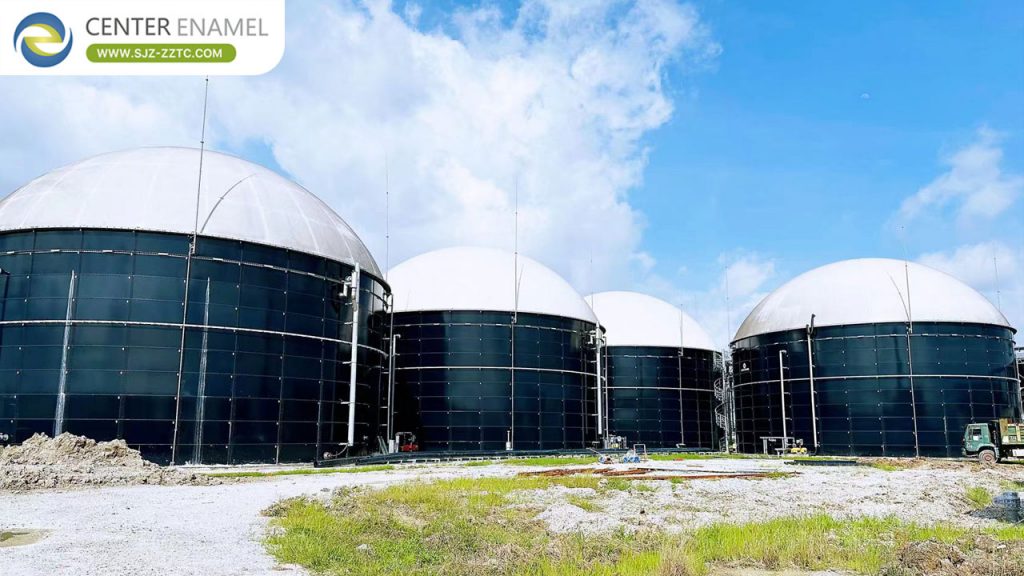
Project Case Study: Zhaqi Biogas Project In Inner Mongolia
Project / Application: Farm animal manure and agricultural waste to biogas, Xing'an, Inner Mongolia, China. Industry: Agriculture and renewable energy. Tank Type: CSTR (Continuous Stirred-Tank Reactor). Key Requirements: Steady co-digestion in a cold climate.
| Field | Value | Source / Evidence |
| Handling Capacity | 900 m3/D (manure + agricultural waste) | Company project reference |
| Treatment Type | Medium Temperature Anaerobic Fermentation | Company project reference |
| Reactor Type | CSTR (Continuous Stirred-Tank Reactor) | Company project reference |
| Reactor Size | 4 sets of O25.98 x 8.4 m | Company project reference |
| Daily Biogas Output | 20,000 m3/day | Company project reference |
| Feedstock | Animal manure + grass straw | Company project reference |
| Installation Year | 2017 | Company project reference |
About The Supplier
Shijiazhuang Zhengzhong Technology Co., Ltd (Center Enamel) supplied the Glass-Fused-to-Steel CSTR tanks for the Zhaqi plant, where 900 m3/day of manure is co-digested with grass straw at 35-38 C. The project demonstrates co-digestion chosen for a real carbon-to-nitrogen benefit, with enamel firing at 820-930 C and certifications including ISO 9001, NSF/ANSI 61, and CE-EN 1090.
Comparison: Single Feed Versus Co-Digestion
| Approach | Best When | Main Trade-off |
| Manure only | Already balanced feed | No partner logistics |
| Manure plus residue | Weak C N ratio | Haul and store the partner |
| Manure plus food waste | High energy gain | Contamination control |
Co-digest manure when a clean, steady, year-round partner genuinely improves the carbon-to-nitrogen ratio and dilutes inhibitors. Pick the partner by haul distance and reliability first, and the biogas gain follows.
Frequently Asked Questions
Q1: Why co-digest manure? A1: A carbon-rich partner lifts the C N ratio toward 20-30:1 and dilutes inhibitors.
Q2: What streams pair with manure? A2: Crop straw, grass, food waste, and agro-industrial slurry are common partners.
Q3: What can go wrong? A3: Seasonal supply, contamination, and overload from a too-rich partner.
Q4: When is co-digestion not worth it? A4: When the partner is unavailable year-round or the base feed is already balanced.
Q5: What ratio is targeted? A5: A carbon-to-nitrogen ratio near 20-30:1 for stable methanogenesis.
Q6: Does co-digestion raise biogas? A6: It usually does, by improving the biology, not by magic.
Q7: What temperature is used? A7: Mesophilic digestion typically runs at 35-38 C.
Q8: What tank resists the mix? A8: A Glass-Fused-to-Steel CSTR with a corrosion-resistant enamel lining.
Suggested CTA
List your available feed streams and volumes to an engineer, or request a co-digestion feed assessment and digester scope.