
Professional Slaughterhouse Wastewater Treatment Project Solution and CSTR Process Implementation
The Asia-Pacific region, particularly China, has become the world's largest industrial wastewater treatment market, with the operation and maintenance service segment's contribution continuing to rise, marking a shift from project construction to long-term operational management. The North American market focuses on upgrading existing facilities, while Europe emphasizes high-value-added resource recovery technologies. Wastewater from the new energy industry chain (lithium batteries, photovoltaics, hydrogen) has become the most notable emerging growth area due to its complex composition and high treatment difficulty, generating significant demand for customized solutions. The maturity of third-party treatment models in industrial parks continues to improve, driving consolidation in the professional operation market. The Middle East has strong demand for advanced treatment and reuse of industrial wastewater due to water scarcity; manufacturing transfer in Southeast Asia drives local industrial wastewater treatment facility construction demand.
As regional industrial standards evolve and environmental regulations grow progressively stringent, the demand for targeted facility upgrades continues to expand globally. Designing a robust slaughterhouse Wastewater Treatment Project requires careful consideration of local ecological rules and high-strength effluent characteristics. Adapting to these shifting market landscapes ensures long-term operational compliance and sustainable infrastructure development across diverse international sectors.
Supporting Equipment in CSTR Process
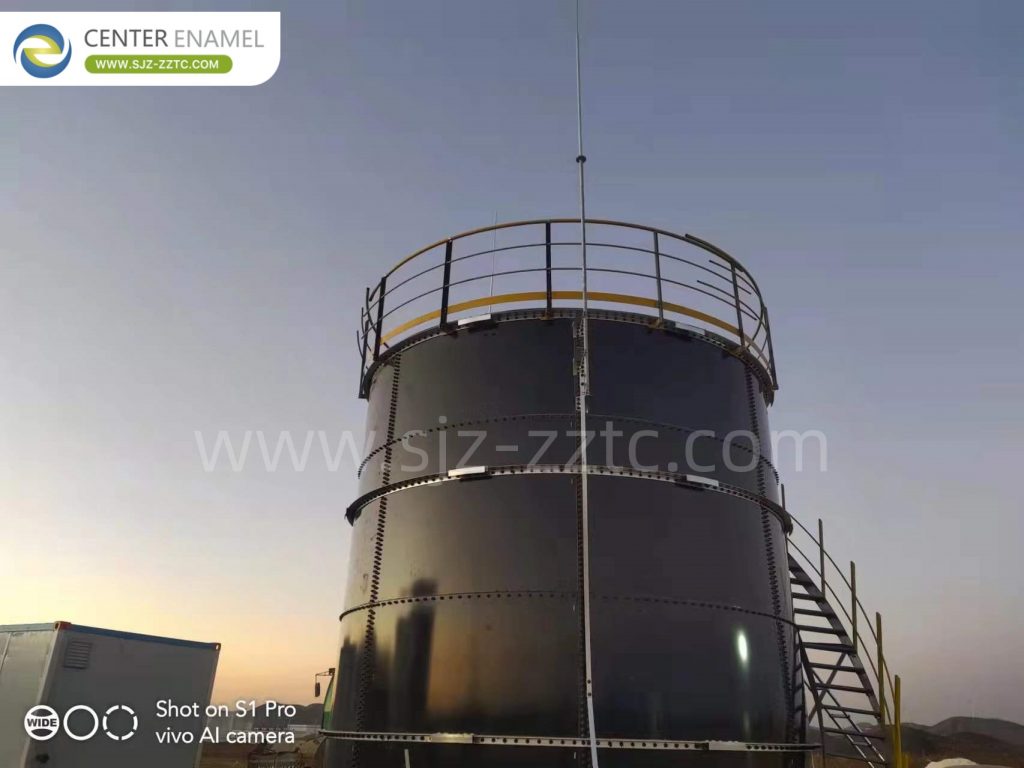
The core equipment is a vertical sealed anaerobic reactor tank, with Center Enamel GFS tanks as the mainstream choice for high-corrosion, high-viscosity wastewater conditions. The key operating equipment is a low-speed mechanical stirrer, comprising motor, gearbox, and impeller blades, achieving uniform mixing throughout the reactor and preventing sedimentation and crusting. Supporting equipment includes corrosion-resistant feed pumps, flow control valves, and inlet piping for precise feed flow control; biogas collection systems (piping, water seals, dual-membrane gas holders, desulfurization units) for biogas collection, purification, and storage. Online monitoring equipment for temperature, pH, and liquid level is integrated for real-time reaction parameter monitoring. Sludge discharge pumps, return piping, and emergency drain systems complete the equipment package, with convenient operation and maintenance, low failure rates, and support for long-term continuous stable operation.
Optimizing biological reaction stages demands reliable supporting hardware capable of maintaining uniform mixing under demanding operating conditions. The integration of a well-engineered CSTR Process ensures smooth mechanical agitation and consistent biogas recovery without premature component failure. Equipping reactors with high-grade accessories guarantees uninterrupted continuity for large-scale biological digestion systems.
Food Waste Standardized Treatment Solutions
Core treatment uses a combination process of "pretreatment oil/grease/solids removal + anaerobic digestion + aerobic treatment + advanced treatment," specifically addressing high oil, high salt, and high organic load characteristics. Pretreatment uses mechanical sorting and crushing/screening to remove inorganic impurities like plastics and bone fragments; three-phase separators recover oil for sale, significantly reducing wastewater oil content; DAF further removes emulsified oil to prevent oil entry into biological systems. The main stage uses CSTR anaerobic process, suitable for high-solids, high-oil organic fermentation with strong shock resistance, simultaneously producing biogas for energy recovery. Anaerobic effluent is followed by A/O or A²O aerobic processes for nitrogen/phosphorus removal. High-salinity wastewater requires salinity load control, with dilution or halophilic bacteria acclimation as needed. Final membrane treatment or constructed wetlands provide polishing for compliance. Digester tanks use Center Enamel GFS tanks, resistant to oil and high-salt corrosion with excellent sealing to prevent odor escape.
Managing high-strength organic wastes requires multi-stage treatment trains designed to handle heavy pollutant loads effectively. Implementing a structured configuration within a slaughterhouse Wastewater Treatment Project prevents oil scaling and mitigates downstream biological inhibition. Such comprehensive processing frameworks ensure that complex waste streams are successfully converted into safe effluents and clean energy.
Indonesia Palm Oil Biogas Project
Specifically designed for high-concentration palm oil wastewater treatment with 3 GFS fermentation tanks, each 19.86 m diameter × 8.4 m height. Installation began November 2009 with only 7 construction personnel, completing all tank assembly in 40 days-highly efficient and time-saving. Tanks are fitted with dual-membrane gas storage covers for POME anaerobic digestion-degrading organics and recovering biogas energy while eliminating palm industry pollution. This is an early benchmark POME biogas treatment project in Southeast Asia.
Real-world installations provide concrete proof of how modular containment and efficient biological systems perform under intense tropical conditions. Deploying advanced anaerobic solutions within a major slaughterhouse Wastewater Treatment Project demonstrates remarkable speed and structural reliability. These landmark reference projects highlight the immense practical value of utilizing resilient engineering approaches for agro-industrial waste mitigation.
Full-Category Complete Product Matrix of Center Enamel
Center Enamel has built a complete product matrix of "core storage tanks + supporting covers + specialty pressure vessels + complete environmental engineering services"-the only company globally to achieve integrated enamel frit R&D, self-manufacturing, and GFS tank application.
- Core: Proprietary GFS Tanks Using proprietary double-sided hot-rolled double-layer enamel anti-corrosion technology-resistant to strong acids/alkalis, high salinity, and microbial corrosion-modular quick assembly-suitable for all strong-corrosion conditions in wastewater, biogas, and chemical applications.
- Supporting: Fusion Bonded Epoxy Tanks Produced on China's first intelligent standardized production line-primarily for drinking water, fire water, and neutral medium storage.
- Sealing: Aluminum Dome Covers Proprietary high-strength aluminum alloy self-supporting structure-meeting international waterproof and load-bearing standards-suitable for tank sealing and biogas collection.
- Other Tanks: Carbon Steel Tanks, Stainless Steel Tanks, Composting Tanks, Various Non-Standard Pressure Vessels.
- Engineering Services: Environmental EPC General Contracting, Anaerobic Process Section Subcontracting-one-stop coverage across food waste, leachate, municipal wastewater, livestock biogas, petrochemical/metallurgical, and seawater desalination industries-customizable tank volume, corrosion protection grade, and complete process solutions with integrated equipment manufacturing and engineering construction.
Sourcing project components from a unified manufacturer eliminates compatibility issues and simplifies complex supply chain coordination. Integrating a versatile product matrix into a slaughterhouse Wastewater Treatment Project ensures that every containment vessel and cover meets strict performance benchmarks. Comprehensive manufacturing capabilities empower project developers to execute large-scale environmental ventures with absolute confidence.
Comprehensive International Authoritative Certifications
Center Enamel holds CE, NSF, WRAS, ISO9001, BSCI, ASME, and other global certifications-fully clearing EU, North American, Southeast Asian, and African project tendering barriers-providing critical hard credential advantages for large overseas project bidding.
Securing international project contracts requires strict adherence to globally recognized quality standards and safety regulations. Possessing extensive industry certifications allows an executing team to streamline customs clearance and regulatory approval processes. These official credentials validate superior product manufacturing and provide reliable guarantees for international clients worldwide.
Aluminum Geodesic Dome Roof
Aluminum Geodesic Dome Roof independently developed by Center Enamel is manufactured using high-strength aluminum alloy plates through integral stamping. It features a triangular grid spherical self-supporting structure, enabling large-span full coverage without internal support columns. Made of aluminum alloy, the roof offers excellent weather resistance and corrosion resistance, capable of long-term protection against acid rain, salt spray, and UV radiation, suitable for various extreme outdoor climate conditions. The structural design complies with international AWWA D108 standards, with aluminum plate thickness, rib cross-sections, and joint connections all verified by finite element stress analysis, ensuring wind and snow load resistance that meets building code requirements across different global regions.
The weight of the Aluminum Geodesic Dome Roof is only one-third to one-half of a steel roof with the same span, significantly reducing the load on the tank top and allowing direct installation without tank wall reinforcement. The roof provides superior overall sealing performance, with double sealing between panels using specialized sealant strips and mechanical interlocking, enabling both airtight gas storage and enclosed odor control, suitable for biogas collection and storage, wastewater tank odor control, and drinking water contamination prevention. The support-column-free design does not interfere with the installation and operation of internal equipment such as mixers and water distributors. The aluminum material does not support microbial growth, requiring no anti-corrosion maintenance over long-term use, resulting in low total life-cycle costs.
Achieving complete gas containment and effective odor suppression requires specialized structural roofing systems built for harsh operational environments. Integrating lightweight aluminum covers with a robust CSTR Process prevents fugitive emissions while protecting internal equipment from atmospheric corrosion. These advanced architectural solutions deliver exceptional durability, structural efficiency, and long-term cost savings across all modern containment applications.