
Sludge Anaerobic Reactors: Types, Design Features, And Solids Handling
A sludge anaerobic reactor is a sealed, heated vessel that holds anaerobic biomass long enough to stabilise organic solids and produce biogas. The configuration - CSTR, plug-flow, two-stage, or high-rate upflow - is decided mainly by total solids, not by the label 'sludge'. Pumpable low-solids feed favours a continuously stirred tank; thick or fibrous feed favours plug-flow or a staged system. Mixing, heating, and gas capture are the three hardware features that separate a working digester from a tank that merely holds waste.
What Counts As A Sludge Anaerobic Reactor
The term covers any enclosed anaerobic vessel treating a solids-rich organic stream - sewage sludge, livestock slurry, manure, or food-processing residuals. What matters is that the feed cannot be treated as a clear wastewater: it carries suspended solids that must be kept in suspension, it is too thick for a simple upflow bed, and it needs a gas-tight cover to capture the methane generated. A reactor that meets those three conditions belongs in this family, whatever the feed is called on the permit.
The Main Reactor Configurations
Four configurations cover most projects. A CSTR is a fully mixed tank suited to pumpable feed; plug-flow handles thicker, fibrous material with less mixing energy; two-stage systems split acid formation from methane formation for better stability; and high-rate upflow reactors (UASB, EGSB, IC) serve low-solids, soluble wastewater where granular biomass can be retained.
| Configuration | Typical feed solids | Where it fits | Main constraint |
| CSTR (stirred tank) | 2-10% TS, pumpable | Slurry, manure, mixed sludge | Mixing energy; scum layer |
| Plug-flow | 8-15% TS, fibrous | Thick manure, straw-rich feed | Poor mixing; channel risk |
| Two-stage | Variable, 2-12% TS | Unstable or high-strength feed | More vessels and controls |
| UASB / EGSB / IC | <1-2% TS, soluble | Clear industrial wastewater | Solids washout if too thick |
How Solids Content Decides The Reactor
Total solids is the first design variable because it sets pumpability and heat demand. At low solids the feed behaves like water and a high-rate reactor can retain granular biomass at short retention times. As solids rise, the feed becomes a paste: it cannot be fed to an upflow bed without washout, so a mixed or plug-flow vessel with a longer retention time is needed. The practical dividing line is not a fixed number but whether the feed can be pumped and mixed uniformly at acceptable energy cost.
Mixing, Heating, And Gas Capture
Mixing prevents scum and keeps biomass in contact with the feed, but it is also a major operating cost - which is why high-solids feed is often handled by plug-flow rather than by more powerful agitators. Heating holds the reactor in the mesophilic band around 35-38 C; below it, reaction rates fall and retention must be extended. A gas-tight dome or membrane cover captures biogas at 55-65% methane and keeps oxygen out of the process.
| Feature | Why it matters | Typical choice |
| Mixing | Prevent scum, contact biomass | Mechanical agitator or gas mixing |
| Heating | Hold 35-38 C mesophilic | External heat exchanger + insulation |
| Gas cover | Capture CH4, exclude oxygen | GFS dome or double membrane |
| Retention | Allow slow methanogens to grow | 15-30 days at mesophilic |
Where Each Configuration Fails
CSTRs are robust but pay for mixing electricity and can develop a floating scum layer if fat is high. Plug-flow systems use less energy but risk channeling when feed thickness varies. Two-stage plants add stability at the cost of a second vessel and more instrumentation. High-rate upflow reactors give compact footprints and short retention, but they fail when suspended solids are high enough to wash out the granules. None of these is universally better; each is a trade against feed properties.
Project Reference - A High-Solids CSTR
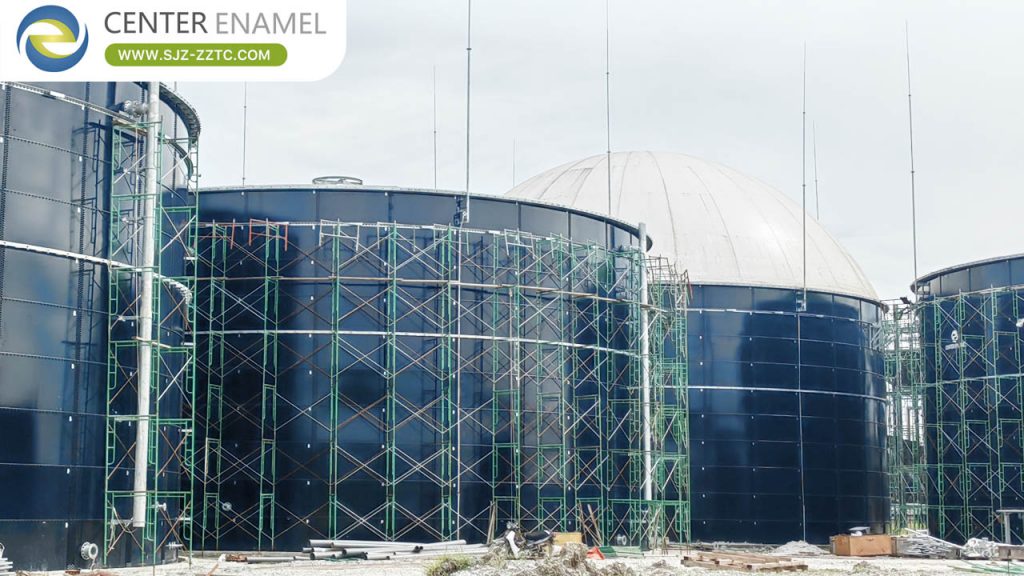
A referenced biogas project in Xing'an, Inner Mongolia (2017) applied four CSTR reactors to 900 m3/day of manure and agricultural waste under medium-temperature (mesophilic) fermentation. Published figures list 4 sets of 25.98 x 8.4 m reactors and 20,000 m3/day of biogas. The feed is manure and straw rather than sewage sludge, so this is cited as a high-solids CSTR construction reference - not as a sewage-sludge performance claim.
| Attribute | Value | Note |
| Location / year | Xing'an, Inner Mongolia / 2017 | Published |
| Feed | Manure + agricultural waste | Not sewage sludge |
| Reactor | 4 x CSTR, 25.98 x 8.4 m | Published |
| Capacity / gas | 900 m3/day / 20,000 m3/day | Published |
About Company
Shijiazhuang Zhengzhong Technology Co., Ltd (Center Enamel) is a comprehensive high-tech enterprise specializing in wastewater engineering, process section contracting, and equipment manufacturing. The company delivers biogas and wastewater projects through three main lines - EPC (turnkey) contracting, equipment supply, and process packages - covering livestock and municipal wastewater, biomass energy, industrial wastewater, and food waste. Its reactor portfolio spans CSTR, USR, UBF, UASB, IC, and EGSB, backed by in-house Glass-Fused-to-Steel tank manufacturing (enamel firing at 820-930 C) and certifications including ISO 9001, NSF/ANSI 61, and CE-EN 1090. With 35+ years of operation, a 150,000 m2 manufacturing base, and projects in 100+ countries, Center Enamel provides the single-responsibility engineering behind high-solids anaerobic reactor references such as the Zhaqi CSTR project - a scoped construction reference, not a generic capability claim.
Conclusion
A sludge anaerobic reactor is chosen by feed solids and the need to keep biomass in contact with that feed. CSTR, plug-flow, two-stage, and high-rate designs each own a solids band; mixing, heating, and gas capture turn the chosen vessel into a working digester.
Frequently Asked Questions
Q1: What is a sludge anaerobic reactor? A1: A sealed, heated vessel that holds anaerobic biomass long enough to stabilise organic solids and produce biogas.
Q2: Which reactor suits high-solids sludge? A2: Plug-flow or a CSTR for thick feed; high-rate UASB/EGSB types require low solids below roughly 1-2%.
Q3: Why does solids content decide the design? A3: It sets pumpability and heat demand, which determine whether a mixed or plug-flow vessel is practical.
Q4: How does mixing work in a digester? A4: Mechanical agitators or gas mixing keep solids suspended and prevent a scum layer, at the cost of operating energy.
Q5: What temperature does a sludge digester run at? A5: Mesophilic operation is typically 35-38 C; lower temperatures slow the reaction and require longer retention.
Q6: How long is the retention time? A6: Mesophilic systems commonly use 15-30 days to allow slow-growing methanogens to establish.
Q7: When is two-stage digestion used? A7: When feed is unstable or high-strength; separating acid formation from methane formation improves process stability.
Q8: What gas does the reactor make? A8: Biogas at roughly 55-65% methane, captured by a gas-tight cover for heat, power, or upgrading.
Suggested CTA
Send your feed solids, daily volume, and fibre content to an engineering team, or request a scoped anaerobic reactor configuration outline.