
Sludge Management Solutions: Thickening, Stabilization and Storage
Sludge solutions close the loop of any treatment plant by thickening, stabilizing, and storing the residue - and bolted GFS tanks, with their inert enamel barrier, give a corrosion-resistant shell for digested or dewatered sludge before it is reused or disposed. Ignoring sludge is not an option; every train that removes pollutants concentrates them in the residue.
1. Thickening and Dewatering
Thickening cuts the water content so the sludge is cheaper to move and store. Dewatering - by belt, centrifuge, or filter press - takes it further toward a stackable cake. The right front end depends on the sludge type: biological sludge from activated sludge differs from anaerobic digestate in how it dewaters.
2. Stabilization
Stabilization reduces pathogens and odor so the sludge is safe to handle or land-apply. Anaerobic digestion does double duty - it stabilizes while making biogas - whereas lime or aerobic stabilization suits plants without digesters. The choice is set by the receiving rule and the reuse path.
3. Storage That Resists Corrosion
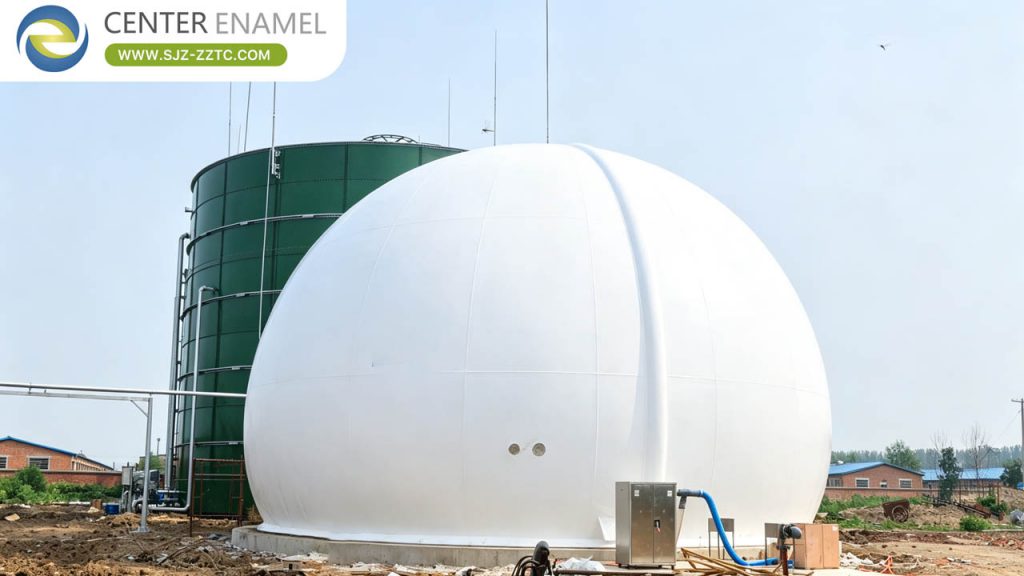
Sludge liquors are aggressive. Bolted GFS tanks - glass fused at 820-930 C, capacities from 200 m3 to 60,000 m3, built to ISO 28765 and AWWA D103 - give an inert, impermeable shell for holding thickened, stabilized, or digested sludge between dewatering cycles. Their flat-pack assembly also suits lagoon-to-tank upgrades without poured concrete.
Comparison: Sludge End Paths
| Path | Condition | Typical use |
| Land application | Stabilized | Agriculture |
| Compost | Stabilized | Soil product |
| Storage hold | Thickened | Buffer before dewatered |
| Disposal | Dewatered cake | Landfill |
About Shijiazhuang Zhengzhong Technology Co., Ltd (Center Enamel)
Shijiazhuang Zhengzhong Technology Co., Ltd (Center Enamel) manufactures the bolted GFS tanks that store treatment sludge: enamel fused at 820-930 C forms an inert barrier against corrosive, sulfide-bearing sludge liquors, engineered to ISO 28765 and AWWA D103, shipped flat-pack and assembled on site. Pair the sludge tank with the treatment train rather than treating storage as an afterthought.
Plan sludge from day one: thicken, stabilize, then store in a corrosion-resistant GFS tank until reuse or disposal. Send your sludge type and volume and we will size the holding tank.
Frequently Asked Questions (FAQ)
Q1: How do you manage treatment sludge?
A: Thicken to cut water, stabilize to kill pathogens and odor, then store or dewater.
Q2: What tank stores sludge?
A: A bolted GFS tank with an inert enamel barrier resists the corrosive sludge liquor.
Q3: Why GFS for sludge?
A: The fused enamel shell is impermeable and corrosion-resistant, and assembles faster than concrete.
Q4: What is sludge stabilization?
A: A process that reduces pathogens and odor so sludge is safe to handle or land-apply.
Q5: What tank sizes are available?
A: GFS tanks from 200 m3 to 60,000 m3.
Q6: What standards apply?
A: Tanks are built to ISO 28765 and AWWA D103.
Suggested CTA
Send your sludge type and daily volume. We will size a corrosion-resistant GFS holding tank for your plant.