
Solving High-Solids Wastewater Challenges with Smart Biogas Plant Design
The core challenges of industrial wastewater treatment center on the "three highs"-high difficulty, high cost, and high energy consumption. Wastewater from new energy, chemical, and pharmaceutical industries is complex in composition with numerous characteristic pollutants, and traditional treatment processes are difficult to remove effectively. Chinese companies have significant price advantages in the mid-to low-end equipment segment.
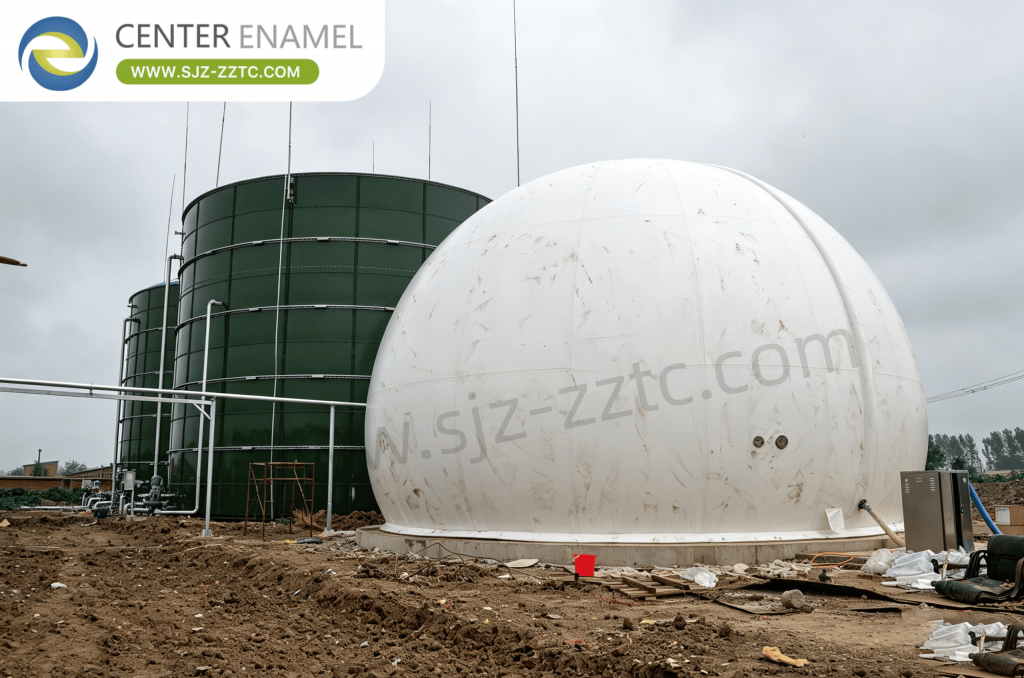
Beyond treatment itself, the industry also faces continuous technological upgrade pressure from increasingly stringent emission standards, as well as new requirements for digitalization and low-carbon transformation on operational refinement management capabilities. Meeting these challenges requires both robust equipment and intelligent Biogas Plant Design that accounts for feedstock variability, site conditions, and long-term operational realities.
Bolted Assembly Construction for Faster Project Delivery
Equipment selection directly affects how quickly a project can be delivered. GFS tanks are assembled on-site from prefabricated panels, with short construction periods and support for expansion, relocation, and reuse-advantages distinctly different from immovable concrete tanks. Concrete tank pouring requires formwork, rebar tying, pouring, and long curing periods, with a single tank construction taking months. Rain, snow, and low temperatures force work stoppages and delays. Once poured, they are permanent fixed structures that cannot be dismantled, expanded, or relocated-project relocation means complete abandonment.
GFS tank panels are all factory-prefabricated, transported to site, and directly assembled in panels with simple procedures. Construction can proceed even in low-temperature, light-rain conditions, with installation time only one-third that of concrete tanks-construction schedules are controllable. For expansion, additional steel panels can be installed to increase volume; for plant relocation, tanks can be fully disassembled with panels transported to new sites for reassembly and reuse, significantly reducing material and construction costs. This is ideally suited for short-term environmental projects, phased expansion projects, and relocated construction projects.
Where USR Reactor Technology Delivers the Most Value
With the right tank platform in place, process selection determines treatment performance. The USR Reactor is a dedicated process for agricultural high-solids wastewater, primarily suitable for large-scale livestock manure, livestock soaking water, agricultural straw leachate, and livestock slaughterhouse high-solids wastewater.
For high-suspended-solids, high-organics, high-impurity wastewater conditions, it is the core process for rural livestock pollution treatment and agricultural organic waste resource utilization. It suits township decentralized wastewater treatment and small to medium-sized agricultural enterprise wastewater treatment. It can also serve as the primary process for large livestock base manure resource recovery, combining wastewater treatment with biogas recovery. Additionally, it is suitable for various high-solids, easily clogged, difficult-to-treat organic wastewater pretreatment, with superior suitability in agricultural environmental applications compared to other anaerobic processes.
Understanding Food Waste O&M Costs and Recovery Benefits
Beyond agriculture, food waste treatment presents its own economic profile. O&M costs are moderate to high, but resource recovery benefits are substantial-good overall economics. Pretreatment oil removal equipment and three-phase separators have high capital investment, but recovered oil can be sold-biodiesel feedstock oil has good market value, providing core revenue for food waste treatment. Stable biogas from anaerobic digestion can be used for power generation or heating, offsetting energy costs. CSTR process has simple equipment with no precision wear parts-low maintenance costs.
High-salt, high-oil conditions require premium corrosion protection such as GFS tanks, with higher initial investment but long service life and low maintenance. Chemical consumption is mainly flocculants and desulfurizers-moderate expenditure. Oil and salt cause pipe fouling and membrane pollution, requiring periodic cleaning-moderate labor requirements. Overall resource recovery revenues from oil sales, biogas energy, and digestate fertilizer generally cover O&M costs-good overall economics.
Bangladesh Poultry Farm Manure Recovery Success
Theory becomes credible when backed by measurable results. In Bangladesh, a large-scale poultry farm manure resource recovery project targets daily treatment of 47 tons. Influent COD, BOD, and SS reach as high as 50,000 mg/L, 25,000 mg/L, and 50,000 mg/L respectively. After CSTR + UASB anaerobic treatment, all three parameters are reduced to below 200 mg/L, 100 mg/L, and 100 mg/L-effluent fully compliant with local environmental discharge standards.
The project produces approximately 4,900 m³ of biogas daily. Each cubic meter of biogas can generate 2 kWh of electricity, yielding daily power generation of 9,800 kWh-simultaneously achieving pollutant reduction and clean energy recovery. This stands as a benchmark project for livestock waste recycling in Southeast Asia.
Bangladesh Poultry Farm Project Performance
| Parameter | Influent | Effluent | Reduction |
| COD | 50,000 mg/L | <200 mg/L | >99.6% |
| BOD | 25,000 mg/L | <100 mg/L | >99.6% |
| SS | 50,000 mg/L | <100 mg/L | >99.8% |
| Biogas Production | - | 4,900 m³/day | - |
| Power Generation | - | 9,800 kWh/day | - |
A Global Footprint Built on Localized Service
Delivering projects worldwide requires more than manufacturing capacity-it demands local presence. Center Enamel's global business covers over 100 countries and regions, with 30,000+ successful overseas projects. Products are exported to all major regions including Europe, the Americas, the Middle East, Africa, Southeast Asia, and Latin America, with a well-established global localized service network.
Domestically, the company is organized into North, South, Central, East, and Southwest marketing regions, covering environmental, water utility, livestock, and petrochemical customers nationwide. Internationally, the company adopts a "standardized products + localized adaptation" model-adjusting tank corrosion protection, sealing, and pressure standards for different national water quality and environmental regulations-with multiple global landmark projects: large-volume GFS tanks in Italy, 20 m tower water supply tanks in Colombia, coastal seawater treatment tanks in Costa Rica, and large municipal wastewater aluminum dome projects in Saudi Arabia. The company has established long-term stable strategic partnerships with many Fortune 500 companies.
Overseas Installation Coverage and Delivery Capability
Behind every international project stands proven field capability. Center Enamel is the pioneer of Chinese GFS equipment exports, with installation service coverage across over 100 countries and regions-possessing full delivery capability across climates, regulations, and geographies.
Overseas coverage includes Southeast Asia (Vietnam, Thailand, Malaysia, Indonesia, Cambodia, Bangladesh, Nepal, etc.), Africa (Ghana, South Africa, Mali, Guinea, Zambia, Kenya, Pakistan, etc.), Europe and the Americas (Sweden, USA, Russia, etc.), the Middle East, and Latin America-adaptable to tropical rainy high-salt spray, high-altitude mountainous, Nordic severe cold, and high-standard European and American facility conditions.
The company uses a dual-service model of "own cross-border construction teams + overseas local agent coordination"-whether clients are in developed countries or remote developing regions-providing one-stop services including on-site survey, on-site installation, process commissioning, and operator training. Complete coverage spans biogas engineering, municipal wastewater, industrial wastewater, livestock manure, and drinking water storage-possessing the full delivery capability to undertake large-scale tank farm projects in any country worldwide.
Facing high-solids wastewater that conventional systems cannot handle? Reach out to our engineers today and let us design a biogas solution tailored to your feedstock and site.
From first concept to final commissioning, contact Center Enamel for a consultation backed by 30,000+ overseas projects and full delivery capability in over 100 countries.
FAQ
What is a USR Reactor best suited for?
A USR Reactor excels at high-solids agricultural wastewater-livestock manure, slaughterhouse waste, and straw leachate. Its clog-resistant design handles high suspended solids without precision separators.
How does Biogas Plant Design affect project cost?
Good Biogas Plant Design matches tank volume, corrosion grade, and process configuration to actual feedstock and site conditions-reducing over-engineering and long-term maintenance costs.
Can GFS tanks be relocated after installation?
Yes. GFS tanks assemble from bolted panels and can be fully disassembled, transported, and reassembled at a new site-ideal for phased or relocatable projects.