
Solving High-Solids Wastewater Challenges with the USR Process and Turnkey Biogas Delivery
High-solids organic wastewater breaks conventional anaerobic systems. Distribution pipes clog, sludge washes out, and reactions proceed unevenly-shutting down reactors that perform perfectly well on cleaner feedstock. Meanwhile, project owners face a second problem: fragmented supply chains in which tank fabrication, process design, and installation are handled by different vendors with no single point of accountability.
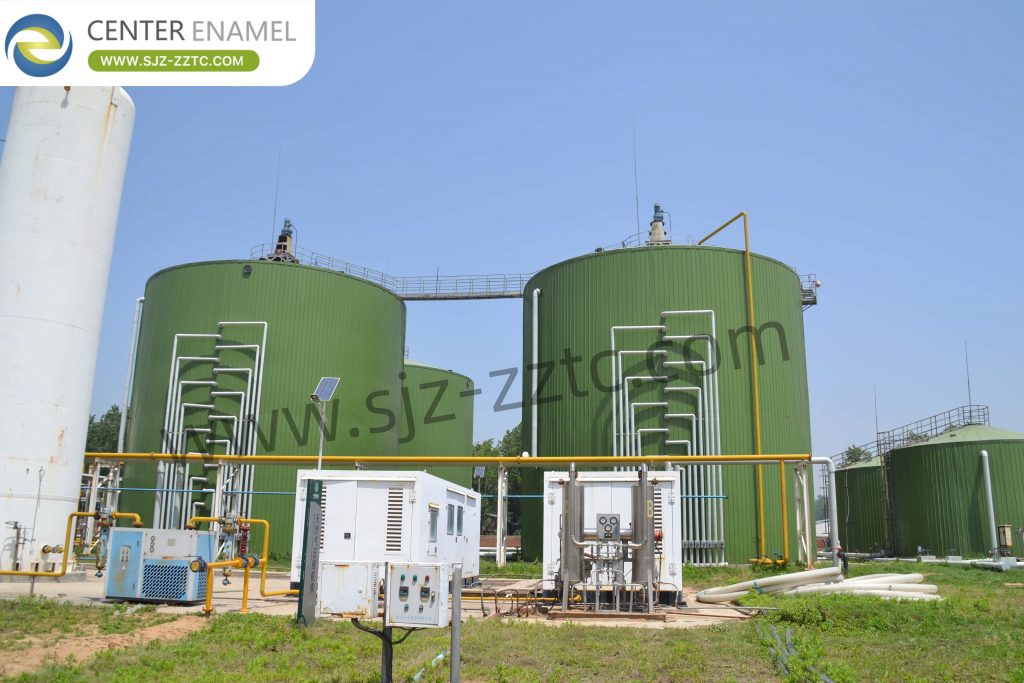
As a Biogas Project Contractor with in-house manufacturing and process engineering, Center Enamel addresses both problems at once. The USR Process solves the technical challenge of high-solids treatment, while integrated contracting solves the delivery challenge-putting containment, process, and construction under one responsible party. This article explains what the USR Process is, where food waste water originates, how a real project performed, and what backs up our delivery capability.
Global Policy Pressures Driving Resource Recovery Adoption
The regulatory environment explains why high-solids treatment technology has moved from niche to necessary. Global industrial wastewater treatment policies are escalating from "compliance discharge" to mandatory "resource recovery" and "zero liquid discharge." The EU, through its Circular Economy Action Plan, requires member states to increase industrial wastewater reuse rates and extends carbon footprint accounting to the full life cycle of wastewater treatment. China continuously updates and tightens industrial water pollutant discharge standards, with increasingly stringent limits on total nitrogen, total phosphorus, and characteristic pollutants for industries such as chemicals, pharmaceuticals, and printing and dyeing.
Some water-scarce regions and highly polluting industries are mandated to adopt zero or near-zero liquid discharge technologies. Germany has established a differentiated pretreatment technical standard system by industry, requiring industrial wastewater to meet specific quality requirements before discharge into municipal wastewater treatment plants, implementing strict source control. For a Biogas Project Contractor, these policies create both obligation and opportunity: treatment systems must now recover resources, not merely dispose of waste-and that requires process technology capable of extracting value from difficult feedstocks.
What Is the USR Process and Why Was It Developed
Meeting those policy goals on high-solids feedstock requires a process built for the purpose. USR, or Upflow Solids Reactor, is an upflow anaerobic process modified for high-suspended-solids, high-solids organic wastewater, specifically designed to solve problems of clogging, sludge washout, and uneven reaction common in traditional anaerobic processes for high-solids wastewater. The process eliminates complex three-phase separators, simplifies internal structure, and relies on upflow hydraulics to promote thorough mixing of solid materials and anaerobic sludge.
Critically, no strict granular sludge formation conditions are required-flocculent sludge can operate stably, which removes the long and fragile start-up phase that plagues high-rate reactors. The key feature is high solids tolerance and impurity resistance, with very high influent suspended solids tolerance. It is a dedicated high-efficiency anaerobic process for livestock manure, agricultural organic waste, and high-solids livestock wastewater, specifically developed for agricultural and environmental applications. In short, the USR Process does not ask the feedstock to adapt to the reactor-it adapts the reactor to the feedstock.
Where Food Waste Water Comes From and What It Contains
Understanding the feedstock is essential to appreciating why the USR Process is necessary. Food waste wastewater originates from the resource recovery process of kitchen waste from catering services, canteens, and food processing and distribution-a typical high-concentration organic wastewater in urban solid waste resource recovery. Major sources include food waste pretreatment sorting wastewater from bag breaking, crushing, and sorting operations; oil separation wastewater from three-phase oil extraction; anaerobic digestion digestate, the residual liquid after food waste anaerobic digestion; and equipment and vehicle wash water.
Food waste consists primarily of food residues, rich in animal and vegetable oils, starches, proteins, cellulose, salts, and seasoning residues. After pretreatment crushing and sorting, these materials enter the treatment train as a heavily loaded, abrasive, and oil-rich stream-exactly the conditions that clog precision reactor internals and motivate the USR Process design.
Case Study: Bangladesh Large-Scale Poultry Farm Manure Resource Recovery Project
The strongest argument for any process or contractor is operational data. Center Enamel's Bangladesh project targets local poultry farm manure resource recovery with daily treatment of 47 tons. Influent COD, BOD, and SS reached as high as 50,000 mg/L, 25,000 mg/L, and 50,000 mg/L respectively. After CSTR + UASB anaerobic treatment, all three parameters were reduced to below 200 mg/L, 100 mg/L, and 100 mg/L-effluent fully compliant with local environmental discharge standards. The project produces approximately 4,900 m³ of biogas daily, and each cubic meter of biogas can generate 2 kWh of electricity, yielding daily power generation of 9,800 kWh. This simultaneously achieves pollutant reduction and clean energy recovery, establishing it as a benchmark project for livestock waste recycling in Southeast Asia.
Treatment Performance (Bangladesh Poultry Manure Project)
| Parameter | Influent | Effluent | Compliance |
| COD | 50,000 mg/L | < 200 mg/L | Meets local discharge standards |
| BOD | 25,000 mg/L | < 100 mg/L | Meets local discharge standards |
| SS | 50,000 mg/L | < 100 mg/L | Meets local discharge standards |
Energy Recovery Output (Bangladesh Poultry Manure Project)
| Metric | Value |
| Daily treatment capacity | 47 tons |
| Daily biogas production | ~4,900 m³ |
| Electricity yield | 2 kWh per m³ biogas |
| Daily power generation | 9,800 kWh |
| Project outcome | Pollutant reduction + clean energy recovery |
Construction Manpower Reserve Behind Every Biogas Project
Delivering projects across 100+ countries requires people, not just equipment. Center Enamel has established its own domestic and international certified construction teams, with regular practical training on GFS Tanks installation and overseas construction standards for various countries. Domestically, regional construction teams cover multiple zones, capable of simultaneously deploying multiple teams for large tank farm projects. Internationally, cross-border professional installation teams are equipped to various country construction standards-sufficient manpower reserves ensure uninterrupted construction delivery for remote African sites, high-standard European and American facilities, and other projects. This capacity is what allows us to function as a genuine Biogas Project Contractor rather than an equipment supplier dependent on local labor of uncertain quality.
R&D Team and Material Technology Barriers
Sustaining performance in aggressive environments depends on continuous material innovation. Center Enamel has built a full-chain professional team covering R&D, design, marketing, installation, and after-sales. The R&D team is led by national-level materials technology experts, specializing in enamel frit and tank anti-corrosion core technologies. External senior environmental engineering and mechanical structure engineers are retained to strengthen R&D capabilities, focusing on anti-corrosion coating formulations, specialty corrosion-resistant tanks, and anaerobic supporting integrated equipment-continuously breaking through industry technological barriers.
The team operates through proprietary laboratories with external university research collaboration, conducting year-round new material and new process durability pilot testing and long-term corrosion simulation testing. Specialized enamel formulations are iteratively developed for extreme conditions such as high-salinity wastewater, strong acid/alkali POME, and high-organic livestock manure-providing core technical support for the company's annual new invention and utility patents and building a proprietary material technology barrier. This is the technical foundation that makes USR Process deployment reliable over decades rather than months.
Single and Double Membrane Roofs for Biogas Storage Projects
Gas containment completes the biogas system, and roof selection determines both recovery efficiency and odor control. Single and Double Membrane Roofs are proprietary airtight tank cover systems for anaerobic digestion and biogas storage projects, specifically developed for biogas collection and odor containment, representing a benchmark lightweight sealing solution for fermentation tanks.
The single-layer membrane roof features a simple structure with economical cost, meeting basic biogas containment needs. The double-layer membrane roof consists of inner and outer corrosion-resistant membrane materials, with pressurized air in the interlayer forming rigid support, providing outstanding thermal insulation that reduces biogas condensate formation inside the tank, with enhanced wind and snow load resistance suitable for high-altitude and windy outdoor sites. The membrane material is specialized aging-resistant and biogas-slurry-corrosion-resistant PVDF membrane, which will not leak or degrade from long-term contact with biogas or hydrogen sulfide. The flexible structure accommodates tank settlement and slight deformation without cracking or gas leakage. The lightweight design eliminates heavy steel support trusses, significantly reducing the load on the tank and foundation, saving construction costs.
The roof integrates biogas outlets, safety pressure relief valves, and access channels, fully enabling closed gas collection for anaerobic fermentation tanks, recovering biogas for power generation and heating while blocking odor diffusion to meet environmental odor control requirements. It is widely used in large-scale livestock biogas projects, municipal sludge anaerobic digestion, and food waste fermentation projects, compatible with large-volume glass-fused-to-steel anaerobic tanks, with fast construction and simple maintenance requiring only periodic membrane seal integrity checks-offering significant overall engineering advantages for any Biogas Project Contractor scope.
Ready to move your high-solids biogas project from concept to commissioning? Share your feedstock analysis and capacity targets with Center Enamel for a tailored USR Process design and turnkey delivery plan. Contact our team today to discuss your project timeline and request a preliminary feasibility review.
Frequently Asked Questions
Q: What problem does the USR Process solve?
USR Process eliminates complex three-phase separators and tolerates very high suspended solids. It prevents clogging, sludge washout, and uneven reaction in high-solids wastewater, and needs no granular sludge-flocculent sludge operates stably.
Q: What makes Center Enamel a qualified Biogas Project Contractor?
We integrate enamel frit R&D, in-house tank manufacturing, and EPC contracting. Our own certified construction teams deploy internationally, and our R&D team develops corrosion-resistant formulations for aggressive biogas environments.
Q: How does membrane roof selection affect biogas projects?
Single-layer roofs suit basic containment economically; double-layer roofs add insulation, wind and snow resistance, and condensate reduction. Both use PVDF membrane resistant to biogas and hydrogen sulfide, with integrated safety valves and gas outlets.