
South Korea Food Waste Biogas Project | Professional Anaerobic Digestion by Center Enamel
South Korea has one of the world’s strictest waste management regulations and a highly developed catering industry, residential communities, hotels, and food manufacturing sectors across Seoul, Busan, Incheon and Daegu. Large amounts of food waste are generated daily from household leftovers, restaurant scraps, hotel buffet waste, and food processing by-products. With high population density and limited urban land, traditional landfill and incineration can no longer meet environmental standards and resource recovery demands.
Under South Korea’s national green growth strategy and mandatory food waste recycling policies, Food Waste Biogas Project has become a core solution for waste reduction and renewable energy expansion. As a professional global EPC contractor, Center Enamel provides customized Anaerobic Digestion technology and mature UASB Process, matched with high-performance biogas equipment, helping South Korea achieve harmless disposal, carbon reduction and stable clean energy supply.
Overview of Food Waste in South Korea
South Korea generates massive food waste every year with high moisture, high salinity and rich organic content. Strict national regulations ban direct landfill of food waste, forcing cities to adopt centralized recycling and treatment. However, traditional composting and incineration still produce odor, greenhouse gas emissions and secondary pollution.
Food waste decay releases large quantities of methane, accelerating global warming. Meanwhile, South Korea actively expands biomass energy proportion to reduce fossil fuel reliance. Building standardized Food Waste Biogas Project via professional Anaerobic Digestion has become the most ideal way to comply with policies, solve pollution and realize waste-to-energy recycling.
How Food Waste Generates Biogas
Food waste is rich in carbohydrates, protein and organic nutrients. Through sealed Anaerobic Digestion without oxygen, microorganisms decompose organic matter into biogas in four stable stages:
- Hydrolysis Stage: Complex organic substances break down into small-molecule sugars and amino acids.
- Acidification Stage: Small molecules convert into volatile fatty acids, hydrogen and carbon dioxide.
- Acetogenesis Stage: Fatty acids further decompose into acetic acid, the key methane precursor.
- Methanogenesis Stage: Methanogenic bacteria produce biogas containing 55%–70% methane and 30%–45% carbon dioxide.
Biogas can be used for power generation, urban heating and industrial energy supply, while fermentation residues turn into high-quality organic fertilizer, forming a complete circular economy model.
Benefits of Food Waste Biogas Project for South Korea
Promoting Food Waste Biogas Project brings remarkable economic, environmental and policy benefits to South Korea.
First, optimize renewable energy structure. Biogas supplements South Korea’s clean energy system, reducing dependence on imported natural gas and fossil fuels.
Second, cut carbon and methane emissions. Anaerobic Digestion captures methane that would otherwise be released from waste decay, helping South Korea meet national carbon neutrality targets.
Third, save urban land and disposal costs. Biogas treatment greatly reduces landfill and incineration volume, easing land pressure and lowering municipal waste management expenses.
Fourth, comply with strict waste policies. Biogas projects fully meet South Korea’s food waste recycling and emission standards, helping cities and enterprises pass environmental inspections and obtain green energy subsidies.
Four Main Anaerobic Technologies for Food Waste Biogas
Center Enamel configures four mature anaerobic technologies, with UASB Process as the core solution tailored to South Korea’s food waste traits and dense urban layout.
CSTR Process (Completely Stirred Tank Reactor)
CSTR adopts full mechanical stirring, suitable for high-solids and high-salinity Korean catering food waste. It prevents scum accumulation and ensures stable fermentation, ideal for large-scale urban centralized biogas plants.
UASB Process (Upflow Anaerobic Sludge Blanket)
As the recommended core technology for South Korea, UASB Process features high organic removal efficiency, low energy consumption and stable operation. Wastewater flows through dense sludge blanket to degrade pollutants efficiently, perfectly fitting liquid food waste and food factory wastewater treatment.
USR Process (Upflow Solids Reactor)
USR has simple structure, low investment and easy maintenance. It is suitable for small-scale decentralized biogas facilities in suburban residential areas and small towns.
IC Process (Internal Circulation)
IC reactor has 3–5 times higher treatment load than traditional equipment, saving precious urban land. It is the best choice for high-density downtown areas in Seoul and Busan.
Core Equipment for South Korea Food Waste Biogas Project
Center Enamel provides full-set equipment adapted to South Korea’s four-season climate, high population density and strict environmental requirements.
Glass-Fused-to-Steel (GFS) Tanks
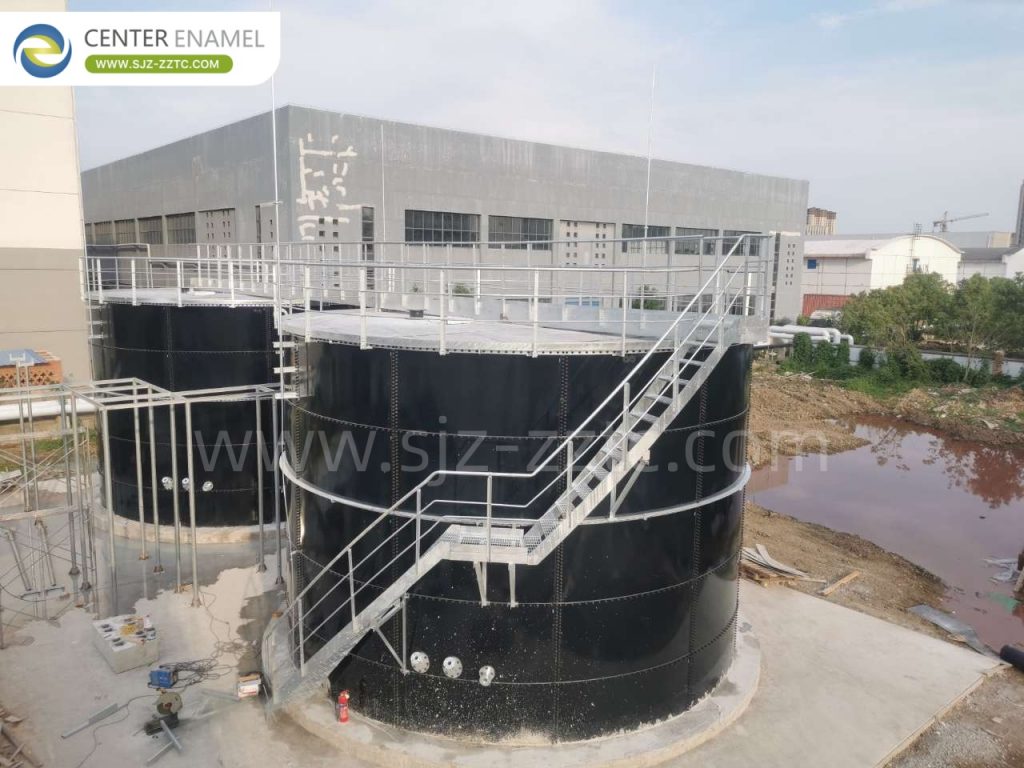
GFS Tanks are fused above 820℃, with pH 1–14 corrosion resistance. They resist food waste acid erosion, frost aging and urban environmental changes. Bolted assembly enables fast construction and over 30 years of service life.
Double Membrane Gas Holders
High airtight design ensures safe biogas storage, automatic pressure regulation, no gas leakage, and stable supply for power generation and urban heating.
Fusion Bonded Epoxy (FBE) Tanks
Used for regulating tanks and clean water storage, providing cost-effective anti-corrosion protection for auxiliary facilities.
Multiple Tank Roof Systems
Includes Air Membrane Roof, Enamel Roof, Aluminum Dome Roof and more, adapting to South Korea’s four seasons, heavy snow and rainfall, ensuring long-term tank sealing.
Agitation, Feeding and Discharging Systems
Customized feeding and stirring systems adapt to Korean high-salinity food waste, ensuring stable circulation and efficient anaerobic digestion.
Why Choose Center Enamel as EPC Contractor
Mature Anaerobic Digestion & UASB Process: Tailor professional technologies for South Korea’s high-salinity food waste and strict emission standards.
Powerful R&D and Manufacturing: Owns 200+ patented enamel formulas and Asia’s largest GFS tank production base.
Global Standard Compliance: All products pass 1500V spark test and comply with ISO, AWWA, CE and other international certifications.
Rich East Asian Project Experience: Familiar with South Korea’s waste policies, urban planning and cold climate construction conditions.
One-Stop EPC Service: Covers design, manufacturing, installation, commissioning and long-term after-sales support.
Center Enamel’s Professional Installation Process
- Hydraulic jacking top-down installation: No large cranes or high scaffolding, suitable for South Korea’s narrow urban construction sites.
- Zero on-site welding: All components factory prefabricated, bolt assembly avoids cold weather and humidity welding defects.
- Rapid commissioning: No concrete curing period, fast put into operation and quick investment return.
- Standardized after-sales: Dedicated East Asia team provides regular maintenance and technical optimization.
Two Successful Project Cases
Case1: Canada Biogas Project
Tank Dimensions: φ8.4 × 7.2 m (H) — 2 Units
Total Volume: 798 m³
Completion Date: 2024
Case2: Sweden Biogas Project
Tank Dimensions: φ19.11 × 19.2 m (H) — 1 Unit
Total Volume: 5,510 m³
Completion Date: 2024
Food waste recycling and renewable energy are crucial for South Korea’s urban green development. Adopting reliable Food Waste Biogas Project, advanced Anaerobic Digestion and mature UASB Process can solve waste pollution, reduce carbon emissions and turn waste into valuable energy. With professional technology, high-quality GFS equipment standardized installation and East Asian project experience, Center Enamel delivers one-stop EPC solutions, supporting South Korea’s circular economy and long-term sustainable energy development.