
Specifying A Sludge Anaerobic Reactor Package: Design Basis And Guarantees
A sludge anaerobic reactor solution is only as good as its written specification. Fix the design basis first - feed solids, daily volume, composition, temperature, and inhibitor load - then ask a supplier to guarantee outcomes against that basis, not against an undefined 'sludge'. A credible spec separates what the vendor controls (reactor sizing, mixing, heating, gas capture) from what the feed controls (achievable COD reduction and gas yield), and defines how performance is tested at handover.
Why The Design Basis Comes Before The Guarantee
Most disputes over an under-performing digester trace back to an incomplete feed description. If salinity, fat, or fibre content was never fixed in the contract, a shortfall in gas output cannot be assigned to either side. Writing the design basis first converts a vague promise into a testable obligation and gives both buyer and supplier the same reference point.
| Design-basis item | Why it is specified | Who controls it |
| Feed solids and daily volume | Sets reactor size and heat demand | Buyer |
| COD / VS and composition | Sets gas yield and loading | Buyer |
| Salinity, fat, inhibitors | Determines process stability | Buyer |
| Temperature band | Sets retention and heating duty | Both |
| Reactor sizing and mixing | Determines contact and retention | Supplier |
What A Reactor Package Specification Must Contain
A complete package names the vessel and cover, the mixing and heating system, the feed and discharge arrangements, gas capture and safety equipment, instrumentation, and the interface points where the buyer's civil and utility work begins. It also states the intended operating regime and the feed envelope the design accepts. Leaving any of these as 'to be confirmed' shifts risk back to the buyer at commissioning.
Performance Guarantees: What Can Honestly Be Promised
Suppliers can credibly guarantee equipment and process outcomes that they control - reactor volume, installed mixing power, ability to hold temperature, and gas-tightness. They can also commit to a COD reduction or gas yield, but only against a stated feed and a defined test method. A guarantee written without a feed basis is either meaningless or a source of future dispute.
| Guarantee | Realistic basis | Caveat to write in |
| Reactor volume / retention | Stated design flow and solids | Valid only within design feed |
| Holding temperature | Ambient range + heating duty | Depends on insulation and utility |
| COD reduction | Defined feed COD and loading | Inhibitors can void the figure |
| Gas yield | Per kg COD or VS removed | Measured over a stable period |
| Gas-tightness | Pressure test at handover | Not a lifetime guarantee |
Acceptance Testing At Handover
A guarantee is only real if there is a method to test it. The spec should name the test period, the feed conditions during the test, the measurement points, and who analyses the samples. Short tests during start-up favour a well-fed reactor and can overstate steady-state performance; a stable operating window of several retention times is a fairer basis for judging a biological system.
Where A Feed Invalidates The Guarantee
Even a sound design will miss its target if the feed changes. A rise in salinity, a solvent cleaning cycle, or a sudden fat load can suppress methanogens for days. The specification should therefore state not only the guarantee but the feed conditions under which it applies, and set out a response - re-baselining, staged feeding, or source segregation - when those conditions are exceeded.
Project Reference - A CSTR + UASB Reactor Package
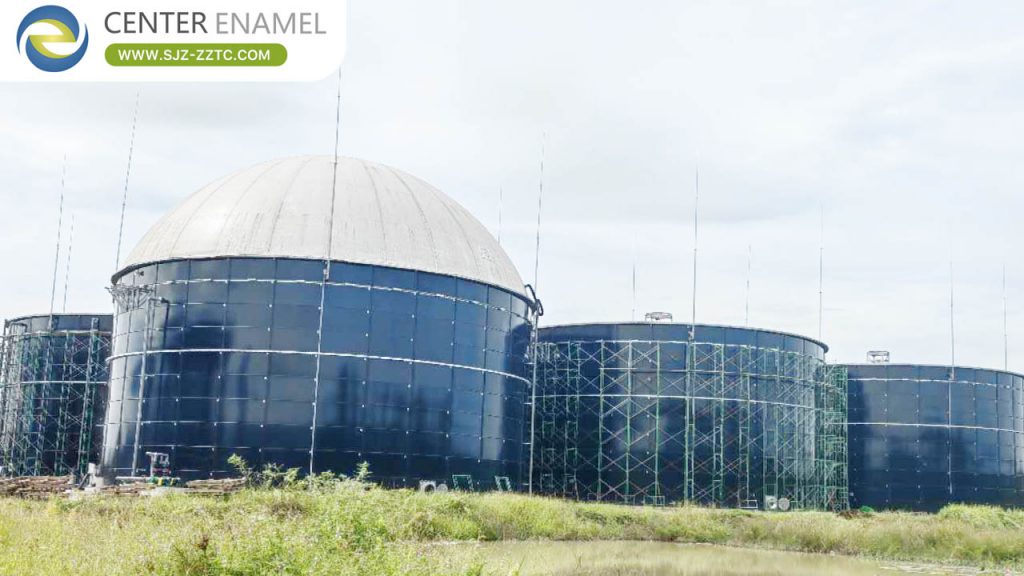
A referenced poultry-waste treatment project in Bangladesh (2026) combined CSTR and UASB anaerobic reactors on 47 tonnes/day of poultry manure. Published figures list approximately 4,900 m3/day of biogas and about 9,800 kWh/day of power generation at 2.0 kWh per m3 of biogas. This is cited as a reactor-package construction and output reference - the feed is poultry manure, not sewage sludge - not as a guarantee for another project.
| Attribute | Value | Note |
| Location / year | Bangladesh / 2026 | Published |
| Feed | 47 t/day poultry manure | Not sewage sludge |
| Reactors | CSTR + UASB | Published |
| Gas / power | ≈4,900 m3/day / ≈9,800 kWh/day | Published output |
About Company
Shijiazhuang Zhengzhong Technology Co., Ltd (Center Enamel) is a comprehensive high-tech enterprise specializing in wastewater engineering, process section contracting, and equipment manufacturing. The company delivers biogas and wastewater projects through three main lines - EPC (turnkey) contracting, equipment supply, and process packages - covering livestock and municipal wastewater, biomass energy, industrial wastewater, and food waste. Its reactor portfolio spans CSTR, USR, UBF, UASB, IC, and EGSB, backed by in-house Glass-Fused-to-Steel tank manufacturing (enamel firing at 820-930 C) and certifications including ISO 9001, NSF/ANSI 61, and CE-EN 1090. With 35+ years of operation, a 150,000 m2 manufacturing base, and projects in 100+ countries, Center Enamel provides the single-responsibility engineering behind reactor-package engineering and process-section contracting - a scoped statement of delivery discipline, not a performance guarantee for any unstated feed.
Conclusion
A sludge anaerobic reactor solution is procured defensibly by fixing the feed design basis before requesting guarantees, then separating what the supplier controls from what the feed determines. A guarantee without a test method and a feed envelope is not a specification - it is an argument deferred to commissioning.
Frequently Asked Questions
Q1: What belongs in a reactor package specification? A1: The vessel and cover, mixing and heating, feed and discharge, gas capture, instrumentation, interface points, and the accepted feed envelope.
Q2: What can a vendor actually guarantee? A2: Sizing, mixing and heating duty, gas-tightness, and a COD or gas figure tied to a stated feed and test method.
Q3: How is a performance guarantee verified? A3: By a defined test period, feed conditions, measurement points, and an agreed laboratory method at handover.
Q4: Can a feed invalidate the guarantee? A4: Yes - a rise in salinity, fat or solvents can suppress methanogens, so the feed envelope must be written into the spec.
Q5: Why not guarantee gas per tonne of sludge? A5: Because gas tracks the volatile solids and COD actually destroyed, not the wet tonnage delivered to the gate.
Q6: How long should an acceptance test run? A6: Long enough to cover several hydraulic retention times so start-up conditions do not flatter the result.
Q7: Who sets the design basis? A7: The buyer supplies the feed analysis and volume; the supplier converts it into sizing, loading, and equipment duties.
Q8: What if the feed changes after handover? A8: Re-baseline against the new analysis, segregate the offending stream, or adjust loading - the original guarantee no longer applies.
Suggested CTA
Share your feed analysis, daily volume, and target discharge limit, or request a scoped reactor-package specification outline.