
Storage Tanks for Biogas Projects: Material Selection, Sizing, and Integration
In a biogas project, storage tanks serve multiple critical functions: they house the anaerobic digester reactor itself, store feedstock slurry before processing, hold digestate after treatment, and buffer biogas between production and utilization. Each of these applications imposes different material, coating, and structural requirements. Selecting the wrong tank material or coating system for a specific duty can lead to premature corrosion, gas leakage, structural failure, and catastrophic project losses.
The biogas environment is uniquely aggressive. Inside a digester, hydrogen sulfide (H2S) concentrations of 200-4,000 ppm, ammonia (NH3), volatile fatty acids, and moisture combine to create a corrosive atmosphere that attacks unprotected steel, degrades concrete, and stresses polymer seals. External surfaces face UV radiation, temperature cycling, and wind loads. Long-term integrity demands purpose-engineered tank systems with proven corrosion resistance.
This guide provides a comprehensive framework for storage tank selection in biogas projects—comparing GFS (Glass-Fused-to-Steel), stainless steel, welded steel with epoxy coating, and reinforced concrete across corrosion resistance, lifespan, CAPEX, and maintenance requirements, with practical sizing and integration guidance.
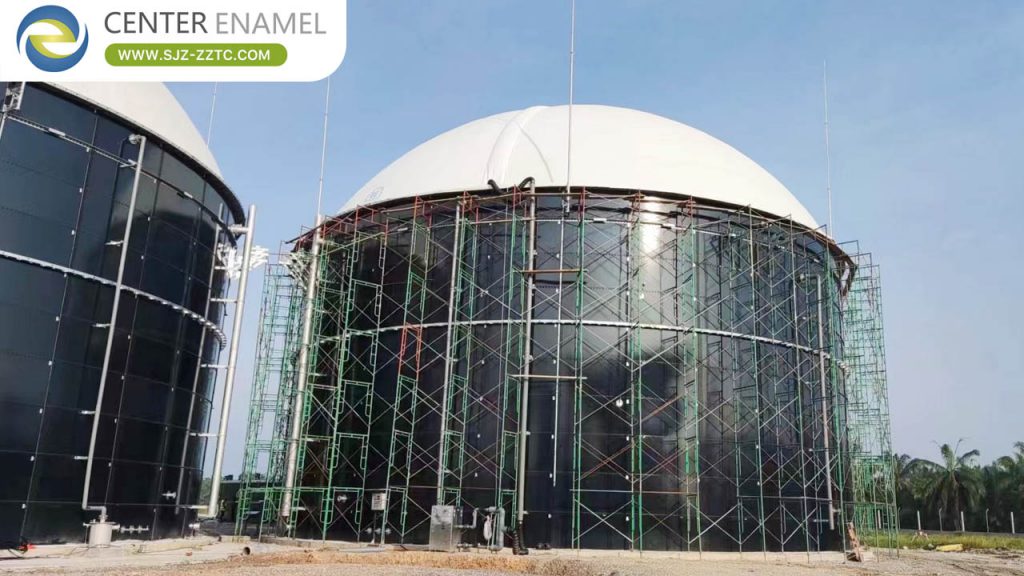
Understanding Storage Tank Materials for Biogas Applications
Storage tanks for biogas projects must withstand a corrosive environment containing hydrogen sulfide, ammonia, volatile fatty acids, and constant moisture. The dominant tank technologies are GFS (Glass-Fused-to-Steel) bolted tanks, stainless steel (304L/316L) welded tanks, carbon steel with factory-applied epoxy coating, and reinforced concrete. Each material offers distinct advantages: GFS provides the best cost-to-lifespan ratio for digester reactors (25-30 year service life, H2S resistant, modular expandability); stainless steel offers superior corrosion resistance for high-sulfur feedstocks but at 2-3x the cost; epoxy-coated steel suits moderate-corrosion applications like feedstock and digestate storage; concrete is economical for large-volume ambient-temperature storage but vulnerable to acid attack and cracking.
The biogas industry has converged on GFS bolted tanks as the preferred digester vessel material. The glass enamel coating is fused to steel at 800-900 degrees C, creating an inert, non-porous barrier that resists H2S corrosion, is impermeable to gas, and requires no recoating during its 25-30 year design life. Modular panel construction allows tanks from 100 to 10,000+ cubic meters, and expansion is possible by adding panels to existing structures.
Comparative Data Table: Biogas Storage Tank Materials
| Material / Coating | Corrosion Resistance (H2S) | Design Life | CAPEX ($/m3) | Maintenance | Expandability |
| GFS (Glass-Fused-to-Steel) | Excellent (inert enamel) | 25-30 years | $250-500 | Minimal (no recoating) | Modular (add panels) |
| Stainless Steel 316L | Superior (all environments) | 30+ years | $600-1,200 | Minimal | Limited (welded) |
| Epoxy-Coated Carbon Steel | Good (coating-dependent) | 15-20 years | $200-400 | Recoat every 5-8 years | Limited |
| Reinforced Concrete | Moderate (acid-vulnerable) | 20-30 years | $150-300 | Crack repair; liner replacement | None (cast-in-place) |
| HDPE Lined Steel | Good (liner-dependent) | 15-25 years | $200-450 | Liner inspection/replacement | Limited |
Tank Sizing and System Integration for Biogas Projects
Storage tank sizing follows the specific functional duty within the biogas system:
1. Feedstock Reception and Pre-Storage: Size for 3-7 days of feedstock inventory to buffer supply chain disruptions. Volume = Daily feedstock tonnage x density x retention days. Include mixing or aeration to prevent settling and premature acidification.
2. Digester Reactor Volume: Calculate per the sizing formula: Volume = (Daily feedstock volume x HRT) / utilization factor. For a 100 t/day facility at 25-day HRT and 0.82 utilization: approximately 3,048 m3 active volume, with 15-20% freeboard for foam and scum management.
3. Digestate Storage: Size post-digestion storage for 90-180 days if digestate is land-applied seasonally. For year-round disposal via solid-liquid separation and composting, 7-14 days of liquid fraction storage suffices.
4. Biogas Buffer Storage: Size for 8-12 hours minimum (see Energy Storage Tanks guide). Double-membrane gas holders on the digester roof are standard for small to medium facilities; external steel vessels for larger operations.
Integration requirements include: digester roof gas-tightness rating (tested at 5 mbar pressure hold); feed pump redundancy (N+1); heat jacket or external heat exchanger for temperature maintenance; and access manways at digester top and bottom for inspection and cleaning.
Frequently Asked Questions (FAQ)
Q1: Why is GFS (Glass-Fused-to-Steel) preferred for biogas digester tanks?
A: GFS tanks combine the structural strength of steel with the chemical inertness of glass. The enamel coating is fused at 800-900 degrees C, creating a non-porous barrier that resists H2S corrosion, ammonia, and fatty acids—eliminating the need for recoating for 25-30 years. They are also modular (expandable by adding panels), faster to install than welded or concrete tanks (2-4 weeks vs 2-6 months), and 40-60% cheaper than stainless steel of equivalent volume.
Q2: Can concrete tanks be used for biogas digesters?
A: Concrete can be used, but it requires an internal liner (HDPE or EPDM) because concrete is porous and vulnerable to acid attack from volatile fatty acids and hydrogen sulfide. Concrete tanks are heavier, require deeper foundations, are impossible to relocate or expand, and liner replacement every 10-15 years adds lifecycle cost. For digester reactor duty, GFS bolted steel is the industry-preferred material.
Q3: What coating is needed for biogas tanks storing raw biogas?
A: Tanks or vessels that contact raw biogas (H2S 200-4,000 ppm) require either glass-fused-to-steel enamel, 316L stainless steel, or a dedicated epoxy/phenolic lining rated for H2S service. Standard uncoated carbon steel will corrode rapidly in biogas environments. External surfaces of gas piping and storage vessels should receive a minimum 3-layer coating system (zinc primer + epoxy intermediate + polyurethane topcoat).
Q4: How long does it take to install a GFS biogas tank?
A: A standard GFS bolted tank of 1,000-3,000 cubic meters can be erected in 2-4 weeks on a prepared concrete foundation. This is significantly faster than cast-in-place concrete (2-6 months) or field-welded steel (4-8 weeks). The modular panel system also allows future capacity expansion by adding rings or panels to the existing structure without dismantling.