
Strategic Wastewater Treatment Contractors for Starch Processing Plants in Indonesia
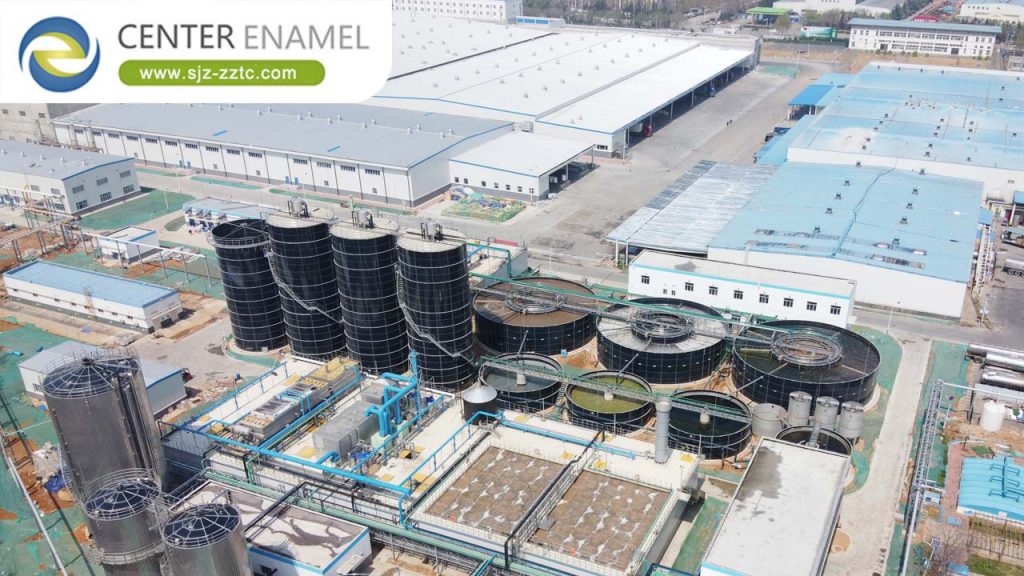
As of 2026, the Indonesian starch industry has shifted from simple disposal to a Circular Economy model. Under the latest Ministry of Environment and Forestry (KLHK) directives, starch processors in regions like Lampung and Central Java are transitioning to "Zero Waste" facilities. Modern treatment is no longer a cost center; it is a resource recovery hub focusing on biogas recovery, protein extraction, and high-quality water reuse.
Shijiazhuang Zhengzhong Technology Co., Ltd. (Center Enamel) is the leading EPC contractor providing the specialized infrastructure required to turn starch effluent into industrial assets.
1. Typical Treatment Process Flow
A modern starch wastewater system engineered by Center Enamel follows a sophisticated multi-stage path to maximize recovery and ensure compliance.
- Primary Treatment (Solid Removal): High-speed centrifuges or hydrocyclones recover "fine starch" and fibers. This stage reduces the organic load on biological reactors while creating a valuable byproduct for animal feed.
- Secondary Treatment (Anaerobic): The "Energy Core." High-rate reactors like IC (Internal Circulation) or EGSB (Expanded Granular Sludge Bed) convert concentrated organic matter into methane-rich biogas.
- Tertiary Treatment (Aerobic & Polishing): Systems such as SBR (Sequencing Batch Reactor) or Activated Sludge remove residual nitrogen and phosphorus to meet "Class A" discharge limits.
- Quaternary Treatment (Advanced Filtration): MBR (Membrane Bioreactors) or Reverse Osmosis (RO) are deployed for facilities intending to reuse water for factory washing or cooling towers.
2. Core Technologies (2026 Standards)
Anaerobic Digestion (Biogas Production)
This is the critical stage for starch plants. Microorganisms break down organic matter in the absence of oxygen.
- IC Reactors: The current 2026 industry standard. They feature a two-stage separator system that allows for exceptionally high organic loading rates within a small physical footprint.
- UASB (Upflow Anaerobic Sludge Blanket): A traditional yet reliable solution that uses a granular sludge blanket to treat wastewater as it flows upward.
Resource Recovery Technology
- Protein Extraction: For cassava and potato starch, "starch milk" is rich in protein. Our systems utilize ultrafiltration and centrifugation to extract this protein as a high-value food or feed additive.
- Biogas Valorization: Biogas is no longer flared. It is scrubbed of $H_2S$ and utilized in factory boilers or gas engines to generate site-wide electricity.
Advanced Separation & Membranes
- MBR (Membrane Bioreactor): Combines biological treatment with membrane filtration, producing high-quality effluent that meets the strictest international discharge standards.
- Micro-Nano Bubble Technology: An emerging 2026 trend used in DAF (Dissolved Air Flotation) units to separate tiny starch particles and proteins more efficiently than traditional aeration.
3. Comparison of Treatment Strategies
| Feature | Traditional Lagoon Systems | Modern IC + SBR Systems |
| Footprint | Massive (Requires 10x land) | Compact (80% less space) |
| Environmental Impact | High odor / Methane emissions | Odor-free / Carbon capture |
| Resource Recovery | None | High (Biogas + Protein) |
| Efficiency (COD Removal) | 60% – 70% | 95% – 99% |
| Construction | Slow (Concrete / Earthwork) | Fast (Modular GFS Tanks) |
4. Critical Challenges & Solutions
- Low pH Shock: Starch wastewater is naturally acidic. Center Enamel plants use automated pH dosing (lime or caustic) and buffering tanks to protect sensitive anaerobic bacteria.
- Nitrogen Removal: High ammonia levels can be toxic. We implement Advanced Anammox (Anaerobic Ammonium Oxidation) for energy-efficient nitrogen removal, a key 2026 technical requirement.
- Cyanide (Cassava Specific): For Indonesian tapioca plants, we utilize pre-treatment stripping or specific bacterial strains to neutralize residual cyanide before it reaches the anaerobic digester.
Center Enamel’s authority as a premier EPC contractor is validated by our large-scale regional deployments:
- Indonesia: Construction of a massive 10,236 m3 system and the world’s tallest GFS tank (34.8 meters) in Central Java.
- Global Scale: Engineering of a 42,188 m3 organic wastewater project, proving our capacity for the world's largest starch processing hubs.