
Professional Textile Wastewater Treatment Project EPC Contractor Delivering GFS Tanks and UASB Process Solutions
Textile wastewater treatment projects present some of the most demanding challenges in industrial environmental management. As a professional Textile Wastewater Treatment Project EPC Contractor, Center Enamel addresses these challenges through integrated solutions combining superior GFS tank corrosion resistance with the proven efficiency of the UASB process. With over 10,000 global projects and installation coverage across more than 100 countries, Center Enamel delivers the durability, performance, and global expertise required for successful project execution.
Core Industry Challenges Define the Need for Advanced Solutions
The core challenges of industrial wastewater treatment center on the "three highs"-high difficulty, high cost, and high energy consumption. Wastewater from new energy, chemical, and pharmaceutical industries is complex in composition with numerous characteristic pollutants, and traditional treatment processes are difficult to remove effectively. These challenges are particularly acute in textile wastewater treatment projects, where diverse dyes, sizing agents, and auxiliaries create highly variable and recalcitrant effluent streams. Chinese companies have significant price advantages in the mid-to-low-end equipment segment. The industry also faces continuous technological upgrade pressure from increasingly stringent emission standards, as well as new requirements for digitalization and low-carbon transformation on operational refinement management capabilities.
These converging pressures make the choice of EPC contractor critical for project success. Center Enamel's integrated approach-combining durable GFS tanks, efficient UASB process technology, and comprehensive EPC services-directly addresses the "three highs" by providing long-term corrosion resistance, reduced energy consumption, and optimized operational efficiency. This holistic solution ensures that textile wastewater treatment projects meet regulatory requirements while minimizing lifecycle costs.
GFS Tanks Deliver Superior Corrosion Resistance for Aggressive Textile Effluents
Center Enamel's independently developed double-sided double-layer enameling technology is the industry's leading coating anti-corrosion technology, with corrosion resistance completely surpassing concrete tanks. Concrete tank interiors are riddled with pores, allowing wastewater and acid/alkaline media to easily penetrate and corrode the structural layer. Long-term use leads to irreversible problems such as internal wall spalling, water seepage, and rebar corrosion, which are difficult to repair and cannot be fundamentally resolved. These failures are particularly costly in textile wastewater treatment projects, where aggressive chemicals and high temperatures accelerate concrete degradation and unplanned downtime disrupts production.
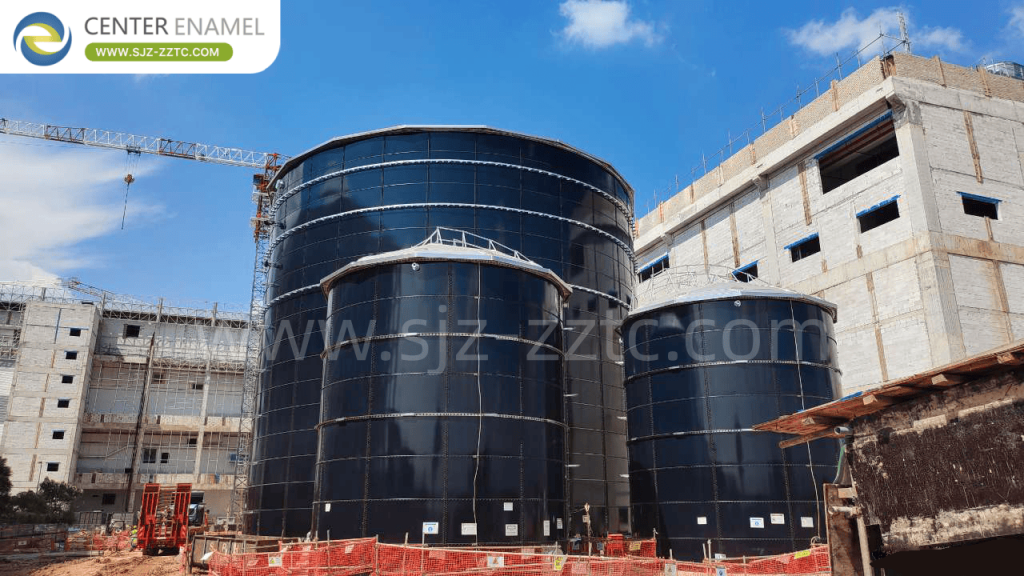
GFS tanks feature high-temperature enameling on both the interior and exterior surfaces of steel panels, with a dense, non-porous enamel finish that completely blocks corrosive liquids and biogas permeation. The enamel layer has extremely strong chemical stability, resisting acids, alkalis, salts, and microbial corrosion. Concrete tanks will develop extensive corrosion and leakage after 5-8 years of use, while GFS tank anti-corrosion service life can exceed 30 years, with no need for frequent internal lining repairs throughout the service life, significantly reducing long-term anti-corrosion maintenance investment and fundamentally eliminating environmental risks of medium leakage contaminating sites and groundwater. Compared to traditional concrete and FRP tanks, GFS tank coatings have no risk of peeling or blistering, and are adaptable to highly corrosive conditions such as palm oil mill effluent, livestock manure, and chemical high-salinity wastewater, with outstanding long-term comprehensive cost advantages.
As a professional Textile Wastewater Treatment Project EPC Contractor, Center Enamel leverages this superior corrosion resistance to provide tanks that maintain structural integrity and process performance for decades. The non-porous enamel surface also prevents biofilm accumulation and simplifies cleaning, further reducing operational costs over the project lifecycle. This durability is essential for textile wastewater treatment projects, where continuous operation and minimal maintenance are critical for economic viability.
The UASB Process Offers Broad Applicability for Industrial Wastewater
Suitable for soluble medium-to-high concentration organic wastewater, covering light industrial wastewater from brewing, sugar refining, starch, papermaking, food processing, printing and dyeing, etc. Suitable for wastewater where organics are predominantly soluble with low suspended solids content, not suitable for high-solids, high-viscosity wastewater. Can be used alone as the primary treatment process or as a pretreatment for high-strength wastewater to reduce downstream aerobic load. Suitable for municipal wastewater anaerobic pretreatment and low-solids livestock wastewater treatment. With its low cost and stable operation advantages, it is suitable for long-term continuous, large-flow industrial wastewater treatment projects.
For textile wastewater treatment projects, the UASB process provides an ideal first-stage treatment, effectively reducing COD by 50-65% while breaking down complex dye molecules to improve downstream biodegradability. The process's ability to handle significant fluctuations in flow and organic loading-common in batch textile operations-ensures stable performance even under challenging conditions. When combined with GFS tanks that prevent corrosion and leakage, the UASB process delivers a reliable, long-term solution that maximizes resource recovery through biogas production while minimizing operational costs.
Operation and Maintenance Cost Analysis Highlights Value of Durable Infrastructure
O&M costs are moderate to high with generally moderate economics. Pretreatment requires pH adjustment chemicals, coagulants, and decolorizing agents-moderate to high chemical costs. Anaerobic + aerobic processes are mature and stable with controllable equipment O&M costs. Advanced decolorization (ozone generators, Fenton oxidation) has high energy consumption and chemical costs-major cost driver. Membrane water reuse systems have high capital investment and frequent membrane replacement-high maintenance costs. Dye and sizing sludge production is high, with significant disposal costs. High-temperature wastewater requires heat exchange cooling, but heat recovery can offset some energy costs. Frequent water quality fluctuations require frequent parameter adjustments-moderate labor requirements. Water reuse can offset some costs, but overall resource recovery benefits are limited-generally moderate economics.
This cost analysis underscores the importance of selecting durable infrastructure that minimizes long-term maintenance and replacement costs. As a Textile Wastewater Treatment Project EPC Contractor, Center Enamel's GFS tanks significantly reduce the corrosion-related O&M expenses that plague concrete and steel tanks. The UASB process further reduces energy costs through its low mixing energy requirements and biogas recovery, providing a more favorable economic profile over the project lifecycle. By addressing the "three highs" through robust design and efficient technology, Center Enamel helps textile manufacturers achieve both environmental compliance and operational profitability.
Global Installation Coverage Ensures Project Success Worldwide
Center Enamel is the pioneer of Chinese GFS equipment exports, with installation service coverage across over 100 countries and regions-possessing full delivery capability across climates, regulations, and geographies. This extensive global footprint is invaluable for textile wastewater treatment projects, which are increasingly located in emerging manufacturing regions with diverse site conditions and regulatory frameworks.
Overseas coverage includes Southeast Asia (Vietnam, Thailand, Malaysia, Indonesia, Cambodia, Bangladesh, Nepal, etc.), Africa (Ghana, South Africa, Mali, Guinea, Zambia, Kenya, Pakistan, etc.), Europe/Americas (Sweden, USA, Russia, etc.), the Middle East, and Latin America-adaptable to tropical rainy high-salt spray, high-altitude mountainous, Nordic severe cold, and high-standard European/American facility conditions. The company uses a dual-service model of "own cross-border construction teams + overseas local agent coordination"-whether clients are in developed countries or remote developing regions-providing one-stop services including on-site survey, on-site installation, process commissioning, and operator training. Complete coverage covers biogas engineering, municipal wastewater, industrial wastewater, livestock manure, drinking water storage, and other global mainstream environmental engineering projects-possessing the full delivery capability to undertake large-scale tank farm projects in any country worldwide.
This comprehensive delivery capability ensures that textile wastewater treatment projects, regardless of location, benefit from consistent quality, timely execution, and expert technical support. As a Textile Wastewater Treatment Project EPC Contractor, Center Enamel's global installation network provides clients with the confidence that their projects will be completed to the highest standards, even in challenging environments.
Flexible Service Delivery System Supports Long-Term Success
Center Enamel's own cross-border construction teams + global localized agent network-modular GFS tank assembly with short construction periods and dismantlable/reusable capability-suitable for overseas short-term projects, phased expansions, and relocation needs-full-lifecycle after-sales O&M support ensuring long-term stable client operations. This flexible service model is particularly valuable for textile wastewater treatment projects, which may require phased implementation or future capacity expansion as production grows.
The modular design of GFS tanks also facilitates rapid installation and minimal site disruption, reducing project timelines and allowing textile manufacturers to achieve compliance and begin operations sooner. The ability to dismantle and relocate tanks provides additional flexibility for manufacturers facing changing production footprints or regulatory requirements. Combined with comprehensive after-sales support, this service delivery system ensures that textile wastewater treatment projects maintain peak performance throughout their operational life.
FRP Roof Cover Solution for General Water Storage Applications
FRP Roof is a general-purpose economical roof for atmospheric pressure storage tanks without air-tightness requirements, suitable for drinking water storage, agricultural irrigation water, firewater reserve, and general production wastewater temporary storage. It is available in two styles: flat and dome, allowing flexible selection based on tank specifications and site aesthetic requirements. The roof is integrally molded from resin and fiberglass, lightweight, with natural water resistance and mild acid/alkali corrosion resistance. It will not rust or rot in long-term humid environments, eliminating the frequent anti-corrosion maintenance required for metal roofs.
The dome style features excellent drainage performance due to its curved structure, resisting water accumulation, dust buildup, snow load, and strong winds. The flat style facilitates the installation of maintenance walkways, level gauges, and vents on top, making inspection and operation convenient. The product is fully insulated with no risk of galvanic corrosion, will not contaminate drinking water quality, and meets environmental standards for domestic water storage. The modular design with low individual component weight allows for simple on-site hoisting and assembly, offering high construction efficiency and affordable procurement and installation costs. It is only suitable for atmospheric pressure water storage tanks without biogas collection or pressurization requirements, and is not recommended for anaerobic fermentation gas-producing conditions. It is widely used in rural agricultural water storage tanks, industrial park firewater tanks, waterworks buffer tanks, and small to medium-sized domestic wastewater temporary storage facilities, making it a cost-effective general-purpose roof choice for conventional water storage applications.
While the FRP roof is suitable for general water storage, textile wastewater treatment projects utilizing the UASB process for biogas generation require the superior sealing and corrosion resistance of Center Enamel's Aluminum Geodesic Dome Roof. This distinction highlights the importance of selecting appropriate roof systems based on specific project requirements, a key consideration for any Textile Wastewater Treatment Project EPC Contractor.
Frequently Asked Questions
1. Why choose Center Enamel as your Textile Wastewater Treatment Project EPC Contractor?
Center Enamel offers integrated EPC solutions combining corrosion-resistant GFS tanks (30+ years service life) and efficient UASB process technology. With installation coverage across 100+ countries, over 10,000 global projects, and full international certifications (NSF, WRAS, ASME, CE), we provide reliable, cost-effective solutions that address the "three highs" of textile wastewater.
2. How do GFS tanks reduce long-term costs in textile wastewater treatment?
GFS tanks feature a non-porous glass enamel coating that resists acids, alkalis, and salts, eliminating the corrosion and leakage problems of concrete tanks (which fail within 5-8 years). With no need for internal lining repairs over 30+ years, they significantly reduce maintenance costs and prevent environmental contamination from leaks.
3. What advantages does the UASB process offer for textile wastewater?
The UASB process requires no mechanical mixing, reducing energy consumption. It handles fluctuating loads common in textile operations, achieves 50-65% COD removal, and produces biogas for energy recovery. Its compact footprint and simple operation make it ideal for large-flow, continuous industrial wastewater treatment projects.